Alexandrov Theodore
Structural and Computational Biology Unit, European Molecular Biology Laboratory, 69117 Heidelberg, Germany.
Skaggs School of Pharmacy and Pharmaceutical Sciences, University of California, San Diego, La Jolla, California 92093, USA.
Annu Rev Biomed Data Sci. 2020 Jul;3:61-87. doi: 10.1146/annurev-biodatasci-011420-031537. Epub 2020 Apr 13.
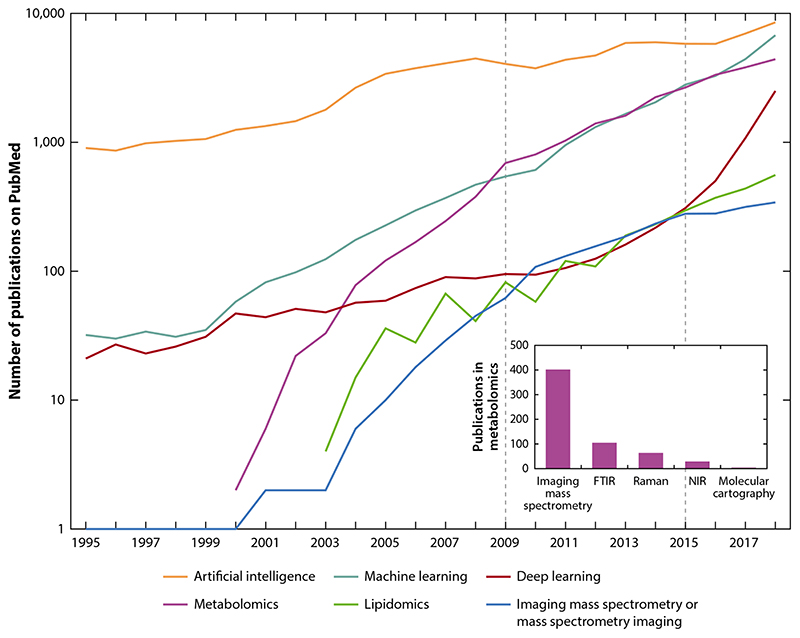
Spatial metabolomics is an emerging field of omics research that has enabled localizing metabolites, lipids, and drugs in tissue sections, a feat considered impossible just two decades ago. Spatial metabolomics and its enabling technology-imaging mass spectrometry-generate big hyper-spectral imaging data that have motivated the development of tailored computational methods at the intersection of computational metabolomics and image analysis. Experimental and computational developments have recently opened doors to applications of spatial metabolomics in life sciences and biomedicine. At the same time, these advances have coincided with a rapid evolution in machine learning, deep learning, and artificial intelligence, which are transforming our everyday life and promise to revolutionize biology and healthcare. Here, we introduce spatial metabolomics through the eyes of a computational scientist, review the outstanding challenges, provide a look into the future, and discuss opportunities granted by the ongoing convergence of human and artificial intelligence.
空间代谢组学是组学研究中一个新兴的领域,它能够在组织切片中定位代谢物、脂质和药物,而就在二十年前,这一壮举还被认为是不可能实现的。空间代谢组学及其支持技术——成像质谱法——生成了大量的高光谱成像数据,这推动了在计算代谢组学和图像分析交叉领域定制计算方法的发展。实验和计算方面的进展最近为空间代谢组学在生命科学和生物医学中的应用打开了大门。与此同时,这些进展恰逢机器学习、深度学习和人工智能的快速发展,它们正在改变我们的日常生活,并有望给生物学和医疗保健带来变革。在这里,我们从计算科学家的视角介绍空间代谢组学,回顾突出的挑战,展望未来,并讨论人类与人工智能不断融合所带来的机遇。