Urology Surgery, Yueyang Hospital of Integrated Traditional Chinese and Western Medicine Hospital, Shanghai University of Traditional Chinese Medicine, 110 Ganhe Road, Shanghai, 200437, China.
Karolinska Institute, Stockholm, Sweden.
Health Qual Life Outcomes. 2021 May 31;19(1):159. doi: 10.1186/s12955-021-01796-8.
The National Institutes of Health Chronic Prostatitis Symptom Index (NIH-CPSI) was developed to accurately assess the pain, urinary symptoms, and quality of life related to chronic prostatitis/chronic pelvic pain syndrome (CP/CPPS). This study aimed to evaluate the cross-cultural adaptations of the NIH-CPSI.
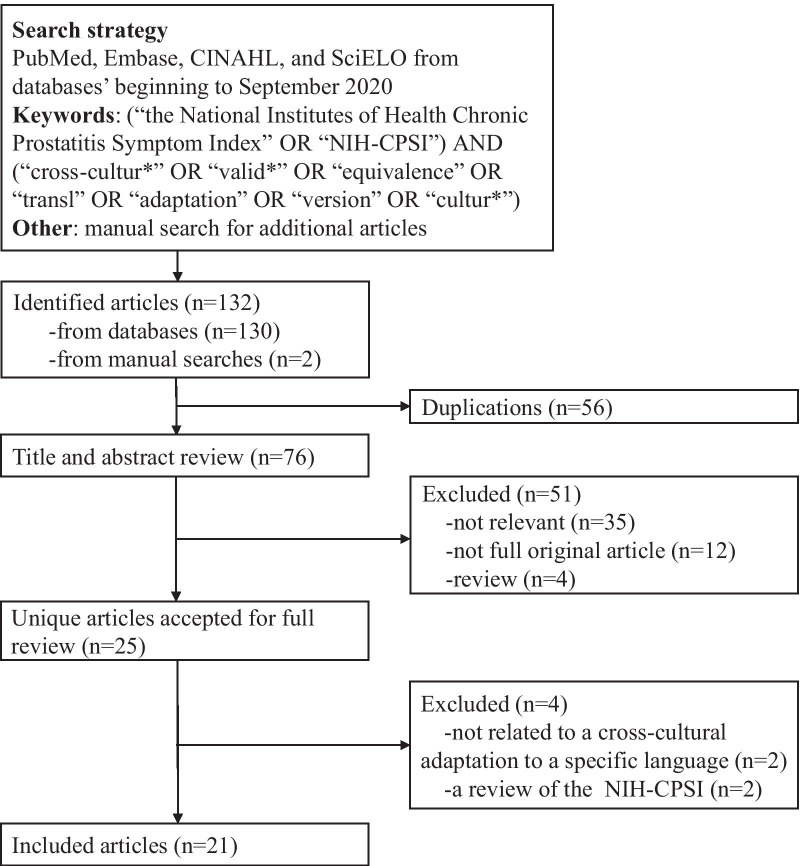
PubMed, Embase, CINAHL, and SciELO databases were searched from their established year to September 2020. Cross-cultural adaptations and the quality control of measurement properties of adaptations were conducted by two reviewers independently according to the Guidelines for the Process of Cross-Cultural Adaptation of Self-Report Measures and the Quality Criteria for Psychometric Properties of Health Status Questionnaire.
Area total of 21 papers with 16 adaptations, and six studies of the original version of the NIH-CPSI were enrolled in the systematic review. Back translation was the weakest process for the quality assessment of the cross-cultural adaptations of the NIH-CPSI. Internal consistency was analyzed for most of the adaptations, but none of them met the standard. Only 11 adaptations reported test reliability, then only the Arabic-Egyptian, Chinese-Mainland, Danish, Italian, Persian, and Turkish adaptations met the criterion. Most adaptations reported the interpretability, but only the Danish adaptation reported the agreement. The other measurement properties, including responsiveness, and floor as well as ceiling effects were not reported in any of the adaptations.
The overall quality of the NIH-CPSI cross-cultural adaptations was not organized as expected. Only the Portuguese-Brazilian, Italian, and Spanish adaptations reached over half the process for the cross-cultural adaptation. Only the Turkish adaptations finished half of the measurement properties of cross-cultural adaptations.
美国国立卫生研究院慢性前列腺炎症状指数(NIH-CPSI)是为了准确评估与慢性前列腺炎/慢性骨盆疼痛综合征(CP/CPPS)相关的疼痛、排尿症状和生活质量而开发的。本研究旨在评估 NIH-CPSI 的跨文化适应性。
通过两位审查员根据跨文化适应自我报告测量的指南和健康状况问卷测量属性的质量标准,独立搜索了 PubMed、Embase、CINAHL 和 SciELO 数据库,从其建立年份到 2020 年 9 月。对文化适应性和测量属性的质量控制进行了跨文化适应。
共纳入 21 篇论文,其中 16 篇为 NIH-CPSI 的改编版,6 篇为 NIH-CPSI 的原始版本研究。NIH-CPSI 跨文化适应的质量评估中,回译是最薄弱的过程。大多数适应性分析了内部一致性,但没有一个符合标准。只有 11 个适应性报告了测试可靠性,只有阿拉伯埃及、中国大陆、丹麦、意大利、波斯语和土耳其适应性符合标准。大多数适应性报告了可解释性,但只有丹麦适应性报告了一致性。其他测量属性,包括反应性、地板和天花板效应,在任何适应性中都没有报告。
NIH-CPSI 跨文化适应性的总体质量并不理想。只有葡萄牙-巴西、意大利和西班牙语适应性达到了跨文化适应的一半以上的过程。只有土耳其适应性完成了跨文化适应性测量属性的一半。