Department of Immunopathology, SA Pathology at the Women's and Children's Hospital, North Adelaide, SA 5006, Australia.
Adelaide School of Medicine and the Robinson Research Institute, University of Adelaide, Adelaide, SA 5005, Australia.
Int J Mol Sci. 2021 May 5;22(9):4907. doi: 10.3390/ijms22094907.
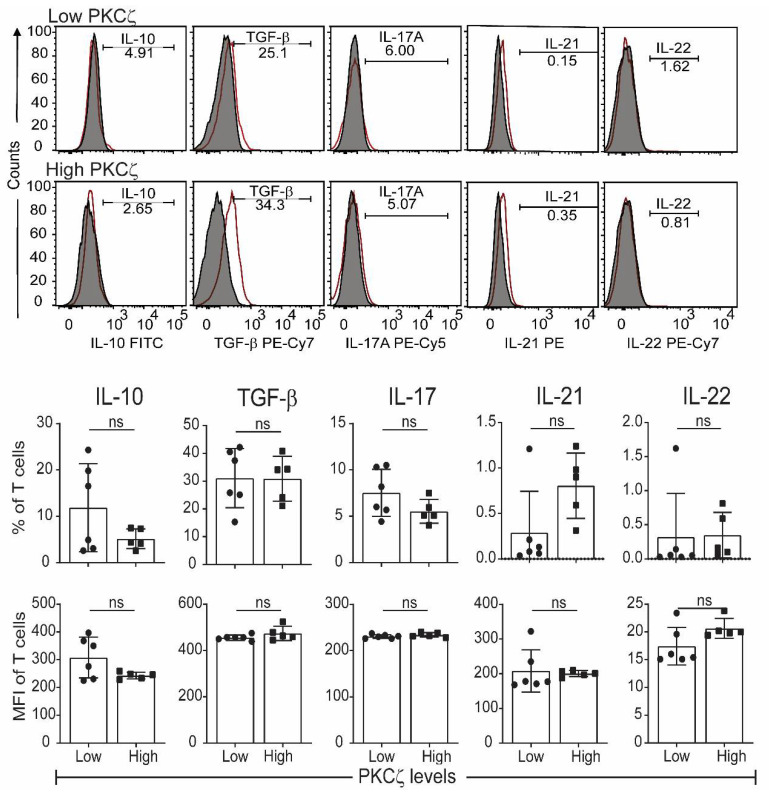
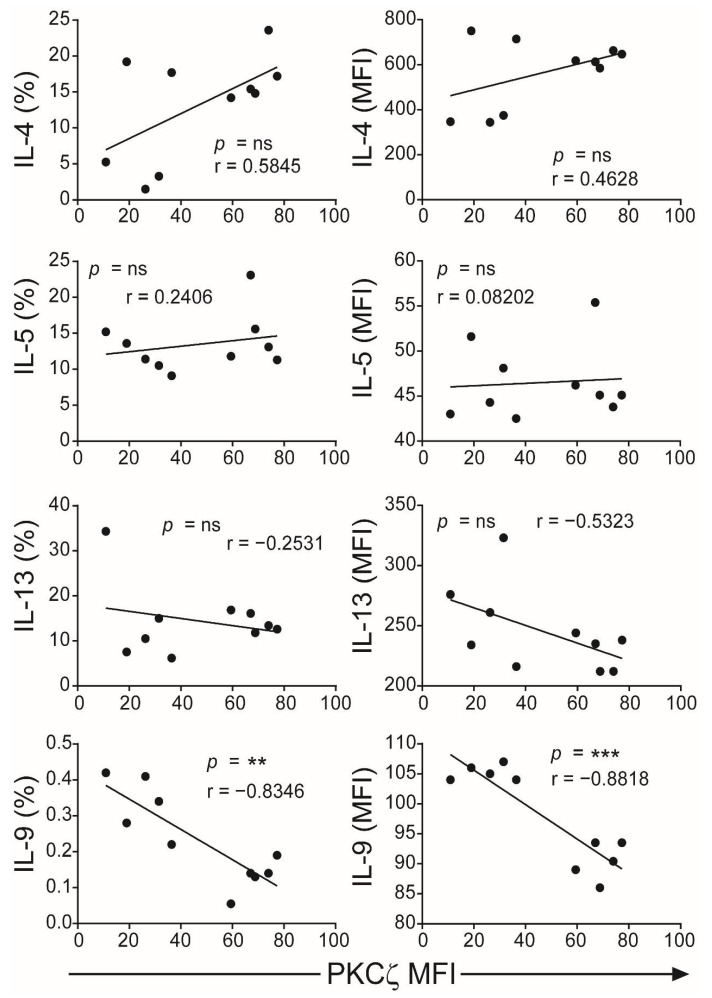
Low Protein Kinase C zeta (PKCζ) levels in cord blood T cells (CBTC) have been shown to correlate with the development of allergic sensitization in childhood. However, little is known about the mechanisms responsible. We have examined the relationship between the expression of different levels of PKCζ in CBTC and their development into mature T cell cytokine producers that relate to allergy or anti-allergy promoting cells. Maturation of naïve CBTC was initiated with anti-CD3/-CD28 antibodies and recombinant human interleukin-2 (rhIL-2). To stimulate lymphocyte proliferation and cytokine production the cells were treated with Phytohaemagglutinin (PHA) and Phorbol myristate acetate (PMA). Irrespective of the PKCζ levels expressed, immature CBTC showed no difference in lymphocyte proliferation and the production of T helper 2 (Th2) cytokine interleukin-4 (IL-4) and Th1 cytokine, interferon-gamma (IFN-γ), and influenced neither their maturation from CD45RA to CD45RO cells nor cell viability/apoptosis. However, upon maturation the low PKCζ expressing cells produced low levels of the Th1 cytokines, IFN-γ, IL-2 and tumour necrosis factor-alpha (TNF), no changes to levels of the Th2 cytokines, IL-4, IL-5 and IL-13, and an increase in the Th9 cytokine, IL-9. Other cytokines, lymphotoxin-α (LT-α), IL-10, IL-17, IL-21, IL-22 and Transforming growth factor-beta (TGF-β) were not significantly different. The findings support the view that low CBTC PKCζ levels relate to the increased risk of developing allergic diseases.
脐血 T 细胞(CBTC)中低蛋白激酶 C ζ(PKCζ)水平与儿童期过敏致敏的发展相关。然而,负责的机制知之甚少。我们研究了 CBTC 中不同水平的 PKCζ 的表达与它们发展为与过敏或抗过敏促进细胞相关的成熟 T 细胞细胞因子产生者之间的关系。通过抗 CD3/-CD28 抗体和重组人白细胞介素-2(rhIL-2)启动幼稚 CBTC 的成熟。为了刺激淋巴细胞增殖和细胞因子产生,用植物血球凝集素(PHA)和佛波醇肉豆蔻酸酯(PMA)处理细胞。无论表达的 PKCζ 水平如何,幼稚 CBTC 在淋巴细胞增殖和 T 辅助 2(Th2)细胞因子白细胞介素-4(IL-4)和 Th1 细胞因子干扰素-γ(IFN-γ)的产生方面没有差异,也不影响其从 CD45RA 到 CD45RO 细胞的成熟或细胞活力/凋亡。然而,在成熟后,低表达 PKCζ 的细胞产生低水平的 Th1 细胞因子 IFN-γ、IL-2 和肿瘤坏死因子-α(TNF),对 Th2 细胞因子 IL-4、IL-5 和 IL-13 的水平没有变化,并增加了 Th9 细胞因子 IL-9。其他细胞因子,淋巴毒素-α(LT-α)、IL-10、IL-17、IL-21、IL-22 和转化生长因子-β(TGF-β)没有明显差异。这些发现支持低 CBTC PKCζ 水平与增加患过敏疾病风险相关的观点。