Medical School, Hangzhou Normal University, Hangzhou 311121, China.
Department of Health Education, Zhejiang Provincial Center for Disease Control and Prevention, Hangzhou 310051, China.
Int J Environ Res Public Health. 2021 May 12;18(10):5123. doi: 10.3390/ijerph18105123.
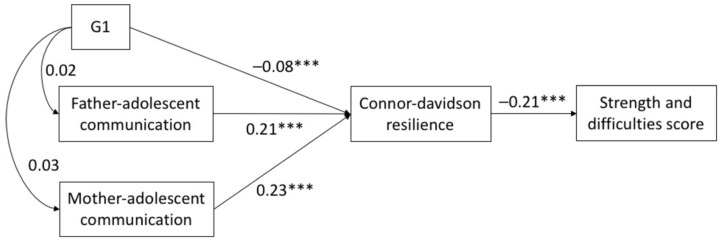
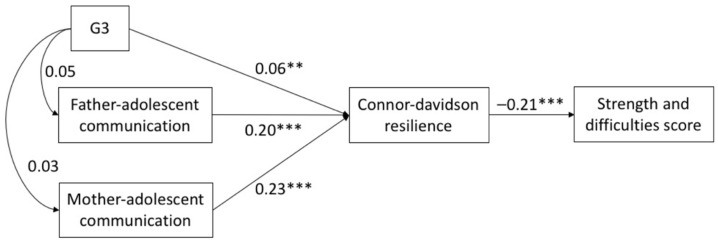
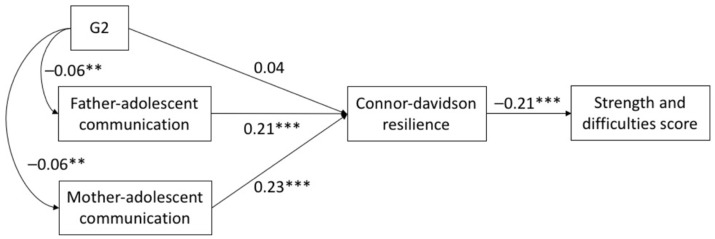
This study aims to examine the role of parental migration status and parent communication in the psychological and related behavioral status of left-behind children and their psychological resilience. A cross-sectional survey was conducted in Anhui Province of China, and a questionnaire survey was conducted with 1992 teens using the Chinese version of the Parent-Adolescent Communication Scale (PACS), Connor-Davidson Resilience Scale (CD-RISC), and Strength and Difficulties Questionnaires (SDQ). Compared with the never left-behind group, left behind children had relatively lower PACS, CD-RISC and SDQ scores. Absence of parents is related with poorer psychological resilience, while good parent communication is related with better psychological resilience. Better psychological resilience is related to fewer psychological problems regardless of parental migration status. Currently left-behind status demonstrated a negative influence on psychological resilience, while never left-behind status had a positive effect. Interventions are needed to enhance psychological resilience of left-behind children to prevent psychological and related behavioral problems.
本研究旨在探讨父母迁移状况和亲子沟通对留守儿童心理及相关行为状况和心理弹性的作用。在中国安徽省进行了一项横断面调查,采用青少年父母沟通量表(PACS)、Connor-Davidson 韧性量表(CD-RISC)和长处和困难问卷(SDQ)对 1992 名青少年进行了问卷调查。与从未留守的青少年相比,留守儿童的 PACS、CD-RISC 和 SDQ 得分相对较低。父母不在身边与较差的心理韧性有关,而良好的亲子沟通与较好的心理韧性有关。无论父母是否移民,较好的心理韧性与较少的心理问题有关。目前,留守状态对心理韧性有负面影响,而从未留守状态则有积极影响。需要采取干预措施来增强留守儿童的心理韧性,以预防心理和相关行为问题。