Yu Xu, Qi Xiwu, Li Shumin, Fang Hailing, Bai Yang, Li Li, Liu Dongmei, Chen Zequn, Li Weilin, Liang Chengyuan
Jiangsu Key Laboratory for the Research and Utilization of Plant Resources, Institute of Botany, Jiangsu Province and Chinese Academy of Sciences (Nanjing Botanical Garden Mem. Sun Yat-Sen), Nanjing 210014, China.
Institute of Botany, Jiangsu Province and Chinese Academy of Sciences, Nanjing University of Chinese Medicine, Nanjing 210023, China.
Plants (Basel). 2021 May 7;10(5):930. doi: 10.3390/plants10050930.
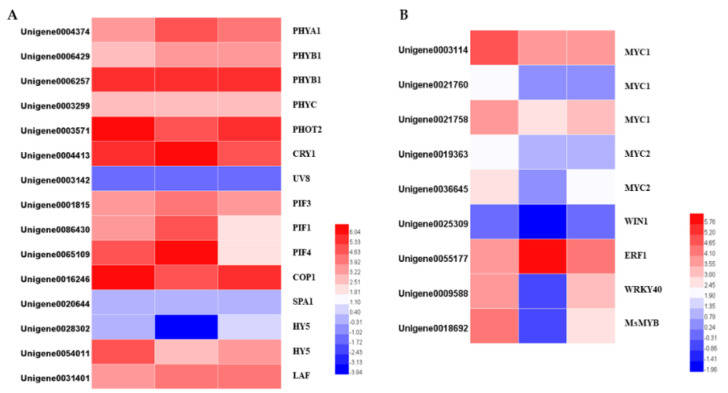
Light is a key environmental aspect that regulates secondary metabolic synthesis. The essential oil produced in mint ( L.) leaves is used widely in the aromatics industry and in medicine. Under low-light treatment, significant reductions in peltate glandular trichome densities were observed. GC-MS analysis showed dramatically reduced essential oil and menthol contents. Light affected the peltate glandular trichomes' development and essential oil yield production. However, the underlying mechanisms of this regulation were elusive. To identify the critical genes during light-regulated changes in oil content, following a 24 h darkness treatment and a 24 h recovery light treatment, leaves were collected for transcriptome analysis. A total of 95,579 unigenes were obtained, with an average length of 754 bp. About 56.58% of the unigenes were annotated using four public protein databases: 10,977 differentially expressed genes (DEGs) were found to be involved in the light signaling pathway and monoterpene synthesis pathway. Most of the TPs showed a similar expression pattern: downregulation after darkness treatment and upregulation after the return of light. In addition, the genes involved in the light signal transduction pathway were analyzed. A series of responsive transcription factors (TFs) were identified and could be used in metabolic engineering as an effective strategy for increasing essential oil yields.
光是调节次生代谢产物合成的关键环境因素。薄荷(L.)叶片中产生的精油广泛应用于香料工业和医药领域。在弱光处理下,观察到盾状腺毛密度显著降低。气相色谱 - 质谱分析表明精油和薄荷醇含量大幅减少。光影响盾状腺毛的发育和精油产量。然而,这种调节的潜在机制尚不清楚。为了确定含油量受光调节变化过程中的关键基因,在进行24小时黑暗处理和24小时恢复光照处理后,收集叶片进行转录组分析。共获得95,579个单基因,平均长度为754 bp。约56.58%的单基因使用四个公共蛋白质数据库进行了注释:发现10,977个差异表达基因(DEG)参与光信号通路和单萜合成途径。大多数转录本显示出相似的表达模式:黑暗处理后下调,光照恢复后上调。此外,还对参与光信号转导途径的基因进行了分析。鉴定出一系列响应转录因子(TF),可将其用于代谢工程,作为提高精油产量的有效策略。