Nobari Hadi, Fani Maryam, Pardos-Mainer Elena, Pérez-Gómez Jorge
Department of Physical Education and Sports, University of Granada, 18010 Granada, Spain.
Department of Exercise Physiology, Faculty of Sport Sciences, University of Isfahan, Isfahan 81746-7344, Iran.
Healthcare (Basel). 2021 May 14;9(5):586. doi: 10.3390/healthcare9050586.
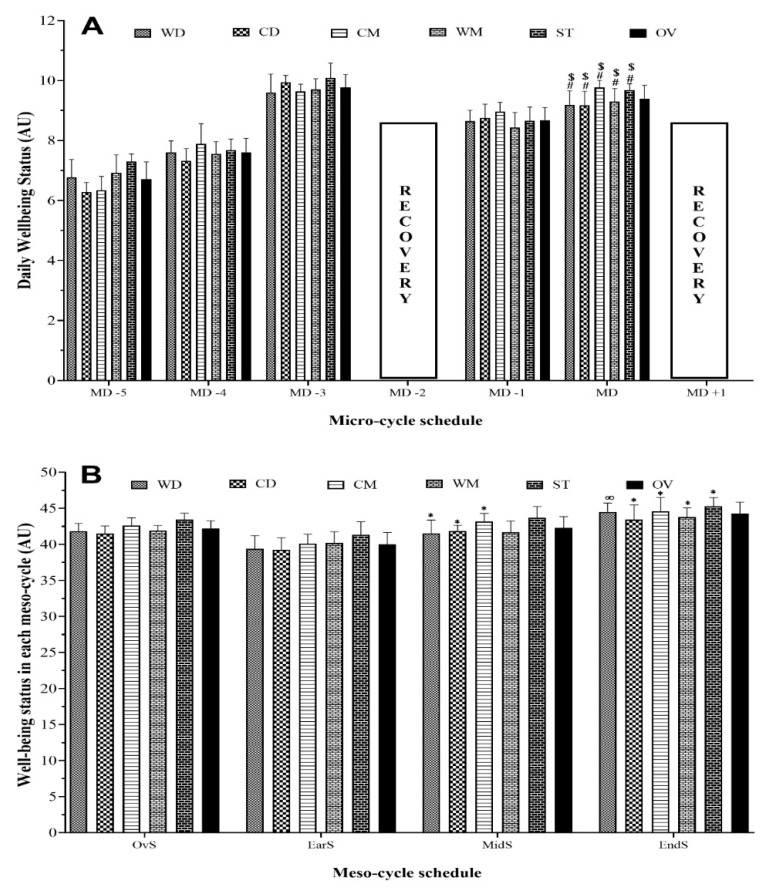
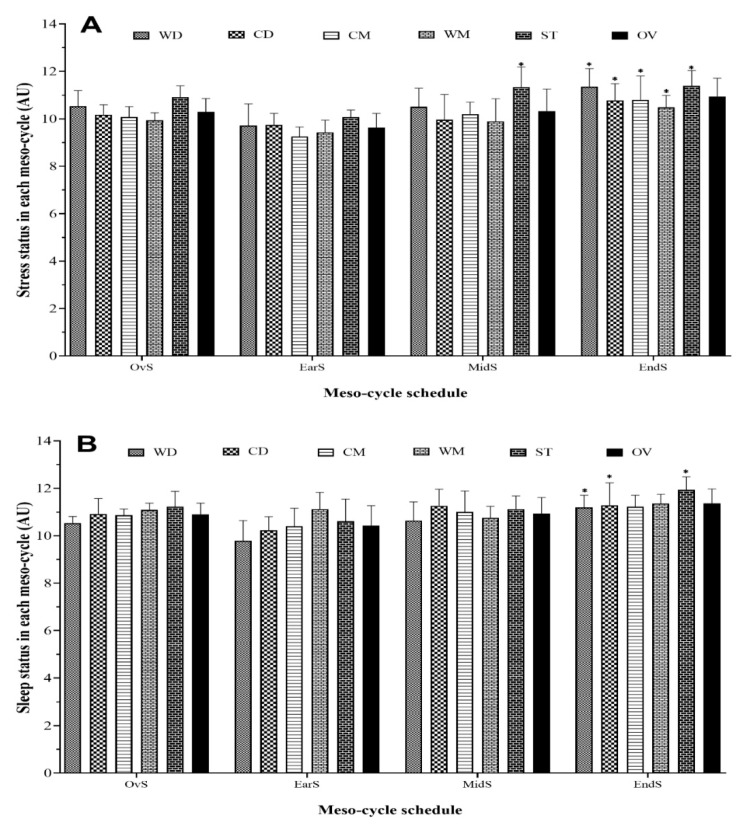
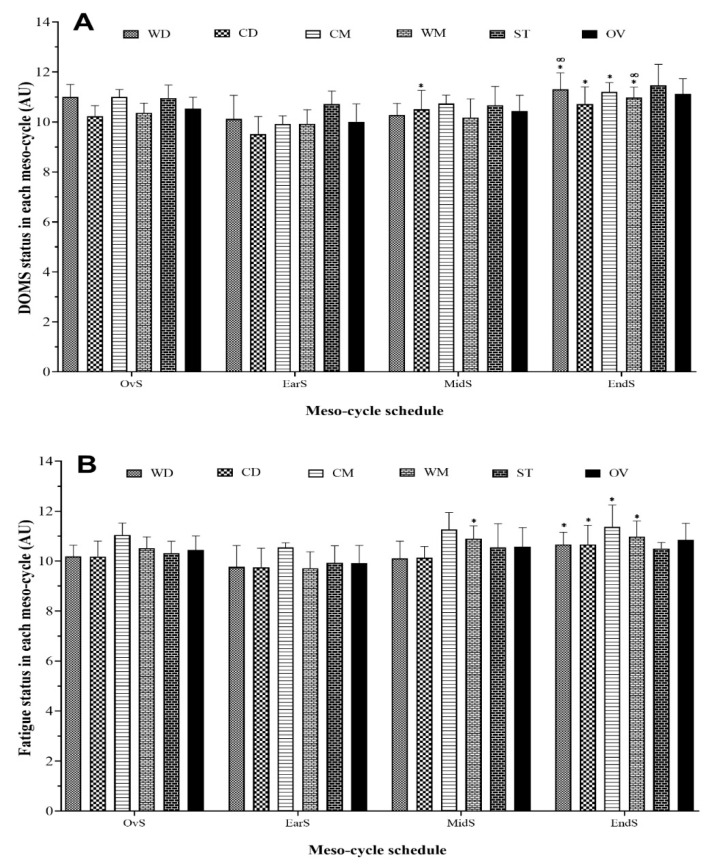
The current study surveyed weekly and daily variations of well-being ratings relative to the Hooper Index (HI): fatigue (wFatigue), stress (wStress), delayed onset muscle soreness (wDOMS), and sleep quality (wSleep) during a soccer season based on players' positions. The full-season was divided into three meso-cycles: Early season, week (W)1 to W7; Mid-season, W8 to W13, and End-season, W14 to W20. Twenty-six young players participated in the study (age, 15.5 ± 0.2 years; height, 172.9 ± 4.2 cm; body mass, 61.4 ± 5.6 kg; body fat, 8.6 ± 2.9%; VO, 48.4 ± 2.4 mL.kg·min; maturity offset, 1.9 ± 0.3 years). Participants played in the same team and competed in Iran national under-16 competitions. Well-being status was monitored on training days using the HI questionnaire. The main result was a significant difference between well-being status 5 days before match day (MD) and 4 days before MD, compared to MD for all playing positions ( ≤ 0.001). The highest and lowest records occurred during End-season for wDOMS (strikers = 11.5 ± 8.4 arbitrary units (AU)), Early season (central defenders = 9.5 ± 0.7 AU) and for wFatigue (central midfielders = 11.4 ± 0.9 AU), and Early season (wide defenders = 9.7 ± 0.7 AU), respectively. Overall, the results showed a significant increase in wStress and wSleep for all players' positions from Early- to End-season. The main application of this study is to make coaches aware of their players' well-being fluctuations throughout the full season, especially in young elite soccer players, and to avoid injuries, overtraining, and overreaching as much as possible.
本研究基于足球运动员的位置,调查了一个足球赛季中相对于胡珀指数(HI)的幸福感评分的每周和每日变化:疲劳(wFatigue)、压力(wStress)、延迟性肌肉酸痛(wDOMS)和睡眠质量(wSleep)。整个赛季分为三个中周期:赛季前期,第1周(W)至第7周;赛季中期,第8周至第13周;赛季末期,第14周至第20周。26名年轻球员参与了该研究(年龄,15.5±0.2岁;身高,172.9±4.2厘米;体重,61.4±5.6千克;体脂,8.6±2.9%;最大摄氧量,48.4±2.4毫升·千克·分钟;成熟度偏移,1.9±0.3岁)。参与者在同一支球队踢球,并参加伊朗国家16岁以下比赛。在训练日使用HI问卷监测幸福感状况。主要结果是,与比赛日(MD)相比,比赛日前5天和前4天所有比赛位置的幸福感状况存在显著差异(P≤0.001)。wDOMS的最高和最低记录分别出现在赛季末期(前锋=11.5±8.4任意单位(AU))、赛季前期(中后卫=9.5±0.7 AU),wFatigue的最高和最低记录分别出现在赛季末期(中场球员=11.4±0.9 AU)、赛季前期(边后卫=9.7±0.7 AU)。总体而言,结果显示从赛季前期到末期,所有球员位置的wStress和wSleep均显著增加。本研究的主要应用是让教练了解其球员在整个赛季中的幸福感波动情况,尤其是年轻的精英足球运动员,并尽可能避免受伤、过度训练和过度疲劳。