Research Unit, Sportive Performance and Physical Rehabilitation, High Institute of Sports and Physical Education of Kef, University of Jendouba, Kef 7100, Tunisia.
High Institute of Sports and Physical Education, Ksar Said, University of Manouba, Tunis 2010, Tunisia.
Int J Environ Res Public Health. 2022 May 11;19(10):5836. doi: 10.3390/ijerph19105836.
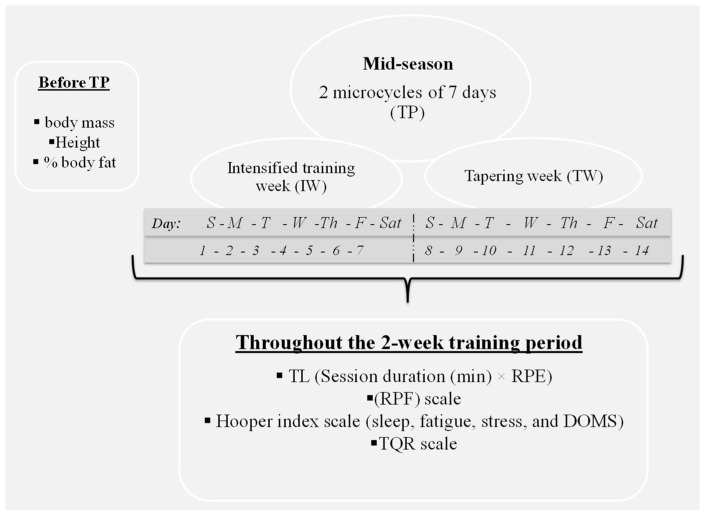
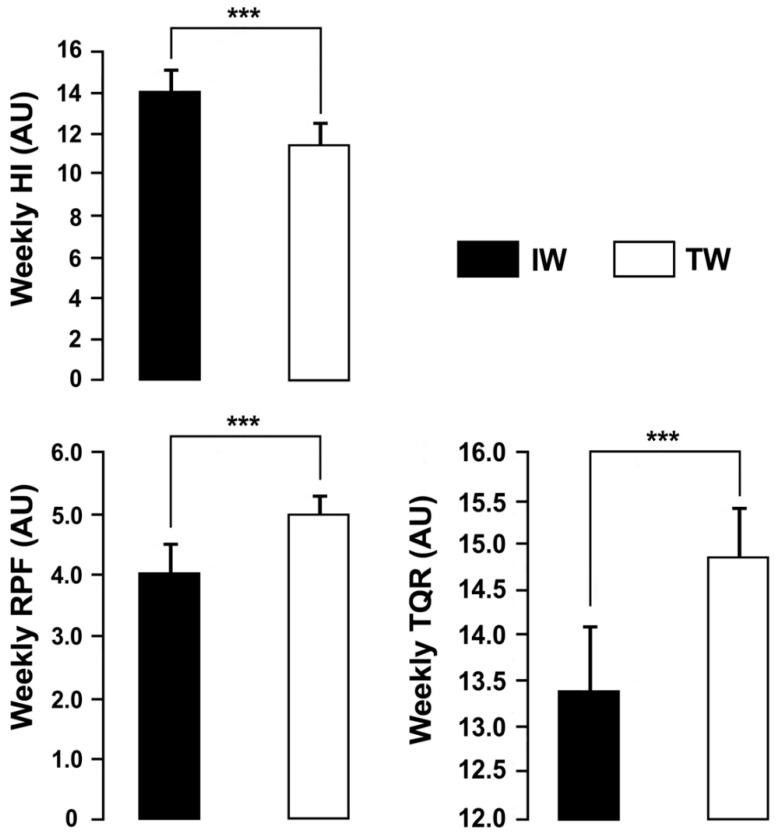
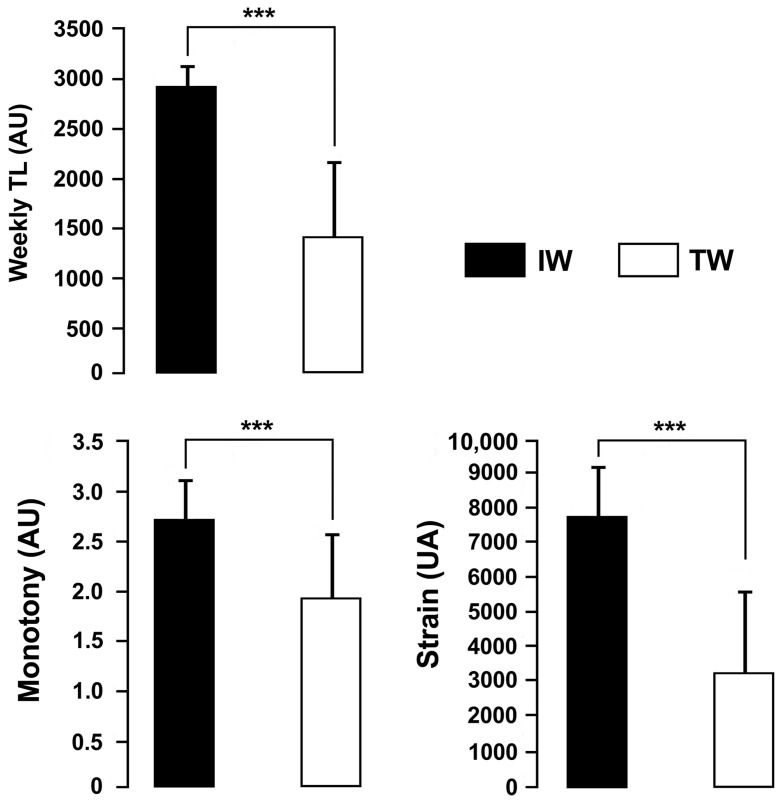
Background: Monitoring physical freshness is essential in assessing athletes’ conditions during training periods, training sessions, or competitions. To date, no single physical freshness scale has been successfully validated against training load variables and widely used scales measuring different facets of physical freshness. Objective: In this study, we develop and test the practical utility of a perceived physical freshness (RPF) scale to monitor the condition of the athletes and to prevent excessive fatigue and insufficient recovery during training sessions or competitions. Methods: Sixteen professional male soccer players (mean ± SD age 26 ± 4 years) were enrolled. Training load (TL), monotony, strain, rate of perceived exertion (RPE), well-being indices (sleep, stress, fatigue, and muscle soreness), total quality recovery (TQR) and RPF were determined each day for two weeks of training, including a week intensified training (IW) and a week taper (TW). The validity of the RPF scale was assessed by measuring the level of agreement of a player’s perceived physical freshness relative to their TL variables, recovery state and well-being indices during each training phase (IW and TW) and during the overall training period (TP). Results: RPF increased during the TW compared to IW (ES = 2.31, p < 0.001, large). For the TP, IW and TW, weekly RPF was related to weekly TL (r = −0.81, r = −0.80, r = −0.69, respectively), well-being (r = −0.91, r = −0.82, r = −0.84, respectively) and TQR (r = 0.76, r = 0.91, r = 0.52, respectively), all p < 0.01. For the TP, IW and TW, daily RPF was related to TL (r = −0.75, r = −0.66, r = −0.70, respectively), well-being (r = −0.84, r = −0.81, r = −0.78, respectively) and TQR (r = 0.82, r = 0.81, r = 0.75, respectively), all p < 0.01. Conclusions: RPF was effective for evaluating the professional soccer players’ physical freshness and may be a strategy for coaches to monitor the physical, psycho-physiological, and psychometric state of the players before training session or matches.
监测身体的新鲜感对于评估运动员在训练期间、训练课或比赛期间的状态至关重要。迄今为止,还没有一个单一的身体新鲜感量表能够成功地与训练负荷变量进行验证,并广泛用于测量身体新鲜感的不同方面。目的:在这项研究中,我们开发并测试了一种感知身体新鲜感(RPF)量表的实用性,以监测运动员的状态,并防止在训练课或比赛期间过度疲劳和恢复不足。方法:招募了 16 名职业男性足球运动员(平均年龄 ± 标准差 26 ± 4 岁)。每天在两周的训练中确定训练负荷(TL)、单调性、应变、感知用力程度(RPE)、健康指数(睡眠、压力、疲劳和肌肉酸痛)、总质量恢复(TQR)和 RPF,包括一周强化训练(IW)和一周减量(TW)。通过测量运动员在每个训练阶段(IW 和 TW)和整个训练期间(TP)相对于他们的 TL 变量、恢复状态和健康指数的感知身体新鲜感的一致性水平,评估 RPF 量表的有效性。结果:TW 期间的 RPF 高于 IW(ES = 2.31,p < 0.001,大)。对于 TP、IW 和 TW,每周 RPF 与每周 TL(r = -0.81,r = -0.80,r = -0.69)、健康状况(r = -0.91,r = -0.82,r = -0.84)和 TQR(r = 0.76,r = 0.91,r = 0.52)相关,所有 p < 0.01。对于 TP、IW 和 TW,每日 RPF 与 TL(r = -0.75,r = -0.66,r = -0.70)、健康状况(r = -0.84,r = -0.81,r = -0.78)和 TQR(r = 0.82,r = 0.81,r = 0.75)相关,所有 p < 0.01。结论:RPF 可有效评估职业足球运动员的身体新鲜感,可能是教练在训练课或比赛前监测运动员身体、心理生理和心理状态的一种策略。