Goldstein Yoel, Spitz Sarah, Turjeman Keren, Selinger Florian, Barenholz Yechezkel, Ertl Peter, Benny Ofra, Bavli Danny
Institute for Drug Research, The School of Pharmacy, Faculty of Medicine, The Hebrew University of Jerusalem, Jerusalem 91120, Israel.
Faculty of Technical Chemistry, Institute of Applied Synthetic Chemistry, Vienna University of Technology, 1040 Vienna, Austria.
Micromachines (Basel). 2021 May 28;12(6):627. doi: 10.3390/mi12060627.
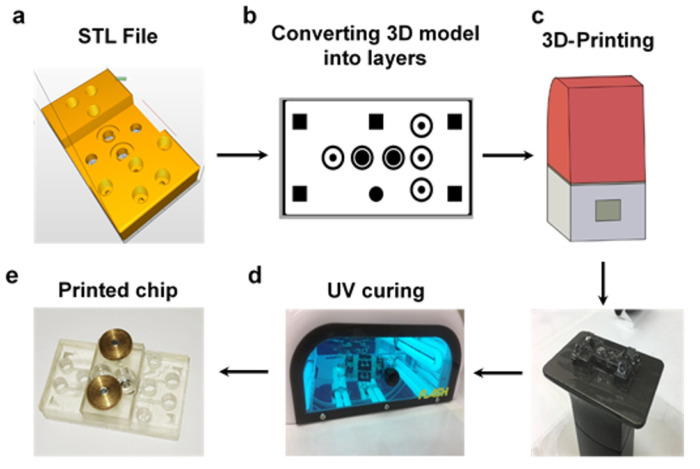
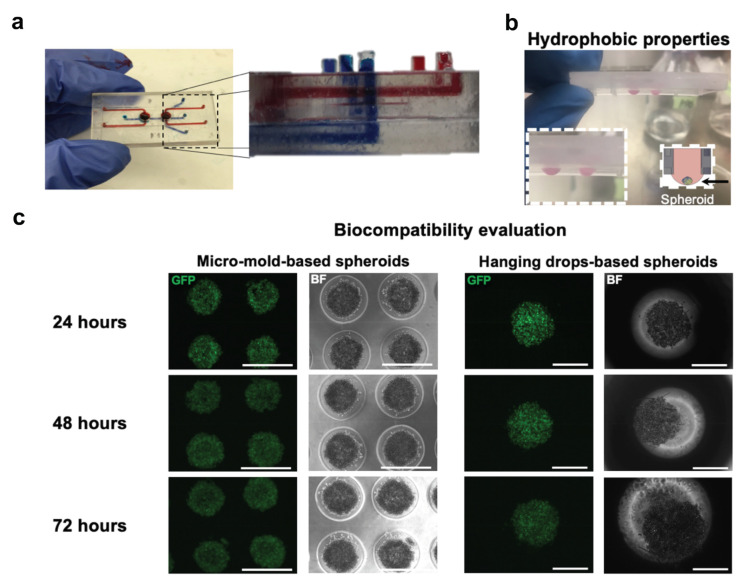
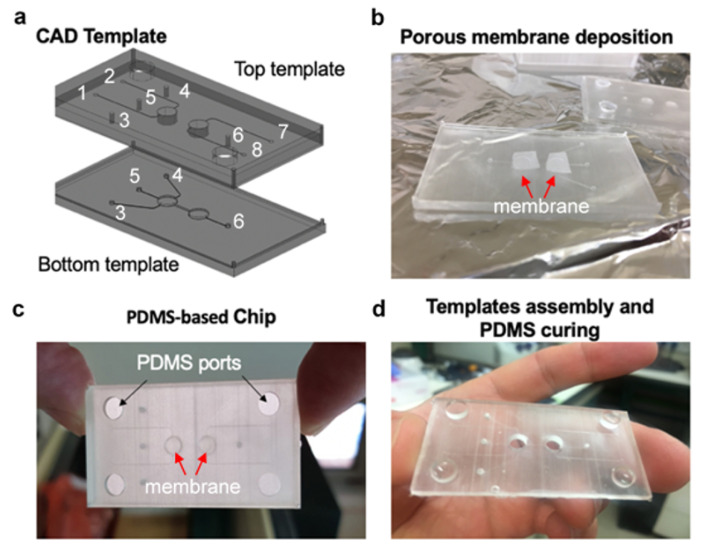
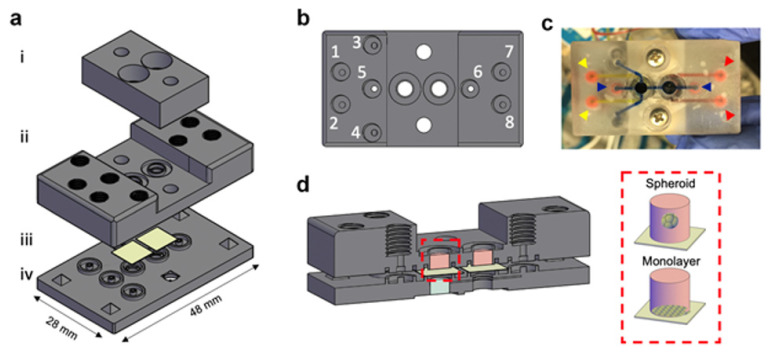
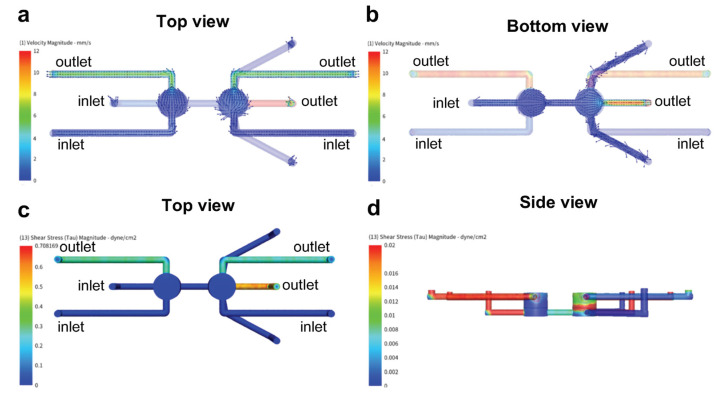
The understanding that systemic context and tissue crosstalk are essential keys for bridging the gap between in vitro models and in vivo conditions led to a growing effort in the last decade to develop advanced multi-organ-on-a-chip devices. However, many of the proposed devices have failed to implement the means to allow for conditions tailored to each organ individually, a crucial aspect in cell functionality. Here, we present two 3D-print-based fabrication methods for a generic multi-organ-on-a-chip device: One with a PDMS microfluidic core unit and one based on 3D-printed units. The device was designed for culturing different tissues in separate compartments by integrating individual pairs of inlets and outlets, thus enabling tissue-specific perfusion rates that facilitate the generation of individual tissue-adapted perfusion profiles. The device allowed tissue crosstalk using microchannel configuration and permeable membranes used as barriers between individual cell culture compartments. Computational fluid dynamics (CFD) simulation confirmed the capability to generate significant differences in shear stress between the two individual culture compartments, each with a selective shear force. In addition, we provide preliminary findings that indicate the feasibility for biological compatibility for cell culture and long-term incubation in 3D-printed wells. Finally, we offer a cost-effective, accessible protocol enabling the design and fabrication of advanced multi-organ-on-a-chip devices.
认识到系统背景和组织间相互作用是弥合体外模型与体内条件之间差距的关键因素,在过去十年中,人们越来越努力开发先进的多器官芯片装置。然而,许多提出的装置未能实现针对每个器官单独定制条件的方法,而这是细胞功能的一个关键方面。在此,我们展示了两种基于3D打印的通用多器官芯片装置制造方法:一种带有PDMS微流体核心单元,另一种基于3D打印单元。该装置通过整合单独的进出口对,设计用于在不同隔室中培养不同组织,从而实现特定组织的灌注速率,有助于生成适应各个组织的灌注曲线。该装置利用微通道配置和用作各个细胞培养隔室之间屏障的可渗透膜实现组织间相互作用。计算流体动力学(CFD)模拟证实了在两个单独的培养隔室之间产生显著剪切应力差异的能力,每个隔室具有选择性剪切力。此外,我们提供的初步研究结果表明,在3D打印孔中进行细胞培养和长期孵育具有生物相容性的可行性。最后,我们提供了一种经济高效、易于使用的方案,可用于设计和制造先进的多器官芯片装置。