Kreß Sebastian, Schaller-Ammann Roland, Feiel Jürgen, Priedl Joachim, Kasper Cornelia, Egger Dominik
Institute of Cell and Tissue Culture Technologies, Department of Biotechnology, University of Natural Resources and Life Sciences, Vienna, Muthgasse 18, 1190 Vienna, Austria.
Health-Institute for Biomedicine and Health Sciences, JOANNEUM RESEARCH Forschungsgesellschaft mbH, Neue Stiftingtalstrasse 2, 8010 Graz, Austria.
Materials (Basel). 2020 Jul 6;13(13):3011. doi: 10.3390/ma13133011.
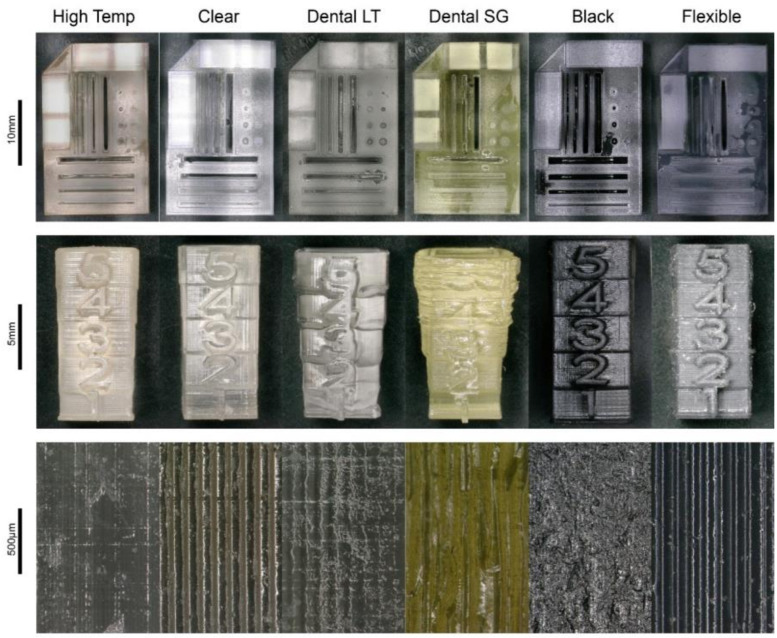
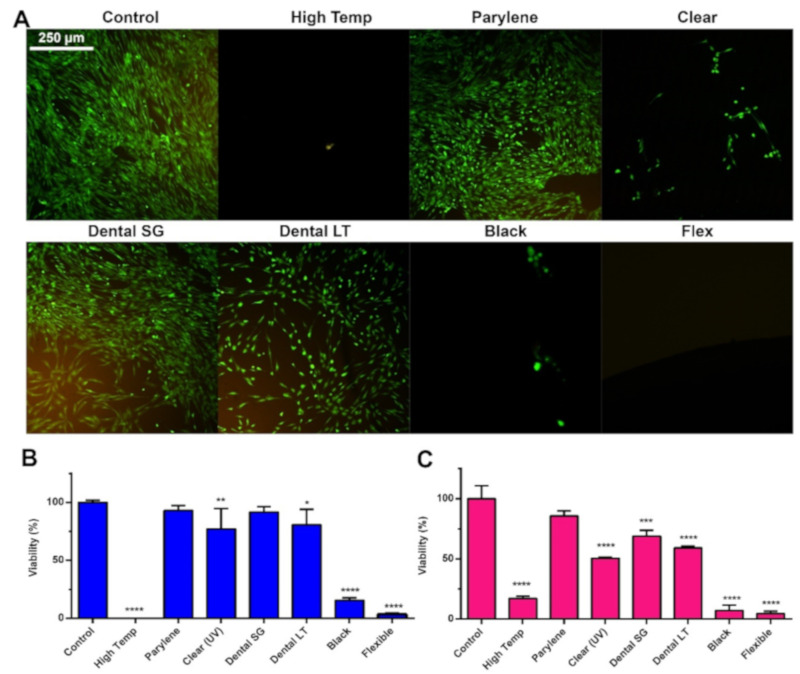
3D printing is increasingly important for the rapid prototyping of advanced and tailor-made cell culture devices. In this context, stereolithography represents a method for the rapid generation of prototypes from photocurable polymers. However, the biocompatibility of commercially available photopolymers is largely unknown. Therefore, we evaluated the cytotoxicity of six polymers, two of them certified as biocompatible according to ISO 10993-5:2009, and we evaluated, if coating with Parylene, an inert polymer widely used in medical applications, might shield cells from the cytotoxic effects of a toxic polymer. In addition, we evaluated the processability, reliability, and consistency of the details printed. Human mesenchymal stem cells (MSCs) were used for cytotoxicity testing as they are widely used and promising for numerous applications in regenerative medicine. MSCs were incubated together with printed photopolymers, and the cytotoxicity was assessed. All photopolymers significantly reduced the viability of MSCs while the officially biocompatible resins displayed minor toxic effects. Further, coating with Parylene completely protected MSCs from toxic effects. In conclusion, none of the tested polymers can be fully recommended for rapid prototyping of cell culture devices. However, coating with Parylene can shield cells from toxic effects and thus might represent a viable option until more compatible materials are available.
3D打印对于先进的定制细胞培养设备的快速原型制作愈发重要。在此背景下,立体光刻代表了一种利用光固化聚合物快速生成原型的方法。然而,市售光聚合物的生物相容性很大程度上未知。因此,我们评估了六种聚合物的细胞毒性,其中两种根据ISO 10993 - 5:2009认证为生物相容,并且我们评估了用聚对二甲苯(一种在医疗应用中广泛使用的惰性聚合物)涂层是否可以保护细胞免受有毒聚合物的细胞毒性影响。此外,我们评估了打印细节的可加工性、可靠性和一致性。人间充质干细胞(MSCs)被用于细胞毒性测试,因为它们被广泛使用且在再生医学的众多应用中前景广阔。将MSCs与打印的光聚合物一起孵育,并评估细胞毒性。所有光聚合物均显著降低了MSCs的活力,而官方认证的生物相容树脂显示出较小的毒性作用。此外,聚对二甲苯涂层完全保护了MSCs免受毒性影响。总之,对于细胞培养设备的快速原型制作,所测试的聚合物均不能完全被推荐。然而,聚对二甲苯涂层可以保护细胞免受毒性影响,因此在有更兼容的材料可用之前可能是一个可行的选择。