Cell and Molecular Biology program, University of Arkansas, Fayetteville, AR, USA.
Cell and Molecular Biology program, University of Arkansas, Fayetteville, AR, USA; Department of Pathology and Veterinary Diagnostics, Institute of Veterinary Medicine, Warsaw University of Life Sciences - SGGW, Warsaw, Poland.
Poult Sci. 2021 Jul;100(7):101148. doi: 10.1016/j.psj.2021.101148. Epub 2021 Mar 22.
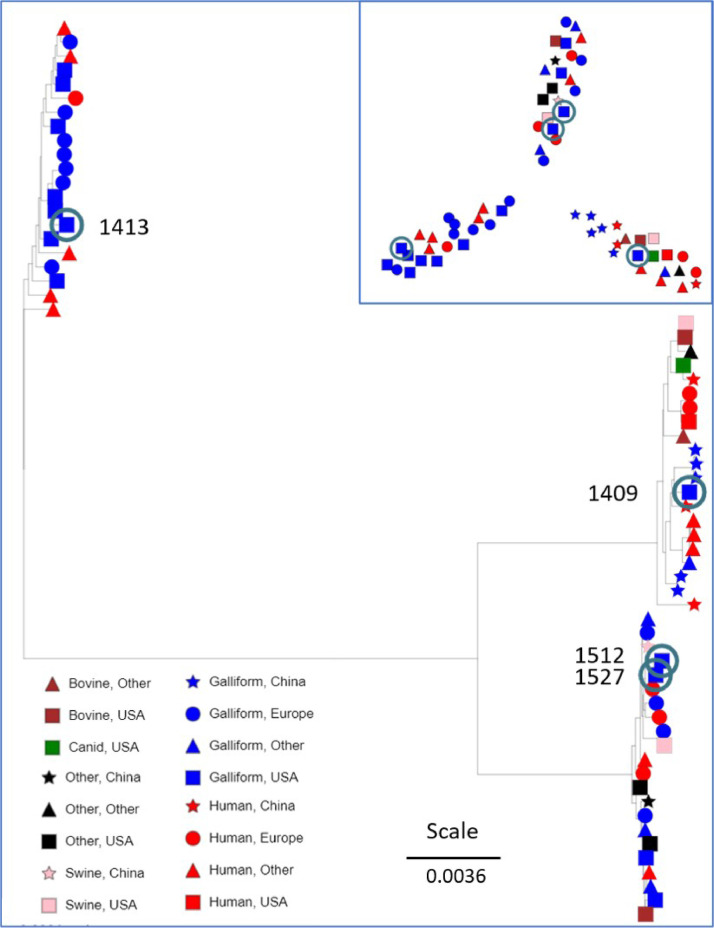
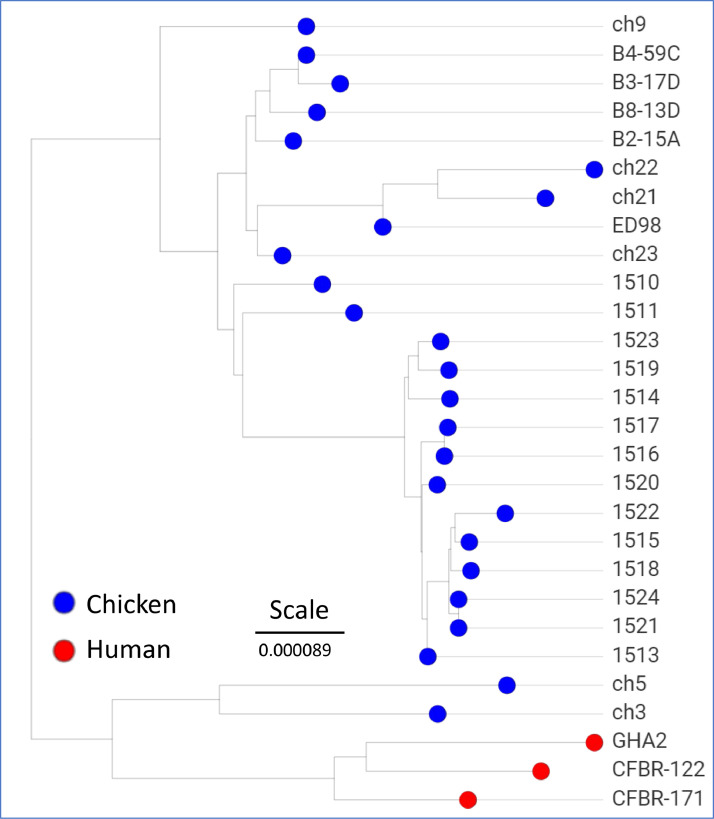
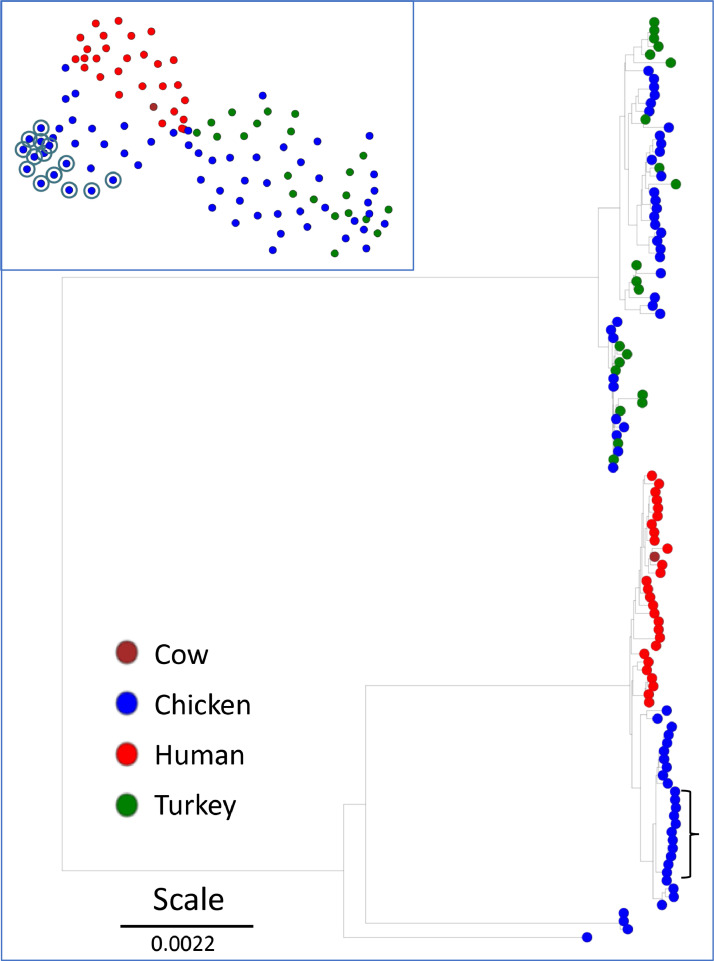
We investigated lameness outbreaks at 3 commercial broiler farms in Arkansas. We isolated several distinct bacterial species from Bacterial Chondronecrosis with Osteomyelitis (BCO) lesions from these 3 farms. The results show that BCO-lameness pathogens on particular farms can differ significantly. We characterized genomes for isolates of the 2 most prevalent species, Escherichia coli and Staphylococcus aureus. Genomes assembled for E. coli isolates from all 3 farms were quite different between farms, and most similar to genomes from different geographical locations and hosts. The E. coli phylogenomics suggests frequent host shifts for this species. Genomes for S. aureus isolates from one farm were highly related to those from chicken isolates from Europe. Highly related isolates have also been characterized from chickens in the Arkansas area for at least a decade. Phylogenomics suggest that this S. aureus has been restricted to poultry for more than 40 y. Detailed analysis of genomes from 2 neighboring clades of S. aureus human and chicken isolates, identifies the acquisition of a specific pathogenicity island in the transition from human to chicken pathogen and that pathogenesis for this clade in chickens may depend on this mobile element. Investigation of the evolution of this chicken-restricted clade from 1980 in Ireland, Poland in 2008, Oklahoma in 2010 and Arkansas in 2019, reveals the acquisition of additional virulence determinants including pathogenicity islands. Isolate-specific genome characterizations will help further our understanding of the disease mechanisms of BCO-lameness, a significant animal welfare issue.
我们调查了阿肯色州的 3 个商业肉鸡场的跛行疫情。我们从这 3 个农场的细菌性软骨坏死性骨髓炎(BCO)病变中分离出几种不同的细菌。结果表明,特定农场的 BCO 跛行病原体可能存在显著差异。我们对两种最常见的分离株(大肠杆菌和金黄色葡萄球菌)的基因组进行了特征描述。从所有 3 个农场分离出的大肠杆菌分离株的基因组组装在农场之间存在很大差异,与来自不同地理位置和宿主的基因组最为相似。大肠杆菌的系统发育基因组学表明该物种经常发生宿主转移。来自一个农场的金黄色葡萄球菌分离株的基因组与来自欧洲鸡的金黄色葡萄球菌基因组高度相关。至少在过去 10 年中,阿肯色州地区的鸡也已经分离出了高度相关的金黄色葡萄球菌。系统发育基因组学表明,这种金黄色葡萄球菌在禽类中已经存在了 40 多年。对金黄色葡萄球菌人类和鸡分离株的两个相邻分支的基因组进行详细分析,确定了在从人类病原体向鸡病原体过渡过程中特定致病性岛的获得,并且该分支在鸡中的发病机制可能依赖于这个可移动元件。对来自 1980 年爱尔兰、2008 年波兰、2010 年俄克拉荷马州和 2019 年阿肯色州的这个鸡中受限分支的进化进行调查,揭示了该分支在鸡中获得了其他毒力决定因素,包括致病性岛。分离株特异性基因组特征分析将有助于我们进一步了解 BCO 跛行的发病机制,这是一个重大的动物福利问题。