Verma Sagar, Singh Priyanka, Khurana Shiffali, Ganguly Nirmal Kumar, Kukreti Ritushree, Saso Luciano, Rana Devinder Singh, Taneja Vibha, Bhargava Vinant
Department of Research, Sir Ganga Ram Hospital, New Delhi, India.
CSIR-Institute of Genomics and Integrative Biology, New Delhi, India.
Kidney Res Clin Pract. 2021 Jun;40(2):183-193. doi: 10.23876/j.krcp.20.163. Epub 2021 May 26.
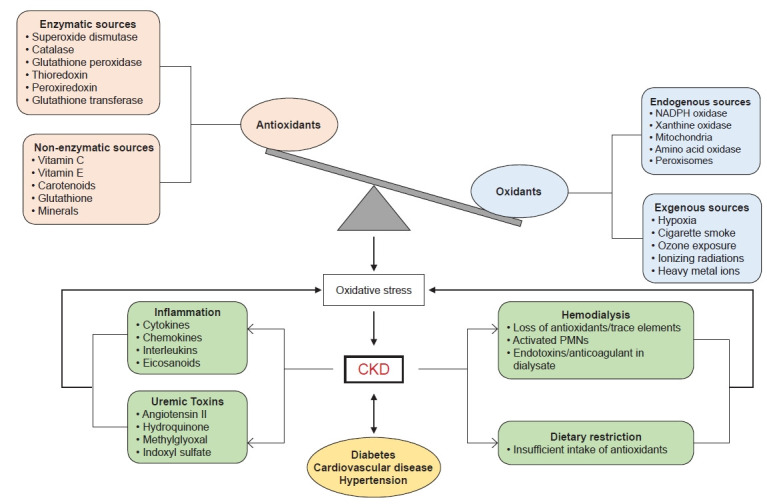
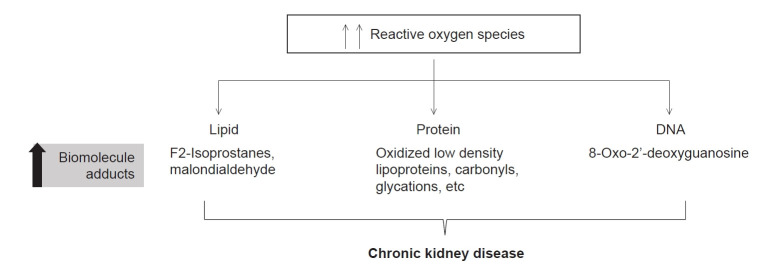
Moderate levels of endogenous reactive oxygen species (ROS) are important for various cellular activities, but high levels lead to toxicity and are associated with various diseases. Levels of ROS are maintained as a balance between oxidants and antioxidants. Accumulating data suggest that oxidative stress is a major factor in deterioration of renal function. In this review, we highlight the possible mechanism by which oxidative stress can lead to chronic kidney disease (CKD). This review also describes therapies that counter the effect of oxidative stress in CKD patients. Numerous factors such as upregulation of genes involved in oxidative phosphorylation and ROS generation, chronic inflammation, vitamin D deficiency, and a compromised antioxidant defense mechanism system cause progressive detrimental effects on renal function that eventually lead to loss of kidney function. Patients with renal dysfunction are highly susceptible to oxidative stress, as risk factors such as diabetes, renal hypertension, dietary restrictions, hemodialysis, and old age predispose them to increased levels of ROS. Biomolecular adducts (DNA, proteins, and lipids) formed due to reaction with ROS can be used to determine oxidative stress levels. Based on the strong correlation between oxidative stress and CKD, reversal of oxidative stress is being explored as a major therapeutic option. Xanthine oxidase inhibitors, dietary antioxidants, and other agents that scavenge free radicals are gaining interest as treatment modalities in CKD patients.
适度水平的内源性活性氧(ROS)对各种细胞活动很重要,但高水平会导致毒性并与多种疾病相关。ROS的水平通过氧化剂和抗氧化剂之间的平衡来维持。越来越多的数据表明,氧化应激是肾功能恶化的主要因素。在本综述中,我们重点介绍氧化应激导致慢性肾脏病(CKD)的可能机制。本综述还描述了对抗CKD患者氧化应激影响的治疗方法。许多因素,如参与氧化磷酸化和ROS生成的基因上调、慢性炎症、维生素D缺乏以及抗氧化防御机制系统受损,都会对肾功能产生渐进性的有害影响,最终导致肾功能丧失。肾功能不全的患者极易受到氧化应激的影响,因为糖尿病、肾性高血压、饮食限制、血液透析和老年等危险因素使他们易出现ROS水平升高。由于与ROS反应形成的生物分子加合物(DNA、蛋白质和脂质)可用于确定氧化应激水平。基于氧化应激与CKD之间的强相关性,逆转氧化应激正被探索为一种主要的治疗选择。黄嘌呤氧化酶抑制剂、膳食抗氧化剂和其他清除自由基的药物作为CKD患者的治疗方式正受到关注。