Wang Yajuan, Ding Austin Shijun, Xu Chonghuan
School of Business Administration, Zhejiang Gongshang University, Hangzhou, China.
Modern Business Research Center, Zhejiang Gongshang University, Hangzhou, China.
Int J Disaster Risk Reduct. 2023 Jan;84:103472. doi: 10.1016/j.ijdrr.2022.103472. Epub 2022 Nov 30.
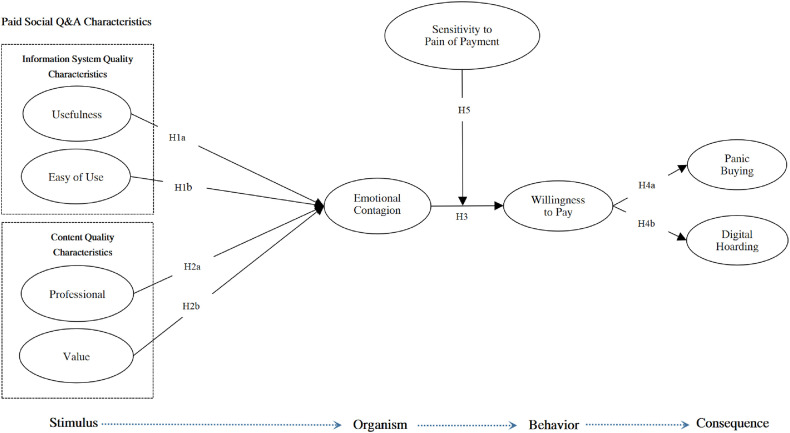
The worldwide disaster caused by COVID-19 and its variants has changed the behavior and psychology of consumers. Panic buying and hoarding of various commodities continue to emerge in our daily life. Meanwhile, many scholars have focused on the causes of panic buying and hoarding of physical products like daily necessities and food during the outbreak of COVID-19. In fact, the phenomenon of panic buying and digital hoarding of paid social Q&A and other digital content products is very prominent, both in the outbreak period of COVID-19 epidemic and the current coexistence stage. However, the existing literature lacks empirical research to explore this phenomenon, and the psychological mechanism behind it has not been clearly revealed. Therefore, at the current stage of coexistence with COVID-19, based on the SOBC framework, we developed a theoretical model and explored the causes of panic buying and digital hoarding in paid social Q&A. The data collected from 863 paid social Q&A users in China are empirically tested. The results show that the characteristics of paid social Q&A (usefulness, ease of use, professionalism and value) can cause emotional contagion among platform users, activate their willingness to pay, and finally lead to digital hoarding and panic buying behavior of COVID-19 co-existence stage. In addition, the sensitivity to pain of payment moderates the relationship between emotional contagion and willingness to pay. Compared with the spendthrifts, the tightwads are more willing to pay. The conclusions will have positive significance for improving the retail service of digital content platform and promoting the consumption of digital content.
由新冠病毒及其变种引发的全球灾难改变了消费者的行为和心理。在我们的日常生活中,各种商品的恐慌性购买和囤积现象不断出现。与此同时,许多学者关注了新冠疫情爆发期间诸如日用品和食品等实物产品的恐慌性购买和囤积的原因。事实上,无论是在新冠疫情爆发期还是当前的共存阶段,付费社交问答等数字内容产品的恐慌性购买和数字囤积现象都非常突出。然而,现有文献缺乏实证研究来探究这一现象,其背后的心理机制也尚未得到清晰揭示。因此,在与新冠病毒共存的现阶段,基于SOBC框架,我们构建了一个理论模型,并探究了付费社交问答中恐慌性购买和数字囤积的原因。对从中国863名付费社交问答用户收集的数据进行了实证检验。结果表明,付费社交问答的特征(有用性、易用性、专业性和价值)会导致平台用户之间的情绪传染,激活他们的支付意愿,并最终导致新冠共存阶段的数字囤积和恐慌性购买行为。此外,支付痛感敏感度调节了情绪传染与支付意愿之间的关系。与大手大脚花钱的人相比,吝啬的人更愿意支付。这些结论对于改善数字内容平台的零售服务以及促进数字内容消费具有积极意义。