Miragall Marta, Herrero Rocío, Vara M Dolores, Galiana Laura, Baños Rosa M
Department of Personality, Evaluation, and Psychological Treatments, University of Valencia, Valencia, Spain.
CIBER Fisiopatología Obesidad y Nutrición (CIBEROBN), Instituto Carlos III, Madrid, Spain.
Eur J Psychotraumatol. 2021 Jun 9;12(1):1918900. doi: 10.1080/20008198.2021.1918900.
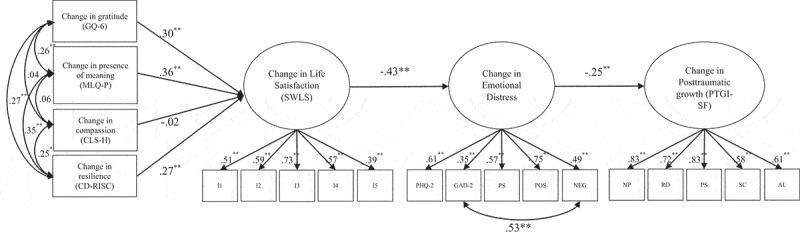
: The adverse consequences of the COVID-19 pandemic on mental health have been widely studied in recent months. However, few studies have examined the protective psychological factors that may explain how individuals are coping with the COVID-19 pandemic and its forced confinements. : This study analyzes the impact of confinement due to the COVID-19 pandemic on positive functioning variables (resilience, meaning of life, gratitude, compassion, life satisfaction), emotional distress (depression, anxiety, perceived stress, affect), and posttraumatic growth (PTG). The impact was measured during and after the first month of strict and obligatory confinement in Spain. : The sample was composed of 438 Spanish residents (78.3% women) between the ages of 18 and 68 ( = 35.68; = 13.19) during the first stage (first two weeks) of confinement. The sample was reduced to 197 participants during the second stage (fifth week) of confinement. Several online self-reported questionnaires were administered to assess positive functioning variables, emotional distress, and PTG. : Women, youths, individuals without a partner, with lower monetary incomes, or diagnosed with a mental disorder or chronic illness experienced lower scores in positive functioning variables and greater emotional distress during the first stage of confinement. Linear mixed models showed that scores on positive functioning variables, emotional distress, and PTG worsened in the second stage of confinement. Nevertheless, a structural equations model showed that increases in positive functioning variables in the second stage were associated with increases in life satisfaction (= .450) and related to decreases in emotional distress (= .186), leading in turn to increases in PTG (= .061). : Individuals could experience PTG during strict and mandatory confinement. The increase in PTG during this adverse event was indirectly associated with increases in positive functioning variables (i.e. gratitude, presence of meaning, resilience), through improvements in life satisfaction and emotional distress.
近几个月来,新冠疫情对心理健康的不良影响已得到广泛研究。然而,很少有研究探讨那些可能解释个体如何应对新冠疫情及其强制隔离措施的保护性心理因素。
本研究分析了新冠疫情导致的隔离对积极功能变量(心理韧性、生活意义、感恩、同情心、生活满意度)、情绪困扰(抑郁、焦虑、感知压力、情感)以及创伤后成长(PTG)的影响。该影响是在西班牙严格且强制隔离的第一个月期间及之后进行测量的。
样本由438名西班牙居民组成(78.3%为女性),年龄在18至68岁之间(平均年龄=35.68岁;标准差=13.19),处于隔离的第一阶段(前两周)。在隔离的第二阶段(第五周),样本减少至197名参与者。通过几份在线自我报告问卷来评估积极功能变量、情绪困扰和创伤后成长。
在隔离的第一阶段,女性、年轻人、没有伴侣的个体、收入较低的个体,或被诊断患有精神障碍或慢性病的个体,在积极功能变量方面得分较低,情绪困扰程度较高。线性混合模型显示,在隔离的第二阶段,积极功能变量、情绪困扰和创伤后成长的得分有所恶化。然而,结构方程模型表明,在第二阶段积极功能变量的增加与生活满意度的提高相关(相关系数=0.450),并与情绪困扰的减少相关(相关系数=0.186),进而导致创伤后成长的增加(相关系数=0.061)。
在严格且强制的隔离期间,个体可能会经历创伤后成长。在这一不良事件中,创伤后成长的增加通过生活满意度和情绪困扰的改善,与积极功能变量(即感恩、生活意义感、心理韧性)的增加间接相关。