Kaufman Brystana G, Whitaker Rebecca, Mahendraratnam Nirosha, Hurewitz Sophie, Yi Jeremy, Smith Valerie A, McClellan Mark
Margolis Center for Health Policy, Duke University, 230 Science Drive, Durham, NC, 27705, USA.
Population Health Sciences, Duke University School of Medicine, Durham, NC, USA.
BMC Public Health. 2021 Jun 28;21(1):1239. doi: 10.1186/s12889-021-11236-3.
The novel coronavirus disease 2019 (COVID-19) sickened over 20 million residents in the United States (US) by January 2021. Our objective was to describe state variation in the effect of initial social distancing policies and non-essential business (NEB) closure on infection rates early in 2020.
We used an interrupted time series study design to estimate the total effect of all state social distancing orders, including NEB closure, shelter-in-place, and stay-at-home orders, on cumulative COVID-19 cases for each state. Data included the daily number of COVID-19 cases and deaths for all 50 states and Washington, DC from the New York Times database (January 21 to May 7, 2020). We predicted cumulative daily cases and deaths using a generalized linear model with a negative binomial distribution and a log link for two models.
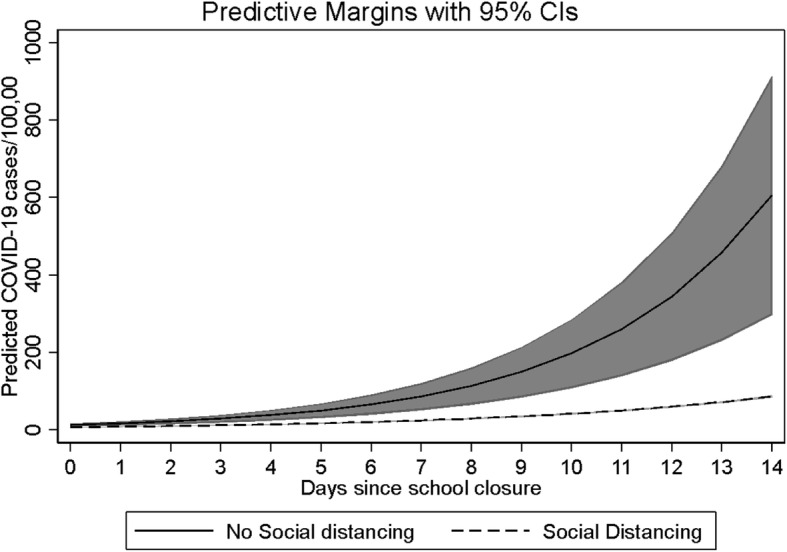
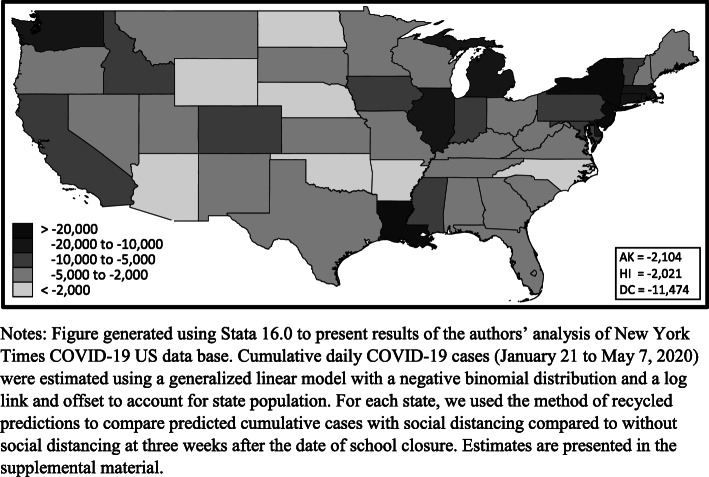
Social distancing was associated with a 15.4% daily reduction (Relative Risk = 0.846; Confidence Interval [CI] = 0.832, 0.859) in COVID-19 cases. After 3 weeks, social distancing prevented nearly 33 million cases nationwide, with about half (16.5 million) of those prevented cases among residents of the Mid-Atlantic census division (New York, New Jersey, Pennsylvania). Eleven states prevented more than 10,000 cases per 100,000 residents within 3 weeks.
The effect of social distancing on the infection rate of COVID-19 in the US varied substantially across states, and effects were largest in states with highest community spread.
截至2021年1月,新型冠状病毒肺炎(COVID-19)已使美国超过2000万居民患病。我们的目标是描述2020年初初始社交距离政策和非必要商业活动(NEB)关闭对感染率的州际差异。
我们采用中断时间序列研究设计,以估计所有州的社交距离指令(包括NEB关闭、就地避难和居家指令)对每个州COVID-19累计病例的总体影响。数据包括来自《纽约时报》数据库(2020年1月21日至5月7日)的美国50个州及华盛顿特区的每日COVID-19病例数和死亡数。我们使用具有负二项分布和对数链接的广义线性模型对两个模型预测每日累计病例数和死亡数。
社交距离与COVID-19病例每日减少15.4%相关(相对风险=0.846;置信区间[CI]=0.832,0.859)。3周后,社交距离在全国范围内预防了近3300万例病例,其中约一半(1650万例)为大西洋中部人口普查区(纽约、新泽西、宾夕法尼亚)居民中被预防的病例。11个州在3周内每10万名居民中预防了超过10000例病例。
社交距离对美国COVID-19感染率的影响在各州之间差异很大,且在社区传播最严重的州影响最大。