Faculty of Social Sciences, 33014 Tampere University, Tampere, Finland.
Finnish Institute for Health and Welfare, Department of Public Health Solutions, 30, 00271 Helsinki, Finland.
Br J Nutr. 2022 Apr 14;127(7):1060-1072. doi: 10.1017/S0007114521001719. Epub 2021 Jun 28.
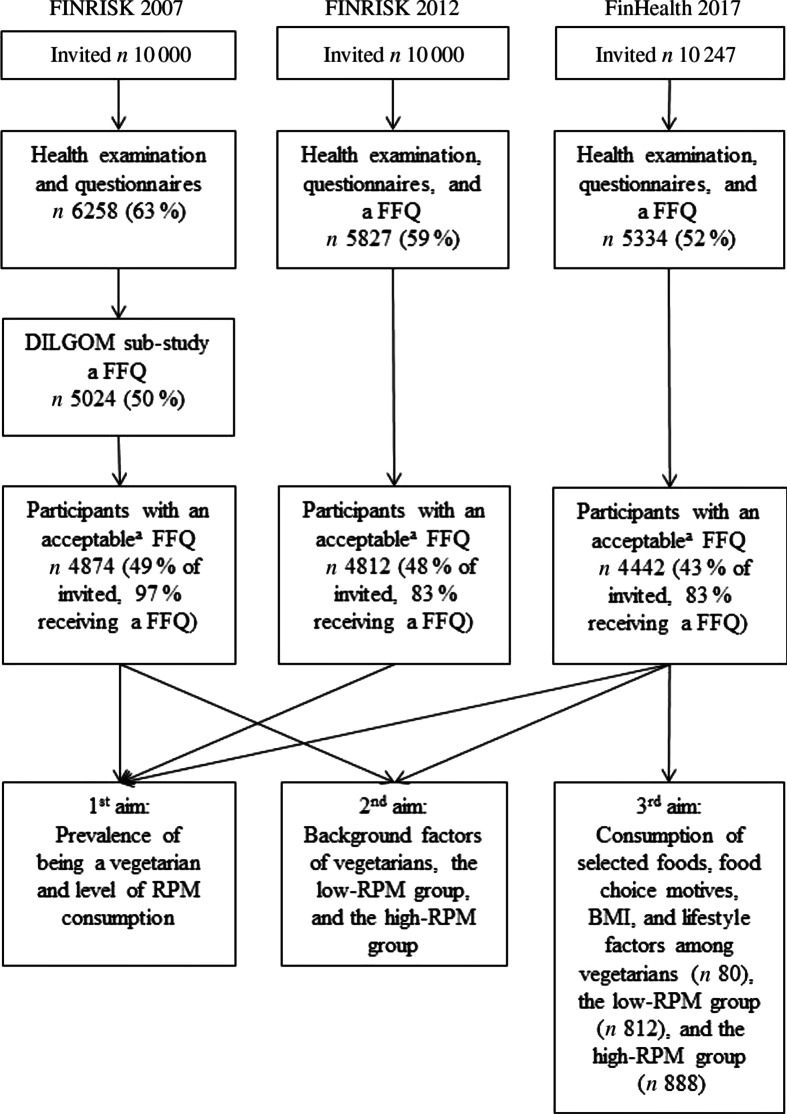
From health and sustainability perspectives, reduction in the consumption of animal-based foods, especially red meat, is a key strategy. The present study examined the prevalence, sociodemographic and lifestyle factors, food consumption and food choice motives of vegetarians and consumers of low and high amounts of red and processed meat (RPM) among Finnish adults. We applied the data from three national health studies: FINRISK 2007 (n 4874), FINRISK 2012 (n 4812) and FinHealth 2017 (n 4442). Participants addressed their food consumption with a FFQ and answered other questionnaires about sociodemographic and lifestyle factors, as well as food choice motives. The prevalence of vegetarianism increased from 0·7 % in 2012 to 1·8 % in 2017, and median daily RPM consumption decreased from 128 g in 2007 to 119 g in 2012 and to 96 g in 2017. Vegetarians and members of the low-RPM group were more often women, younger and more highly educated than the high-RPM group, both in 2007 and 2017. Still, the importance of sex for the probability of a vegetarian diet decreased, while its importance for high-RPM consumption increased. Vegetarians consumed more fruit, vegetables, legumes, nuts and seeds than either the low- or high-RPM groups. The high-RPM group had the lowest scores in several aspects of healthy and sustainable diet, healthy food choice motives and healthy lifestyle. Vegetarians and groups differing in their RPM consumption levels might benefit from differing interventions and nutrition information taking into account their other dietary habits, food choice motives and lifestyle factors.
从健康和可持续性的角度来看,减少动物源性食品的消费,尤其是红色肉类的消费,是一项关键策略。本研究调查了芬兰成年人中素食者以及低、高红色和加工肉类(RPM)消费者的流行率、社会人口和生活方式因素、食物消费和食物选择动机。我们应用了三项国家健康研究的数据:FINRISK 2007(n 4874)、FINRISK 2012(n 4812)和 FinHealth 2017(n 4442)。参与者使用 FFQ 记录他们的食物消费情况,并回答了关于社会人口和生活方式因素以及食物选择动机的其他问卷。素食者的流行率从 2012 年的 0.7%增加到 2017 年的 1.8%,而 RPM 的日均消费量从 2007 年的 128 克下降到 2012 年的 119 克,再下降到 2017 年的 96 克。无论是在 2007 年还是 2017 年,素食者和低 RPM 组的成员通常都是女性、更年轻、受教育程度更高。尽管如此,性别对素食饮食概率的重要性降低,而对高 RPM 消费的重要性增加。素食者比低或高 RPM 组消费更多的水果、蔬菜、豆类、坚果和种子。在健康和可持续饮食、健康食品选择动机和健康生活方式的几个方面,高 RPM 组的得分最低。素食者和 RPM 消费水平不同的群体可能受益于不同的干预措施和营养信息,同时考虑到他们的其他饮食习惯、食物选择动机和生活方式因素。