• 文献检索
  • 文档翻译
  • 深度研究
  • 学术资讯
  • Suppr Zotero 插件Zotero 插件
  • 邀请有礼
  • 套餐&价格
  • 历史记录
应用&插件
Suppr Zotero 插件Zotero 插件浏览器插件Mac 客户端Windows 客户端微信小程序
定价
高级版会员购买积分包购买API积分包
服务
文献检索文档翻译深度研究API 文档MCP 服务
关于我们
关于 Suppr公司介绍联系我们用户协议隐私条款
关注我们

Suppr 超能文献

核心技术专利:CN118964589B侵权必究
粤ICP备2023148730 号-1Suppr @ 2026

文献检索

告别复杂PubMed语法,用中文像聊天一样搜索,搜遍4000万医学文献。AI智能推荐,让科研检索更轻松。

立即免费搜索

文件翻译

保留排版,准确专业,支持PDF/Word/PPT等文件格式,支持 12+语言互译。

免费翻译文档

深度研究

AI帮你快速写综述,25分钟生成高质量综述,智能提取关键信息,辅助科研写作。

立即免费体验

在新冠肺炎背景下,使用监督式机器学习辅助细菌感染诊断。

Supervised machine learning to support the diagnosis of bacterial infection in the context of COVID-19.

作者信息

Rawson Timothy M, Hernandez Bernard, Wilson Richard C, Ming Damien, Herrero Pau, Ranganathan Nisha, Skolimowska Keira, Gilchrist Mark, Satta Giovanni, Georgiou Pantelis, Holmes Alison H

机构信息

National Institute for Health Research Health Protection Research Unit in Healthcare Associated Infections and Antimicrobial Resistance, Imperial College London, Hammersmith Campus, Du Cane Road, London W12 0NN, UK.

Centre for Antimicrobial Optimisation, Hammersmith Hospital, Imperial College London, Du Cane Road, London W12 0NN, UK.

出版信息

JAC Antimicrob Resist. 2021 Feb 3;3(1):dlab002. doi: 10.1093/jacamr/dlab002. eCollection 2021 Mar.

DOI:10.1093/jacamr/dlab002
PMID:34192255
原文链接:https://pmc.ncbi.nlm.nih.gov/articles/PMC7928888/
Abstract

BACKGROUND

Bacterial infection has been challenging to diagnose in patients with COVID-19. We developed and evaluated supervised machine learning algorithms to support the diagnosis of secondary bacterial infection in hospitalized patients during the COVID-19 pandemic.

METHODS

Inpatient data at three London hospitals for the first COVD-19 wave in March and April 2020 were extracted. Demographic, blood test and microbiology data for individuals with and without SARS-CoV-2-positive PCR were obtained. A Gaussian Naive Bayes, Support Vector Machine (SVM) and Artificial Neural Network were trained and compared using the area under the receiver operating characteristic curve (AUCROC). The best performing algorithm (SVM with 21 blood test variables) was prospectively piloted in July 2020. AUCROC was calculated for the prediction of a positive microbiological sample within 48 h of admission.

RESULTS

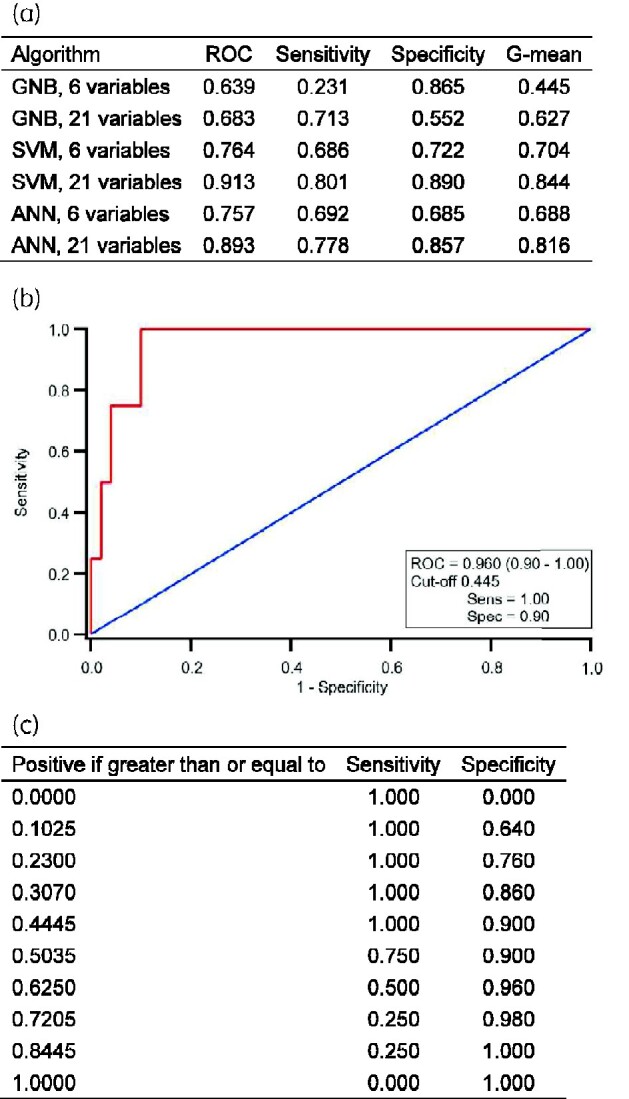
A total of 15 599 daily blood profiles for 1186 individual patients were identified to train the algorithms; 771/1186 (65%) individuals were SARS-CoV-2 PCR positive. Clinically significant microbiology results were present for 166/1186 (14%) patients during admission. An SVM algorithm trained with 21 routine blood test variables and over 8000 individual profiles had the best performance. AUCROC was 0.913, sensitivity 0.801 and specificity 0.890. Prospective testing on 54 patients on admission (28/54, 52% SARS-CoV-2 PCR positive) demonstrated an AUCROC of 0.960 (95% CI: 0.90-1.00).

CONCLUSIONS

An SVM using 21 routine blood test variables had excellent performance at inferring the likelihood of positive microbiology. Further prospective evaluation of the algorithms ability to support decision making for the diagnosis of bacterial infection in COVID-19 cohorts is underway.

摘要

背景

新冠病毒病(COVID-19)患者的细菌感染诊断具有挑战性。我们开发并评估了监督式机器学习算法,以支持对COVID-19大流行期间住院患者继发性细菌感染的诊断。

方法

提取了伦敦三家医院在2020年3月和4月第一波COVID-19疫情期间的住院患者数据。获取了SARS-CoV-2聚合酶链反应(PCR)检测呈阳性和阴性个体的人口统计学、血液检测及微生物学数据。使用接受者操作特征曲线下面积(AUCROC)对高斯朴素贝叶斯、支持向量机(SVM)和人工神经网络进行训练并比较。性能最佳的算法(具有21个血液检测变量的SVM)于2020年7月进行了前瞻性试点。计算入院48小时内微生物样本呈阳性预测的AUCROC。

结果

共识别出1186例个体患者的15599份每日血液检测结果用于训练算法;771/1186(65%)个体SARS-CoV-2 PCR检测呈阳性。166/1186(14%)患者在住院期间有具有临床意义的微生物学检测结果。用21个常规血液检测变量和8000多个个体检测结果训练的SVM算法表现最佳。AUCROC为0.913,敏感性为0.801,特异性为0.890。对54例入院患者(28/54,52% SARS-CoV-2 PCR阳性)进行的前瞻性检测显示AUCROC为0.960(95%置信区间:0.90 - 1.00)。

结论

使用21个常规血液检测变量的SVM在推断微生物学检测呈阳性的可能性方面表现出色。目前正在对这些算法支持COVID-19队列中细菌感染诊断决策的能力进行进一步的前瞻性评估。
https://cdn.ncbi.nlm.nih.gov/pmc/blobs/0e64/8210046/f76e035f0334/dlab002f1.jpg

相似文献

1
Supervised machine learning to support the diagnosis of bacterial infection in the context of COVID-19.在新冠肺炎背景下,使用监督式机器学习辅助细菌感染诊断。
JAC Antimicrob Resist. 2021 Feb 3;3(1):dlab002. doi: 10.1093/jacamr/dlab002. eCollection 2021 Mar.
2
A prospective, randomized, single-blinded, crossover trial to investigate the effect of a wearable device in addition to a daily symptom diary for the remote early detection of SARS-CoV-2 infections (COVID-RED): a structured summary of a study protocol for a randomized controlled trial.一项前瞻性、随机、单盲、交叉试验,旨在研究可穿戴设备对远程早期检测 SARS-CoV-2 感染(COVID-RED)的影响:一项随机对照试验研究方案的结构化总结。
Trials. 2021 Jun 22;22(1):412. doi: 10.1186/s13063-021-05241-5.
3
A prospective, randomized, single-blinded, crossover trial to investigate the effect of a wearable device in addition to a daily symptom diary for the Remote Early Detection of SARS-CoV-2 infections (COVID-RED): a structured summary of a study protocol for a randomized controlled trial.一项前瞻性、随机、单盲、交叉试验,旨在研究可穿戴设备对 SARS-CoV-2 感染(COVID-RED)的远程早期检测的影响:一项随机对照试验研究方案的结构化总结。
Trials. 2021 Oct 11;22(1):694. doi: 10.1186/s13063-021-05643-5.
4
Supervised machine learning for the prediction of infection on admission to hospital: a prospective observational cohort study.基于监督学习的入院时感染预测:一项前瞻性观察队列研究。
J Antimicrob Chemother. 2019 Apr 1;74(4):1108-1115. doi: 10.1093/jac/dky514.
5
Development and External Validation of a Machine Learning Tool to Rule Out COVID-19 Among Adults in the Emergency Department Using Routine Blood Tests: A Large, Multicenter, Real-World Study.利用常规血液检测排除急诊科成人COVID-19的机器学习工具的开发与外部验证:一项大型、多中心、真实世界研究
J Med Internet Res. 2020 Dec 2;22(12):e24048. doi: 10.2196/24048.
6
[Constructing a predictive model for the death risk of patients with septic shock based on supervised machine learning algorithms].基于监督机器学习算法构建脓毒症休克患者死亡风险预测模型
Zhonghua Wei Zhong Bing Ji Jiu Yi Xue. 2024 Apr;36(4):345-352. doi: 10.3760/cma.j.cn121430-20230930-00832.
7
Machine learning algorithms for predicting COVID-19 mortality in Ethiopia.用于预测埃塞俄比亚 COVID-19 死亡率的机器学习算法。
BMC Public Health. 2024 Jun 28;24(1):1728. doi: 10.1186/s12889-024-19196-0.
8
Clinical Features of Emergency Department Patients from Early COVID-19 Pandemic that Predict SARS-CoV-2 Infection: Machine-learning Approach.早期新冠疫情期间急诊科患者的临床特征预测 SARS-CoV-2 感染:机器学习方法。
West J Emerg Med. 2021 Mar 4;22(2):244-251. doi: 10.5811/westjem.2020.12.49370.
9
Application of supervised machine learning algorithms for classification and prediction of type-2 diabetes disease status in Afar regional state, Northeastern Ethiopia 2021.2021 年,埃塞俄比亚东北部阿法尔地区使用监督机器学习算法对 2 型糖尿病疾病状况进行分类和预测。
Sci Rep. 2023 May 13;13(1):7779. doi: 10.1038/s41598-023-34906-1.
10
Predicting mortality in SARS-COV-2 (COVID-19) positive patients in the inpatient setting using a novel deep neural network.利用新型深度神经网络预测住院 SARS-COV-2(COVID-19)阳性患者的死亡率。
Int J Med Inform. 2021 Oct;154:104556. doi: 10.1016/j.ijmedinf.2021.104556. Epub 2021 Aug 21.

引用本文的文献

1
Classifying patients with invasive fungal disease: towards a unified case definition?侵袭性真菌病患者的分类:迈向统一的病例定义?
J Antimicrob Chemother. 2025 Sep 3;80(9):2337-2343. doi: 10.1093/jac/dkaf261.
2
Artificial Intelligence in Infectious Diseases: .传染病中的人工智能:.
Sultan Qaboos Univ Med J. 2025 May 2;25(1):183-185. doi: 10.18295/2075-0528.2828.
3
Data-driven rapid detection of infection through machine learning with limited laboratory parameters in Chinese primary clinics.在中国基层诊所中,通过机器学习利用有限的实验室参数进行数据驱动的感染快速检测。

本文引用的文献

1
Bacterial co-infection and secondary infection in patients with COVID-19: a living rapid review and meta-analysis.COVID-19 患者的细菌合并感染和继发感染:一项实时快速综述和荟萃分析。
Clin Microbiol Infect. 2020 Dec;26(12):1622-1629. doi: 10.1016/j.cmi.2020.07.016. Epub 2020 Jul 22.
2
Antimicrobial use, drug-resistant infections and COVID-19.抗菌药物使用、耐药菌感染与新冠病毒。
Nat Rev Microbiol. 2020 Aug;18(8):409-410. doi: 10.1038/s41579-020-0395-y.
3
Co-infections in people with COVID-19: a systematic review and meta-analysis.
Heliyon. 2024 Aug 2;10(15):e35586. doi: 10.1016/j.heliyon.2024.e35586. eCollection 2024 Aug 15.
4
From Data to Decisions: Leveraging Artificial Intelligence and Machine Learning in Combating Antimicrobial Resistance - a Comprehensive Review.从数据到决策:利用人工智能和机器学习对抗抗菌药物耐药性——全面综述
J Med Syst. 2024 Aug 1;48(1):71. doi: 10.1007/s10916-024-02089-5.
5
Tackling the Antimicrobial Resistance "Pandemic" with Machine Learning Tools: A Summary of Available Evidence.使用机器学习工具应对抗微生物药物耐药性“大流行”:现有证据综述
Microorganisms. 2024 Apr 23;12(5):842. doi: 10.3390/microorganisms12050842.
6
Development and validation of machine learning-based models for predicting healthcare-associated bacterial/fungal infections among COVID-19 inpatients: a retrospective cohort study.基于机器学习的模型用于预测COVID-19住院患者医疗相关细菌/真菌感染的开发与验证:一项回顾性队列研究
Antimicrob Resist Infect Control. 2024 Apr 14;13(1):42. doi: 10.1186/s13756-024-01392-7.
7
Using Machine Learning to Predict Antimicrobial Resistance-A Literature Review.利用机器学习预测抗菌药物耐药性——文献综述
Antibiotics (Basel). 2023 Feb 24;12(3):452. doi: 10.3390/antibiotics12030452.
8
Machine learning and synthetic outcome estimation for individualised antimicrobial cessation.用于个性化抗菌药物停用的机器学习与合成结果估计
Front Digit Health. 2022 Nov 21;4:997219. doi: 10.3389/fdgth.2022.997219. eCollection 2022.
9
Artificial Intelligence in Infection Management in the ICU.人工智能在 ICU 感染管理中的应用。
Crit Care. 2022 Mar 22;26(1):79. doi: 10.1186/s13054-022-03916-2.
COVID-19 患者合并感染:系统评价和荟萃分析。
J Infect. 2020 Aug;81(2):266-275. doi: 10.1016/j.jinf.2020.05.046. Epub 2020 May 27.
4
COVID-19 and the potential long-term impact on antimicrobial resistance.COVID-19 与潜在的长期抗菌药物耐药性影响
J Antimicrob Chemother. 2020 Jul 1;75(7):1681-1684. doi: 10.1093/jac/dkaa194.
5
Bacterial and Fungal Coinfection in Individuals With Coronavirus: A Rapid Review To Support COVID-19 Antimicrobial Prescribing.细菌和真菌合并感染冠状病毒的个体:一项支持 COVID-19 抗菌药物处方的快速综述。
Clin Infect Dis. 2020 Dec 3;71(9):2459-2468. doi: 10.1093/cid/ciaa530.
6
Machine learning for clinical decision support in infectious diseases: a narrative review of current applications.机器学习在传染病临床决策支持中的应用:当前应用的叙述性综述。
Clin Microbiol Infect. 2020 May;26(5):584-595. doi: 10.1016/j.cmi.2019.09.009. Epub 2019 Sep 17.
7
Supervised machine learning for the prediction of infection on admission to hospital: a prospective observational cohort study.基于监督学习的入院时感染预测:一项前瞻性观察队列研究。
J Antimicrob Chemother. 2019 Apr 1;74(4):1108-1115. doi: 10.1093/jac/dky514.
8
Supervised learning for infection risk inference using pathology data.基于病理学数据的感染风险推理的有监督学习。
BMC Med Inform Decis Mak. 2017 Dec 8;17(1):168. doi: 10.1186/s12911-017-0550-1.
9
A systematic review of clinical decision support systems for antimicrobial management: are we failing to investigate these interventions appropriately?临床决策支持系统对抗菌药物管理的系统评价:我们是否未能恰当地研究这些干预措施?
Clin Microbiol Infect. 2017 Aug;23(8):524-532. doi: 10.1016/j.cmi.2017.02.028. Epub 2017 Mar 6.