Mamprin Marco, Lopes Ricardo R, Zelis Jo M, Tonino Pim A L, van Mourik Martijn S, Vis Marije M, Zinger Svitlana, de Mol Bas A J M, de With Peter H N
Department of Electrical Engineering, Eindhoven University of Technology, 5612 AE Eindhoven, The Netherlands.
Department of Biomedical Engineering and Physics, Amsterdam UMC, University of Amsterdam, 1105 AZ Amsterdam, The Netherlands.
J Cardiovasc Dev Dis. 2021 Jun 4;8(6):65. doi: 10.3390/jcdd8060065.
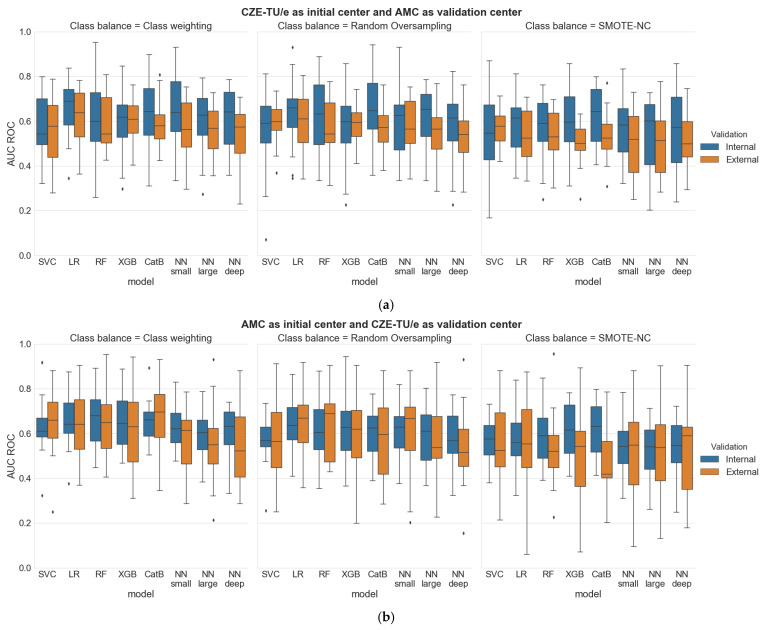
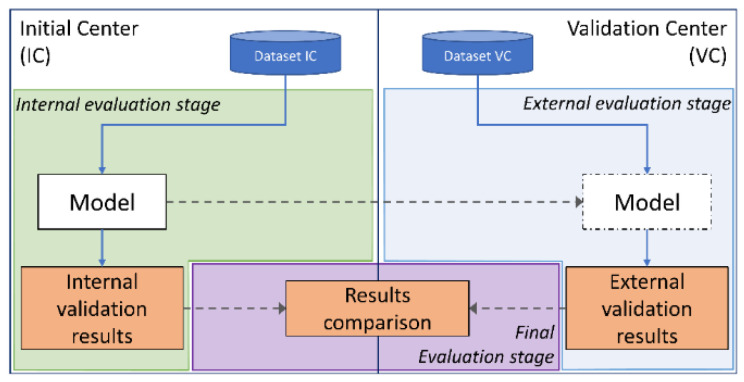
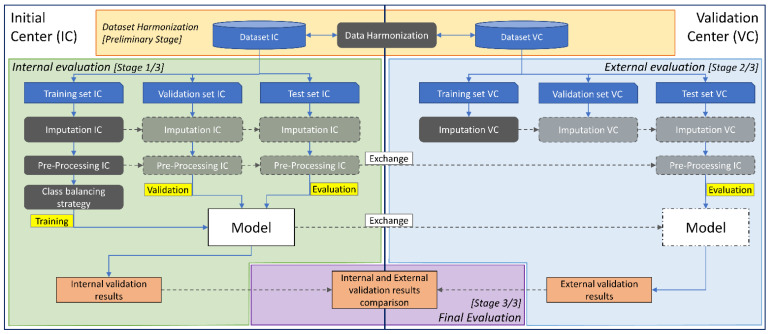
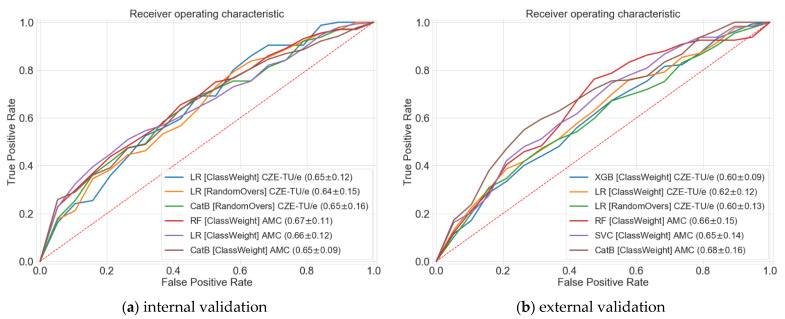
Current prognostic risk scores for transcatheter aortic valve implantation (TAVI) do not benefit yet from modern machine learning techniques, which can improve risk stratification of one-year mortality of patients before TAVI. Despite the advancement of machine learning in healthcare, data sharing regulations are very strict and typically prevent exchanging patient data, without the involvement of ethical committees. A very robust validation approach, including 1300 and 631 patients per center, was performed to validate a machine learning model of one center at the other external center with their data, in a mutual fashion. This was achieved without any data exchange but solely by exchanging the models and the data processing pipelines. A dedicated exchange protocol was designed to evaluate and quantify the model's robustness on the data of the external center. Models developed with the larger dataset offered similar or higher prediction accuracy on the external validation. Logistic regression, random forest and CatBoost lead to areas under curve of the ROC of 0.65, 0.67 and 0.65 for the internal validation and of 0.62, 0.66, 0.68 for the external validation, respectively. We propose a scalable exchange protocol which can be further extended on other TAVI centers, but more generally to any other clinical scenario, that could benefit from this validation approach.
目前经导管主动脉瓣植入术(TAVI)的预后风险评分尚未从现代机器学习技术中获益,而机器学习技术可以改善TAVI术前患者一年死亡率的风险分层。尽管机器学习在医疗保健领域取得了进展,但数据共享规定非常严格,通常会阻止在没有伦理委员会参与的情况下交换患者数据。一种非常稳健的验证方法,每个中心包括1300名和631名患者,以相互的方式在另一个外部中心使用其数据验证一个中心的机器学习模型。这是在没有任何数据交换的情况下实现的,仅通过交换模型和数据处理管道。设计了一个专用的交换协议来评估和量化模型在外部中心数据上的稳健性。使用较大数据集开发的模型在外部验证中提供了相似或更高的预测准确性。逻辑回归、随机森林和CatBoost在内部验证中的ROC曲线下面积分别为0.65、0.67和0.65,在外部验证中的曲线下面积分别为0.62、0.66、0.68。我们提出了一种可扩展的交换协议,可以在其他TAVI中心进一步扩展,但更广泛地适用于任何其他临床场景,这些场景可能会从这种验证方法中受益。