Department of Chemical Engineering, CUCEI, Universidad de Guadalajara, Guadalajara 44430, Mexico.
Colloids and Polymers Physics Group, Department of Particle Physics, Faculty of Physics and Health Research Institute of Santiago de Compostela (IDIS), Universidade de Santiago de Compostela, E-15782 Santiago de Compostela, Spain.
Int J Mol Sci. 2021 Jun 23;22(13):6758. doi: 10.3390/ijms22136758.
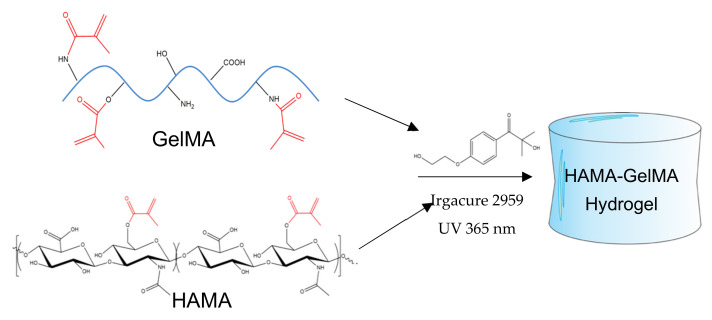
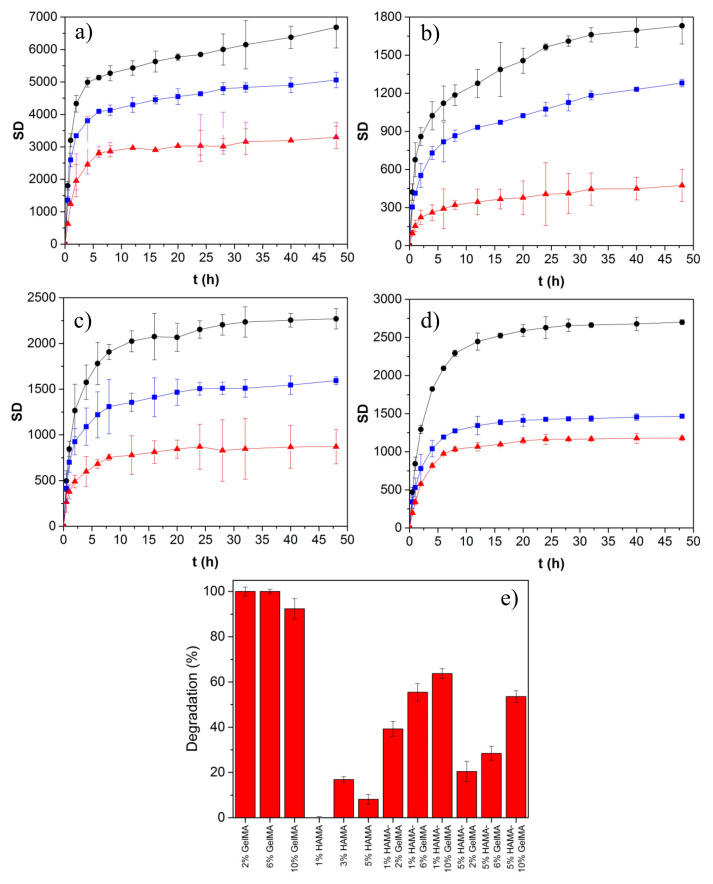
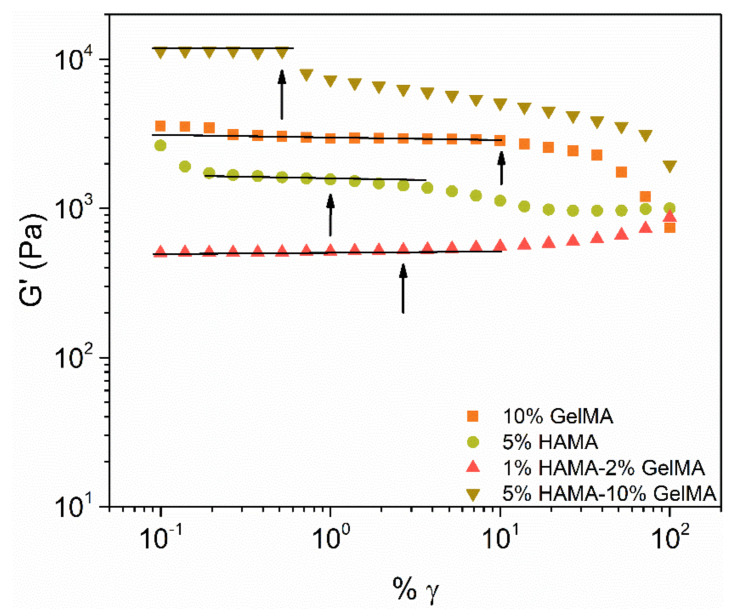
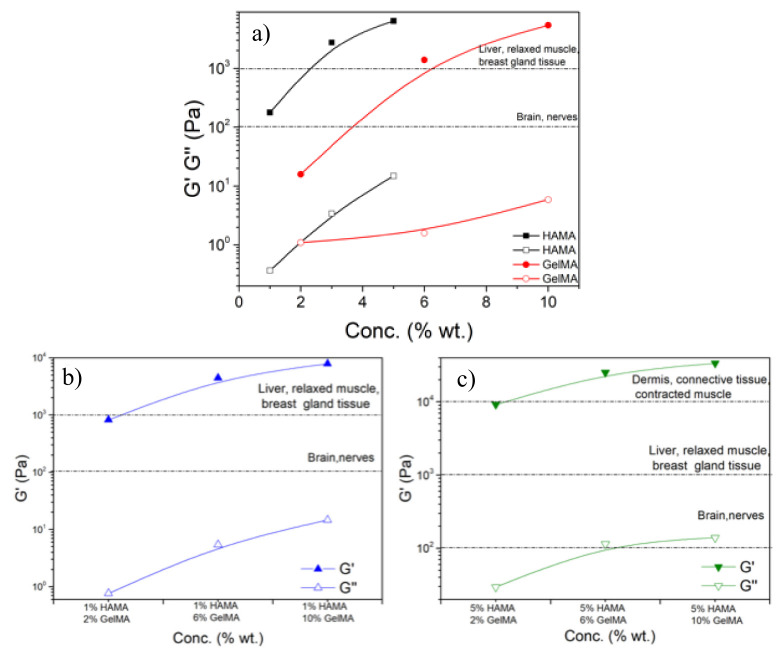
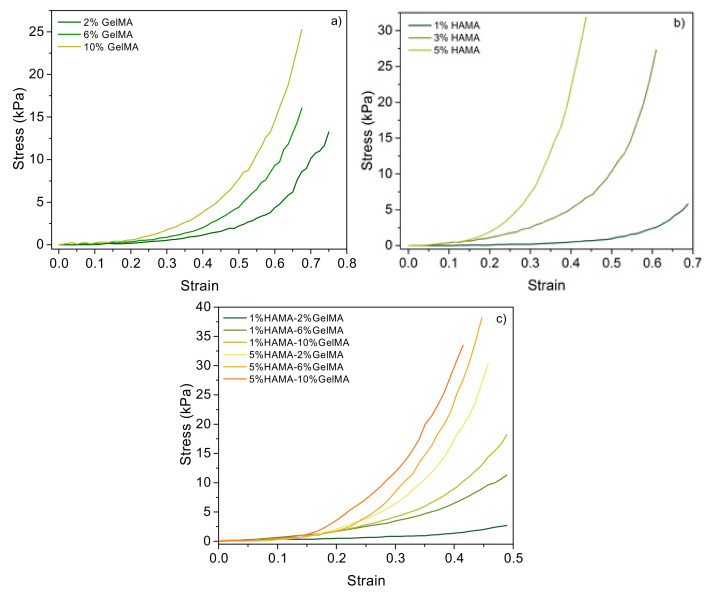
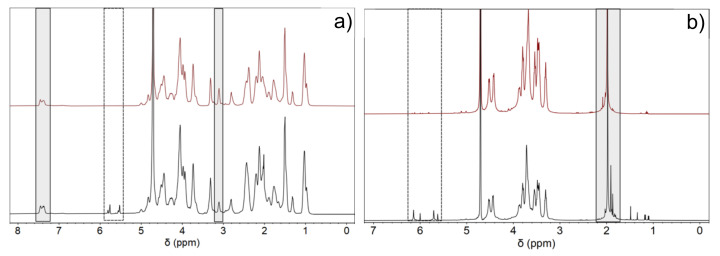
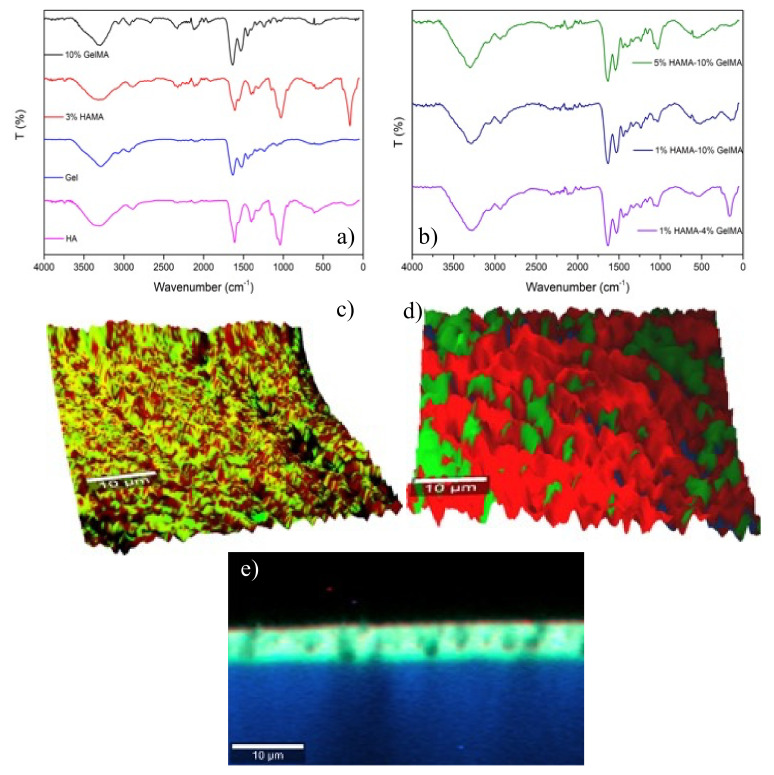
Hyaluronic acid (HA) and gelatin (Gel) are major components of the extracellular matrix of different tissues, and thus are largely appealing for the construction of hybrid hydrogels to combine the favorable characteristics of each biopolymer, such as the gel adhesiveness of Gel and the better mechanical strength of HA, respectively. However, despite previous studies conducted so far, the relationship between composition and scaffold structure and physico-chemical properties has not been completely and systematically established. In this work, pure and hybrid hydrogels of methacroyl-modified HA (HAMA) and Gel (GelMA) were prepared by UV photopolymerization and an extensive characterization was done to elucidate such correlations. Methacrylation degrees of ca. 40% and 11% for GelMA and HAMA, respectively, were obtained, which allows to improve the hydrogels' mechanical properties. Hybrid GelMA/HAMA hydrogels were stiffer, with elastic modulus up to ca. 30 kPa, and porous (up to 91%) compared with pure GelMA ones at similar GelMA concentrations thanks to the interaction between HAMA and GelMA chains in the polymeric matrix. The progressive presence of HAMA gave rise to scaffolds with more disorganized, stiffer, and less porous structures owing to the net increase of mass in the hydrogel compositions. HAMA also made hybrid hydrogels more swellable and resistant to collagenase biodegradation. Hence, the suitable choice of polymeric composition allows to regulate the hydrogels´ physical properties to look for the most optimal characteristics required for the intended tissue engineering application.
透明质酸(HA)和明胶(Gel)是不同组织细胞外基质的主要成分,因此非常适合构建混合水凝胶,将每种生物聚合物的优点结合起来,例如 Gel 的凝胶粘附性和 HA 的更好的机械强度。然而,尽管迄今为止已经进行了许多研究,但组成与支架结构和物理化学性质之间的关系尚未完全系统地建立。在这项工作中,通过紫外光聚合制备了 methacroyl 修饰的 HA(HAMA)和 Gel(GelMA)的纯和混合水凝胶,并进行了广泛的表征以阐明这种相关性。 GelMA 和 HAMA 的甲丙烯酰化程度分别约为 40%和 11%,这可以提高水凝胶的机械性能。与具有相似 GelMA 浓度的纯 GelMA 水凝胶相比,混合 GelMA/HAMA 水凝胶具有更高的刚性,弹性模量高达约 30kPa,且具有更高的多孔性(高达 91%),这是由于在聚合物基质中 HAMA 与 GelMA 链之间的相互作用。由于水凝胶组成中的质量净增加,逐渐存在 HAMA 导致支架结构更加无序、刚性和多孔性降低。HAMA 还使混合水凝胶具有更高的溶胀性和抵抗胶原酶降解的能力。因此,适当选择聚合物组成可以调节水凝胶的物理性质,以寻找最适合预期组织工程应用的最佳特性。