CREA Council for Agricultural Research and Economics-Research Centre for Food and Nutrition, Via Ardeatina 546, 00178 Rome, Italy.
Nutrients. 2021 Jun 30;13(7):2279. doi: 10.3390/nu13072279.
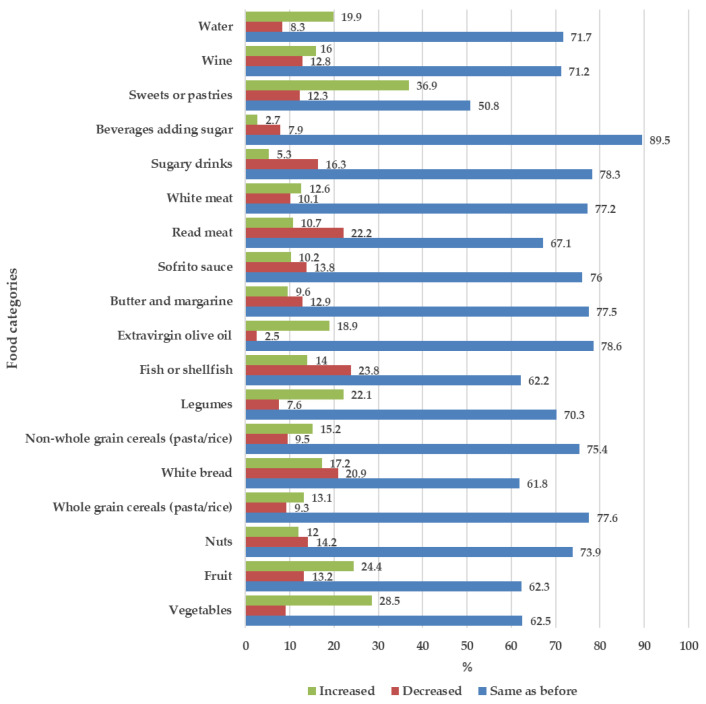
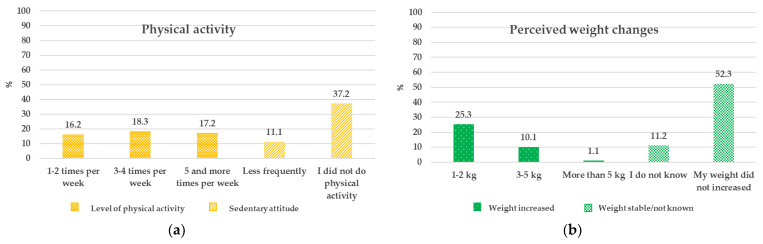
To limit the spread of coronavirus SARS-CoV-2, a nationwide lockdown started in Italy in March 2020. In this unpredictable situation, a cross-sectional study using an online questionnaire was carried out by the Observatory on Food Surplus, Recovery and Waste of CREA Food and Nutrition Centre. The aim of this work was to evaluate how Italian habits changed during this period, the determinants of changes, and the effect on food waste prevention. In a sample of 2678 respondents, 62% showed low Adherence to the Mediterranean Diet (AMD). During lockdown many of participants improved the quality of their diet, increasing their consumption of fruit (24.4%), vegetables (28.5%), legumes (22.1%), nuts (12%), and fish or shellfish (14%). Unfavorable changes were observed with the excessive consumption of sweets or pastries (36.9%) and comfort foods (22.7%), and a lack of physical activity (37.2%). The main novelty of this study was the examination of dietary changes identified by a cluster analysis. Respondents with generally high AMD improved their eating habits, while the habits of the respondents with generally low AMD remained unchanged. In addition, nearly 80% of respondents were sensitive to food waste. The study provides a useful contribution to the debate on nutritional recommendations in case of further lockdown.
为了限制冠状病毒 SARS-CoV-2 的传播,意大利于 2020 年 3 月开始全国封锁。在这种不可预测的情况下,意大利农业政策研究所食品与营养中心的食品过剩、回收和浪费观察站利用在线问卷进行了一项横断面研究。这项工作的目的是评估意大利人在这段时间里的习惯如何改变、改变的决定因素以及对防止食物浪费的影响。在 2678 名受访者的样本中,62%的人对地中海饮食(AMD)的依从性较低。在封锁期间,许多参与者改善了他们的饮食质量,增加了水果(24.4%)、蔬菜(28.5%)、豆类(22.1%)、坚果(12%)和鱼或贝类(14%)的摄入量。然而,人们也观察到了一些不利的变化,如甜食或糕点(36.9%)和舒适食品(22.7%)的过度消费,以及缺乏身体活动(37.2%)。这项研究的主要新颖之处在于通过聚类分析检查了饮食变化。一般来说,AMD 水平较高的受访者改善了他们的饮食习惯,而 AMD 水平一般较低的受访者的饮食习惯则保持不变。此外,近 80%的受访者对食物浪费很敏感。该研究为进一步封锁期间的营养建议提供了有益的贡献。