Awogbindin Ifeoluwa O, Ben-Azu Benneth, Olusola Babatunde A, Akinluyi Elizabeth T, Adeniyi Philip A, Di Paolo Therese, Tremblay Marie-Ève
Division of Medical Sciences, University of Victoria, Victoria, BC, Canada.
Neuroimmunology Group, Molecular Drug Metabolism and Toxicology Laboratory, Department of Biochemistry, College of Medicine, University of Ibadan, Ibadan, Nigeria.
Front Cell Neurosci. 2021 Jun 15;15:670298. doi: 10.3389/fncel.2021.670298. eCollection 2021.
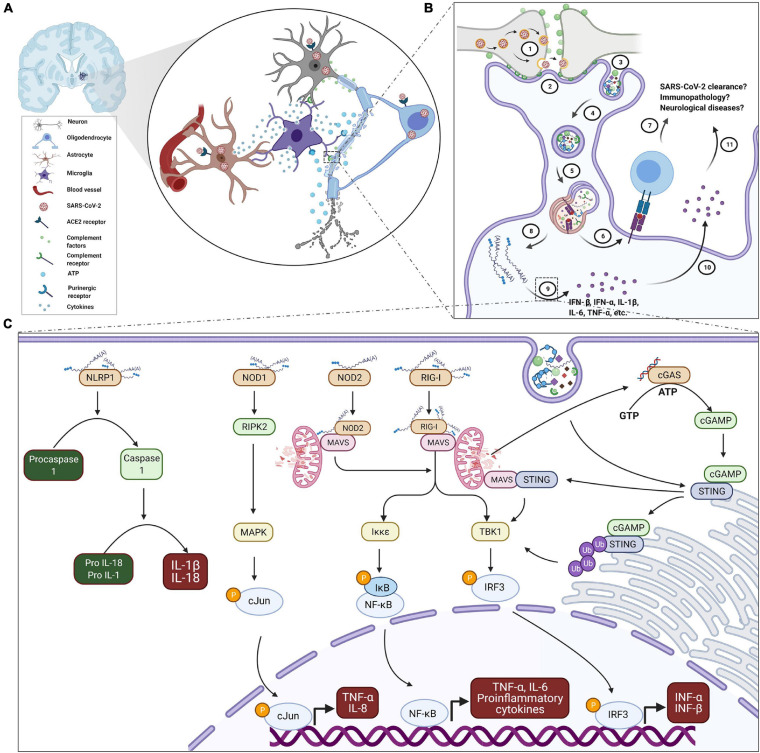
Since December 2019, humankind has been experiencing a ravaging severe acute respiratory syndrome coronavirus 2 (SARS-CoV-2) outbreak, the second coronavirus pandemic in a decade after the Middle East respiratory syndrome coronavirus (MERS-CoV) disease in 2012. Infection with SARS-CoV-2 results in Coronavirus disease 2019 (COVID-19), which is responsible for over 3.1 million deaths worldwide. With the emergence of a second and a third wave of infection across the globe, and the rising record of multiple reinfections and relapses, SARS-CoV-2 infection shows no sign of abating. In addition, it is now evident that SARS-CoV-2 infection presents with neurological symptoms that include early hyposmia, ischemic stroke, meningitis, delirium and falls, even after viral clearance. This may suggest chronic or permanent changes to the neurons, glial cells, and/or brain vasculature in response to SARS-CoV-2 infection or COVID-19. Within the central nervous system (CNS), microglia act as the central housekeepers against altered homeostatic states, including during viral neurotropic infections. In this review, we highlight microglial responses to viral neuroinfections, especially those with a similar genetic composition and route of entry as SARS-CoV-2. As the primary sensor of viral infection in the CNS, we describe the pathogenic and neuroinvasive mechanisms of RNA viruses and SARS-CoV-2 vis-à-vis the microglial means of viral recognition. Responses of microglia which may culminate in viral clearance or immunopathology are also covered. Lastly, we further discuss the implication of SARS-CoV-2 CNS invasion on microglial plasticity and associated long-term neurodegeneration. As such, this review provides insight into some of the mechanisms by which microglia could contribute to the pathophysiology of post-COVID-19 neurological sequelae and disorders, including Parkinson's disease, which could be pervasive in the coming years given the growing numbers of infected and re-infected individuals globally.
自2019年12月以来,人类一直在经历严重急性呼吸综合征冠状病毒2(SARS-CoV-2)肆虐的疫情,这是继2012年中东呼吸综合征冠状病毒(MERS-CoV)疾病之后十年内的第二次冠状病毒大流行。感染SARS-CoV-2会导致2019冠状病毒病(COVID-19),该病在全球已造成超过310万人死亡。随着全球第二波和第三波感染的出现,以及多次再感染和复发记录的增加,SARS-CoV-2感染没有减弱的迹象。此外,现在很明显,即使病毒清除后,SARS-CoV-2感染仍会出现神经症状,包括早期嗅觉减退、缺血性中风、脑膜炎、谵妄和跌倒。这可能表明神经元、神经胶质细胞和/或脑血管对SARS-CoV-2感染或COVID-19有慢性或永久性变化。在中枢神经系统(CNS)中,小胶质细胞充当抵御内环境稳态改变的核心守护者,包括在病毒嗜神经性感染期间。在这篇综述中,我们重点介绍小胶质细胞对病毒神经感染的反应,特别是那些与SARS-CoV-2具有相似基因组成和进入途径的感染。作为中枢神经系统中病毒感染的主要传感器,我们描述RNA病毒和SARS-CoV-2相对于小胶质细胞病毒识别方式的致病和神经侵袭机制。还涵盖了可能最终导致病毒清除或免疫病理的小胶质细胞反应。最后,我们进一步讨论SARS-CoV-2侵入中枢神经系统对小胶质细胞可塑性和相关长期神经退行性变的影响。因此,这篇综述深入探讨了小胶质细胞可能导致COVID-19后神经后遗症和疾病病理生理学的一些机制,包括帕金森病,鉴于全球感染和再感染人数不断增加,未来几年这种疾病可能会普遍存在。