Chary Sowmya, Amrein Karin, Soeteman Djøra I, Mehta Sangeeta, Christopher Kenneth B
Biogen, Inc., 225 Binney St, Cambridge, MA, 02142, USA.
Division of Endocrinology and Diabetology, Medical University of Graz, Auenbruggerplatz 15, 8036, Graz, Austria.
Ann Intensive Care. 2021 Jul 2;11(1):103. doi: 10.1186/s13613-021-00889-3.
Bibliometric analyses show gender bias against women in scientific publications and citations. We hypothesized that a metric of an individual senior author's inclusivity of women as first authors in critical care publications would predict gender inequality.
Using PubMed and Web of Science, we conducted a bibliometric analysis of original research publications in critical care from 2008 to 2018 in 11 specialty and general journals. Gender for first and senior authors was assigned by a gender determination application, and manually if needed. For all senior authors we defined the novel Female First Author Index (FFA-index) = #Female first authors in publications by an individual senior author/Total # publications by that senior author. We produced a novel interactive web-based application using the R package Shiny to increase potential utilization of the FFA-index.
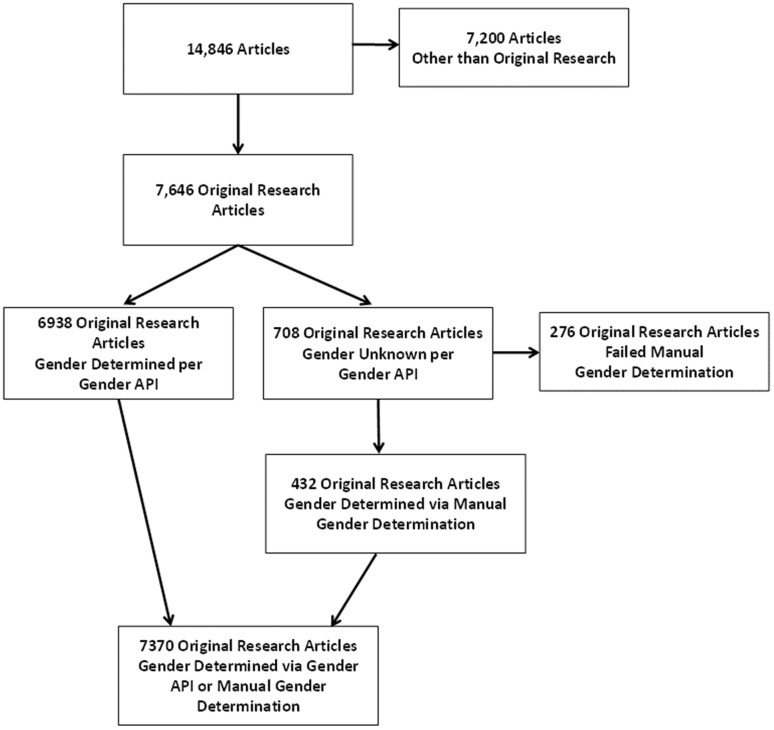
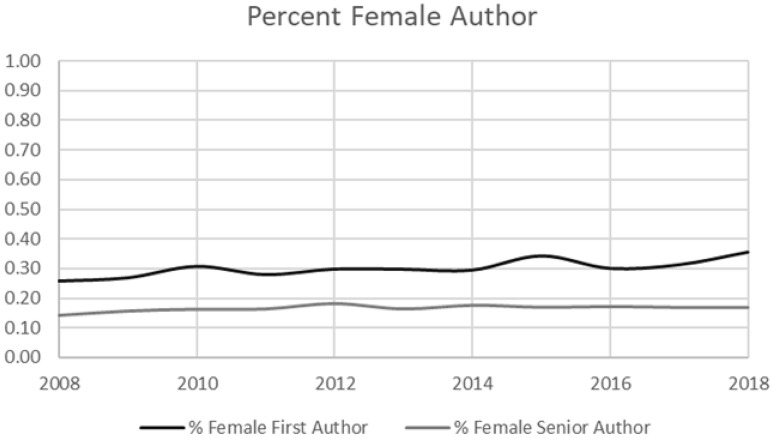
Of 7370 publications, 30.4% had female first authors and 15.5% had female senior authors. After adjustment for impact factor, journal, year of publication, number of authors, country, and gender determination accuracy, female senior authorship was associated with a 1.9-fold increase in female first authorship [OR = 1.85 (95% CI 1.62, 2.11); p < 0.001] compared with male senior authorship. The mean (SD) FFA-index for all individual senior authors was 30.5 (42.9); with a significant difference in FFA-index between male and female senior authors (27.6 versus 42.5, respectively; p < 0.001). The interactive web-based application (FFA-index App) produces the same FFA-index output as our study results.
Female representation at prominent authorship positions in critical care publications is still far from achieving gender parity. By creating an authorship index score, we propose a frame of reference for the advancement of female first authorship.
文献计量分析表明,科学出版物及引用方面存在对女性的性别偏见。我们推测,在重症医学出版物中,以女性作为第一作者的个体资深作者包容性指标可预测性别不平等情况。
利用PubMed和科学网,我们对2008年至2018年11种专业及综合性期刊上发表的重症医学原创研究出版物进行了文献计量分析。第一作者和资深作者的性别由性别判定应用程序确定,必要时进行人工判定。对于所有资深作者,我们定义了新的女性第一作者指数(FFA指数)=个体资深作者出版物中的女性第一作者数量/该资深作者的出版物总数。我们使用R包Shiny制作了一个基于网络的新型交互式应用程序,以提高FFA指数的潜在利用率。
在7370篇出版物中,30.4%的第一作者为女性,15.5%的资深作者为女性。在对影响因子、期刊、出版年份、作者数量、国家和性别判定准确性进行调整后,与男性资深作者相比,女性资深作者的女性第一作者比例增加了1.9倍[比值比=1.85(95%置信区间1.62,2.11);P<0.001]。所有个体资深作者的平均(标准差)FFA指数为30.5(42.9);男性和女性资深作者的FFA指数存在显著差异(分别为27.6和42.5;P<0.001)。基于网络的交互式应用程序(FFA指数应用程序)产生的FFA指数输出与我们的研究结果相同。
在重症医学出版物中,女性在重要作者职位上的代表性仍远未实现性别平等。通过创建一个作者指数得分,我们为提高女性第一作者地位提出了一个参考框架。