• 文献检索
  • 文档翻译
  • 深度研究
  • 学术资讯
  • Suppr Zotero 插件Zotero 插件
  • 邀请有礼
  • 套餐&价格
  • 历史记录
应用&插件
Suppr Zotero 插件Zotero 插件浏览器插件Mac 客户端Windows 客户端微信小程序
定价
高级版会员购买积分包购买API积分包
服务
文献检索文档翻译深度研究API 文档MCP 服务
关于我们
关于 Suppr公司介绍联系我们用户协议隐私条款
关注我们

Suppr 超能文献

核心技术专利:CN118964589B侵权必究
粤ICP备2023148730 号-1Suppr @ 2026

文献检索

告别复杂PubMed语法,用中文像聊天一样搜索,搜遍4000万医学文献。AI智能推荐,让科研检索更轻松。

立即免费搜索

文件翻译

保留排版,准确专业,支持PDF/Word/PPT等文件格式,支持 12+语言互译。

免费翻译文档

深度研究

AI帮你快速写综述,25分钟生成高质量综述,智能提取关键信息,辅助科研写作。

立即免费体验

重度幼儿龋患儿龈上菌斑和口腔拭子微生物群的特征分析

Characterization of Supragingival Plaque and Oral Swab Microbiomes in Children With Severe Early Childhood Caries.

作者信息

de Jesus Vivianne Cruz, Khan Mohd Wasif, Mittermuller Betty-Anne, Duan Kangmin, Hu Pingzhao, Schroth Robert J, Chelikani Prashen

机构信息

Manitoba Chemosensory Biology Research Group, Department of Oral Biology, University of Manitoba, Winnipeg, MB, Canada.

Children's Hospital Research Institute of Manitoba (CHRIM), Winnipeg, MB, Canada.

出版信息

Front Microbiol. 2021 Jun 25;12:683685. doi: 10.3389/fmicb.2021.683685. eCollection 2021.

DOI:10.3389/fmicb.2021.683685
PMID:34248903
原文链接:https://pmc.ncbi.nlm.nih.gov/articles/PMC8267818/
Abstract

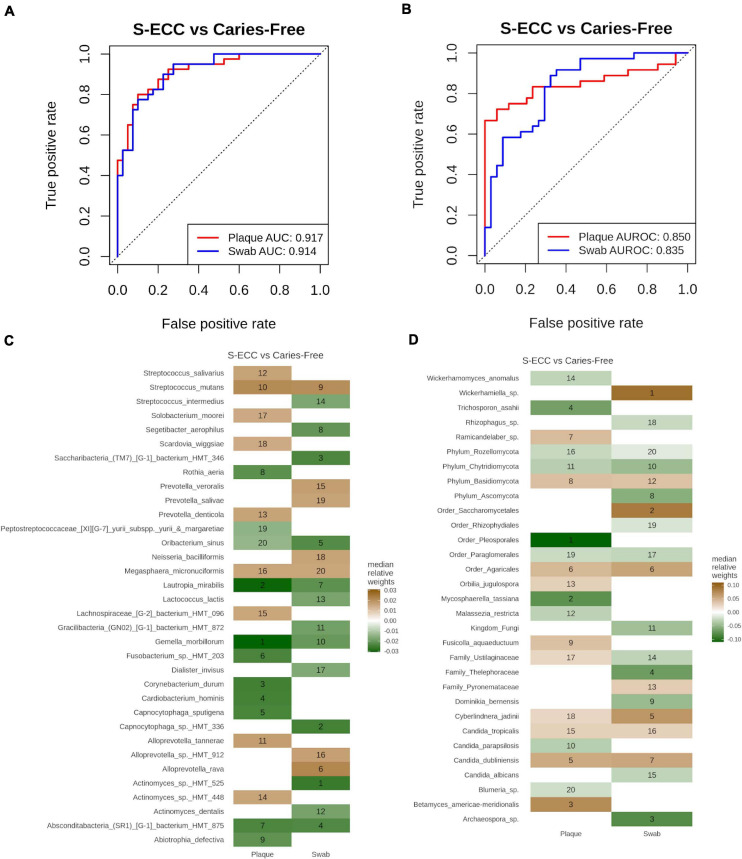
The human oral cavity harbors one of the most diverse microbial communities with different oral microenvironments allowing the colonization of unique microbial species. This study aimed to determine which of two commonly used sampling sites (dental plaque vs. oral swab) would provide a better prediction model for caries-free vs. severe early childhood caries (S-ECC) using next generation sequencing and machine learning (ML). In this cross-sectional study, a total of 80 children (40 S-ECC and 40 caries-free) < 72 months of age were recruited. Supragingival plaque and oral swab samples were used for the amplicon sequencing of the V4-16S rRNA and ITS1 rRNA genes. The results showed significant differences in alpha and beta diversity between dental plaque and oral swab bacterial and fungal microbiomes. Differential abundance analyses showed that, among others, the cariogenic species was enriched in the dental plaque, compared to oral swabs, of children with S-ECC. The fungal species and were more abundant in the oral swab samples of children with S-ECC compared to caries-free controls. They were also among the top 20 most important features for the classification of S-ECC vs. caries-free in oral swabs and for the classification of dental plaque vs. oral swab in the S-ECC group. ML approaches revealed the possibility of classifying samples according to both caries status and sampling sites. The tested site of sample collection did not change the predictability of the disease. However, the species considered to be important for the classification of disease in each sampling site were slightly different. Being able to determine the origin of the samples could be very useful during the design of oral microbiome studies. This study provides important insights into the differences between the dental plaque and oral swab bacteriome and mycobiome of children with S-ECC and those caries-free.

摘要

人类口腔中存在着最多样化的微生物群落之一,不同的口腔微环境使得独特的微生物物种得以定植。本研究旨在确定两种常用的采样部位(牙菌斑与口腔拭子)中哪一种能利用下一代测序和机器学习(ML)为无龋与重度幼儿早期龋(S-ECC)提供更好的预测模型。在这项横断面研究中,共招募了80名年龄小于72个月的儿童(40名S-ECC患儿和40名无龋儿童)。龈上菌斑和口腔拭子样本用于V4-16S rRNA和ITS1 rRNA基因的扩增子测序。结果显示,牙菌斑和口腔拭子的细菌和真菌微生物群在α和β多样性上存在显著差异。差异丰度分析表明,与口腔拭子相比,S-ECC患儿的牙菌斑中致龋菌等物种富集。与无龋对照组相比,S-ECC患儿的口腔拭子样本中真菌物种和更为丰富。它们也是口腔拭子中S-ECC与无龋分类以及S-ECC组中牙菌斑与口腔拭子分类的前20个最重要特征之一。ML方法揭示了根据龋病状态和采样部位对样本进行分类的可能性。测试的样本采集部位并未改变疾病的可预测性。然而,在每个采样部位被认为对疾病分类重要的物种略有不同。在口腔微生物组研究设计过程中,能够确定样本来源可能非常有用。本研究为S-ECC患儿和无龋患儿的牙菌斑与口腔拭子细菌群落和真菌群落之间的差异提供了重要见解。
https://cdn.ncbi.nlm.nih.gov/pmc/blobs/133b/8267818/675f4e51a5c8/fmicb-12-683685-g005.jpg

相似文献

1
Characterization of Supragingival Plaque and Oral Swab Microbiomes in Children With Severe Early Childhood Caries.重度幼儿龋患儿龈上菌斑和口腔拭子微生物群的特征分析
Front Microbiol. 2021 Jun 25;12:683685. doi: 10.3389/fmicb.2021.683685. eCollection 2021.
2
Sex-Based Diverse Plaque Microbiota in Children with Severe Caries.性别相关的儿童重度龋齿菌斑微生物组多样性。
J Dent Res. 2020 Jun;99(6):703-712. doi: 10.1177/0022034520908595. Epub 2020 Feb 28.
3
Association between Oral Candida and Bacteriome in Children with Severe ECC.儿童重度 ECC 中口腔念珠菌与细菌组的相关性。
J Dent Res. 2018 Dec;97(13):1468-1476. doi: 10.1177/0022034518790941. Epub 2018 Jul 26.
4
Site-Specific Profiling of the Dental Mycobiome Reveals Strong Taxonomic Shifts during Progression of Early-Childhood Caries.口腔微生物组的特定部位分析显示,在儿童早期龋病进展过程中存在强烈的分类学变化。
Appl Environ Microbiol. 2020 Mar 18;86(7). doi: 10.1128/AEM.02825-19.
5
Microbiome Associated with Severe Caries in Canadian First Nations Children.加拿大原住民儿童重度龋齿相关的微生物群
J Dent Res. 2017 Nov;96(12):1378-1385. doi: 10.1177/0022034517718819. Epub 2017 Jul 14.
6
Evaluating the ecological hypothesis: early life salivary microbiome assembly predicts dental caries in a longitudinal case-control study.评估生态假说:纵向病例对照研究中,早期唾液微生物组装配可预测龋齿。
Microbiome. 2022 Dec 26;10(1):240. doi: 10.1186/s40168-022-01442-5.
7
Role of socioeconomic factors and interkingdom crosstalk in the dental plaque microbiome in early childhood caries.社会经济因素和种间串扰在幼儿龋病牙菌斑微生物组中的作用。
Cell Rep. 2024 Aug 27;43(8):114635. doi: 10.1016/j.celrep.2024.114635. Epub 2024 Aug 17.
8
Candida albicans Carriage in Children with Severe Early Childhood Caries (S-ECC) and Maternal Relatedness.重度幼儿龋(S-ECC)患儿白色念珠菌携带情况及其与母亲的相关性
PLoS One. 2016 Oct 14;11(10):e0164242. doi: 10.1371/journal.pone.0164242. eCollection 2016.
9
Comparison of the salivary and dentinal microbiome of children with severe-early childhood caries to the salivary microbiome of caries-free children.比较严重婴幼儿龋儿童的唾液和牙本质微生物组与无龋儿童的唾液微生物组。
BMC Oral Health. 2019 Jan 14;19(1):13. doi: 10.1186/s12903-018-0693-1.
10
Microbiomes of Site-Specific Dental Plaques from Children with Different Caries Status.不同龋病状态儿童特定部位牙菌斑的微生物群
Infect Immun. 2017 Jul 19;85(8). doi: 10.1128/IAI.00106-17. Print 2017 Aug.

引用本文的文献

1
Oral microbiome diversity and composition before and after chemotherapy treatment in pediatric oncology patients.儿科肿瘤患者化疗前后口腔微生物群的多样性和组成
BMC Oral Health. 2025 Jul 2;25(1):981. doi: 10.1186/s12903-025-06405-4.
2
A cross-cohort analysis of dental plaque microbiome in early childhood caries.幼儿龋齿中牙菌斑微生物群的跨队列分析。
iScience. 2024 Jul 4;27(8):110447. doi: 10.1016/j.isci.2024.110447. eCollection 2024 Aug 16.
3
A comparative study of microbial changes in dental plaque before and after single- and multiappointment treatments in patients with severe early childhood caries.

本文引用的文献

1
The pulmonary mycobiome-A study of subjects with and without chronic obstructive pulmonary disease.肺部真菌组群——慢阻肺患者与非慢阻肺患者的研究
PLoS One. 2021 Apr 7;16(4):e0248967. doi: 10.1371/journal.pone.0248967. eCollection 2021.
2
Microbiome meta-analysis and cross-disease comparison enabled by the SIAMCAT machine learning toolbox.通过 SIAMCAT 机器学习工具箱进行微生物组荟萃分析和跨疾病比较。
Genome Biol. 2021 Mar 30;22(1):93. doi: 10.1186/s13059-021-02306-1.
3
A Machine Learning Approach to Uncovering Hidden Utilization Patterns of Early Childhood Dental Care Among Medicaid-Insured Children.
一项关于严重婴幼儿早期龋齿患者单次和多次就诊治疗前后牙菌斑微生物变化的对比研究。
BMC Oral Health. 2024 Jun 15;24(1):695. doi: 10.1186/s12903-024-04458-5.
4
Early life factors and oral microbial signatures define the risk of caries in a Swedish cohort of preschool children.早期生活因素和口腔微生物特征可定义瑞典学龄前儿童龋齿的患病风险。
Sci Rep. 2024 Apr 11;14(1):8463. doi: 10.1038/s41598-024-59126-z.
5
-acyl homoserine lactone signaling modulates bacterial community associated with human dental plaque.酰基高丝氨酸内酯信号传导调节与人类牙菌斑相关的细菌群落。
bioRxiv. 2024 Mar 15:2024.03.15.585217. doi: 10.1101/2024.03.15.585217.
6
A toolbox of machine learning software to support microbiome analysis.一个支持微生物组分析的机器学习软件工具箱。
Front Microbiol. 2023 Nov 22;14:1250806. doi: 10.3389/fmicb.2023.1250806. eCollection 2023.
7
Personalized Medicine in Oral Oncology: Imaging Methods and Biological Markers to Support Diagnosis of Oral Squamous Cell Carcinoma (OSCC): A Narrative Literature Review.口腔肿瘤学中的个性化医疗:支持口腔鳞状细胞癌(OSCC)诊断的成像方法和生物标志物:一项叙述性文献综述
J Pers Med. 2023 Sep 19;13(9):1397. doi: 10.3390/jpm13091397.
8
, but not other bacterial taxa, are associated with childhood caries regardless of age in a South China population.但无论年龄如何,在中国南方人群中,与儿童龋病相关的是 ,而不是其他细菌分类群。
PeerJ. 2023 Jun 26;11:e15605. doi: 10.7717/peerj.15605. eCollection 2023.
9
Correlation between caries activity and salivary microbiota in preschool children.学龄前儿童龋齿活动与唾液微生物群的相关性。
Front Cell Infect Microbiol. 2023 Apr 11;13:1141474. doi: 10.3389/fcimb.2023.1141474. eCollection 2023.
10
Can salivary microbiome become a biodetector for type-2 diabetes? Opinion for future implications and strategies.唾液微生物群能成为2型糖尿病的生物探测器吗?对未来影响和策略的见解。
Front Nutr. 2023 Jan 19;10:1113591. doi: 10.3389/fnut.2023.1113591. eCollection 2023.
机器学习方法揭示医疗补助保险儿童早期牙科保健的隐藏利用模式。
Front Public Health. 2021 Jan 18;8:599187. doi: 10.3389/fpubh.2020.599187. eCollection 2020.
4
Bacterial diversity and functional analysis of severe early childhood caries and recurrence in India.印度严重婴幼儿早期龋及其复发的细菌多样性和功能分析。
Sci Rep. 2020 Dec 4;10(1):21248. doi: 10.1038/s41598-020-78057-z.
5
Maturation of the gut microbiome during the first year of life contributes to the protective farm effect on childhood asthma.生命早期肠道微生物组的成熟促进了保护性农场效应对儿童哮喘的作用。
Nat Med. 2020 Nov;26(11):1766-1775. doi: 10.1038/s41591-020-1095-x. Epub 2020 Nov 2.
6
Saliva in the Diagnosis of COVID-19: A Review and New Research Directions.唾液在 COVID-19 诊断中的应用:综述及新的研究方向。
J Dent Res. 2020 Dec;99(13):1435-1443. doi: 10.1177/0022034520960070. Epub 2020 Sep 16.
7
Critically Appraising the Significance of the Oral Mycobiome.口腔微生物组的重要性评价
J Dent Res. 2021 Feb;100(2):133-140. doi: 10.1177/0022034520956975. Epub 2020 Sep 13.
8
COVID-19 salivary signature: diagnostic and research opportunities.新冠病毒唾液特征:诊断与研究机遇
J Clin Pathol. 2020 Aug 7. doi: 10.1136/jclinpath-2020-206834.
9
Associations between early childhood caries, malnutrition and anemia: a global perspective.幼儿龋齿、营养不良与贫血之间的关联:全球视角
BMC Nutr. 2020 May 4;6:16. doi: 10.1186/s40795-020-00340-z. eCollection 2020.
10
Defining the oral microbiome by whole-genome sequencing and resistome analysis: the complexity of the healthy picture.通过全基因组测序和抗药基因组分析定义口腔微生物组:健康状况的复杂性。
BMC Microbiol. 2020 May 18;20(1):120. doi: 10.1186/s12866-020-01801-y.