IHEM, Universidad Nacional de Cuyo, CONICET, Casilla de Correo 33, 5500 Mendoza, Argentina; Universidad Nacional de Cuyo, Facultad de Ciencias Médicas, Instituto de Fisiología, Casilla de Correo 33, 5500 Mendoza, Argentina; Universidad Nacional de Villa Mercedes, Escuela de Ciencias de la Salud-Medicina, Departamento de Ciencias Básicas, 5730 San Luis, Argentina.
Universidad Nacional de Cuyo, Facultad de Ciencias Médicas, Instituto de Fisiología, Casilla de Correo 33, 5500 Mendoza, Argentina.
Sci Total Environ. 2021 Nov 20;796:148887. doi: 10.1016/j.scitotenv.2021.148887. Epub 2021 Jul 7.
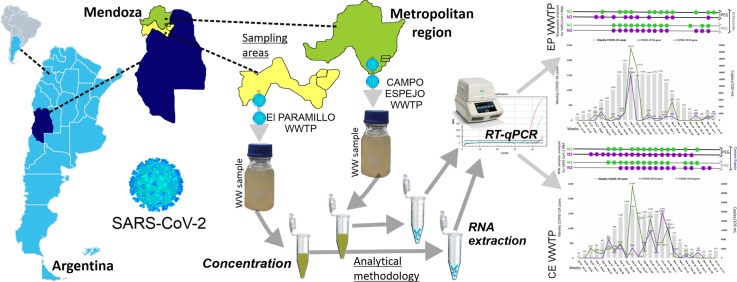
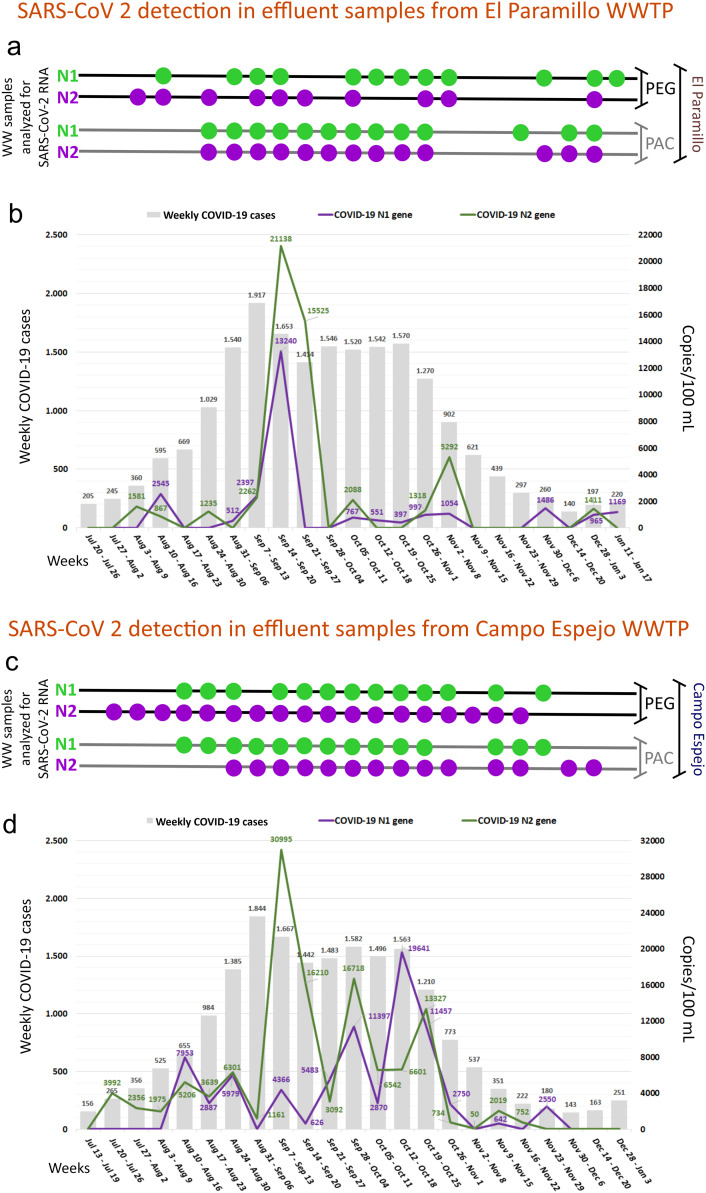
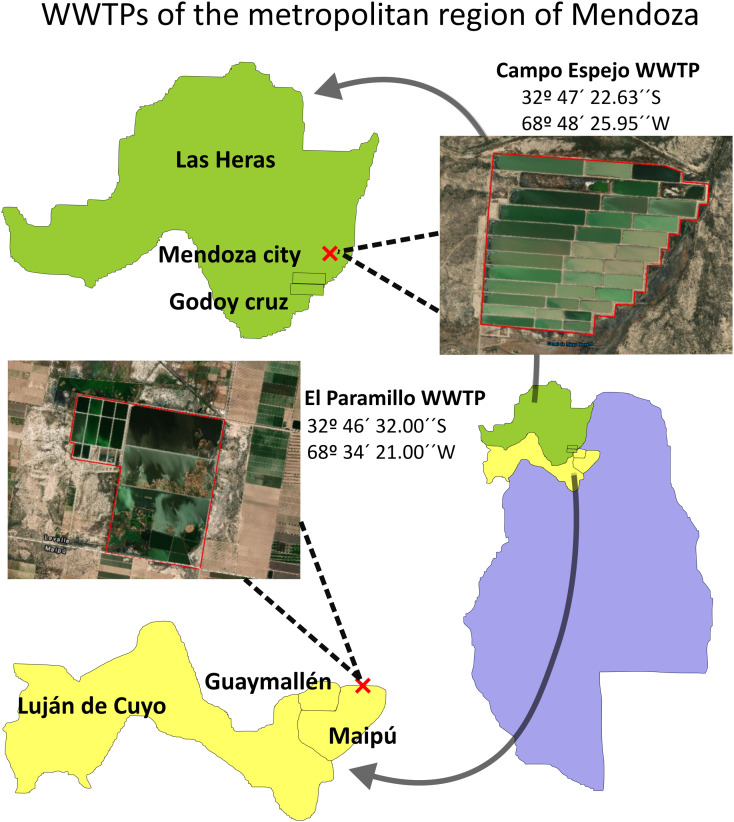
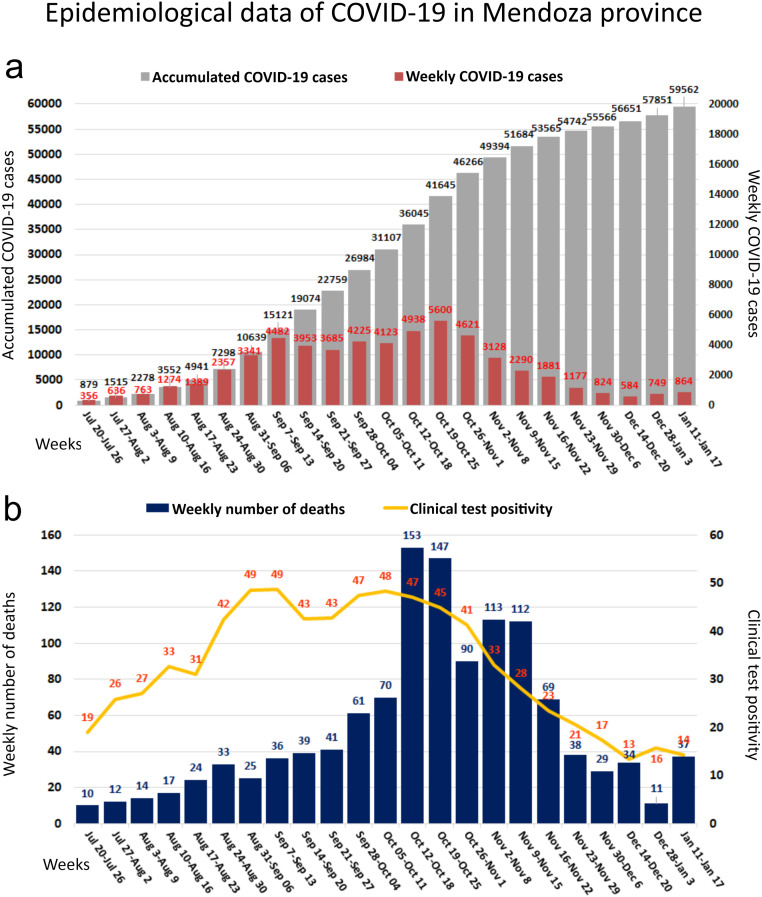
Wastewater-based epidemiology (WBE) is an emerging tool that gives temporal and spatial information on a population's health status. Here, we report the epidemiological dynamics of a population of ~1.2 million residents in the metropolitan region of Mendoza province, Argentina, within the period July 2020 to January 2021. We combined the use of WBE of two wastewater treatment plants with epidemiological surveillance of the corresponding populations. We applied two viral concentration methods (polyethylene glycol precipitation and aluminum-based adsorption-flocculation) and RNA isolation methods in each wastewater sample to increase the possibility of detection and quantification of nucleocapsid markers (N1 and N2) of SARS-CoV-2 by RT-qPCR. Overall, our results allowed us to trace the rise, exponential growth, plateau, and fall of SARS-CoV-2 infections for 26 weeks. Individual analysis for each wastewater treatment plant showed a positive correlation between the viral load of SARS-CoV-2 genetic markers and COVID-19 cases that were diagnosed per week. Our findings indicate that WBE is a useful epidemiological indicator to anticipate the increase in COVID-19 cases and monitor the advance of the pandemic and different waves of infections.
基于污水的流行病学(WBE)是一种新兴的工具,可以提供有关人群健康状况的时间和空间信息。在这里,我们报告了 2020 年 7 月至 2021 年 1 月期间,阿根廷门多萨省大都市区约 120 万居民的人口流行病学动态。我们结合了使用两个污水处理厂的 WBE 和相应人群的流行病学监测。我们在每个污水样本中应用了两种病毒浓缩方法(聚乙二醇沉淀和基于铝的吸附-絮凝)和 RNA 分离方法,以增加通过 RT-qPCR 检测和定量 SARS-CoV-2 核衣壳标志物(N1 和 N2)的可能性。总体而言,我们的结果使我们能够追踪 SARS-CoV-2 感染的上升、指数增长、平台期和下降 26 周。对每个污水处理厂的单独分析表明,SARS-CoV-2 遗传标记的病毒载量与每周诊断出的 COVID-19 病例之间存在正相关。我们的研究结果表明,WBE 是一种有用的流行病学指标,可以预测 COVID-19 病例的增加,并监测大流行的进展和不同波次的感染。