Marriott Catherine F S, Petrella Andrea F M, Marriott Emily C S, Boa Sorte Silva Narlon C, Petrella Robert J
Centre for Studies in Family Medicine, Department of Family Medicine, Schulich School of Medicine and Dentistry, Western University, London, ON, Canada.
Aging, Mobility, and Cognitive Neuroscience Lab, Djavad Mowafaghian Centre for Brain Health, University of British Columbia, Vancouver, BC, Canada.
Sports Med Open. 2021 Jul 19;7(1):49. doi: 10.1186/s40798-021-00344-4.
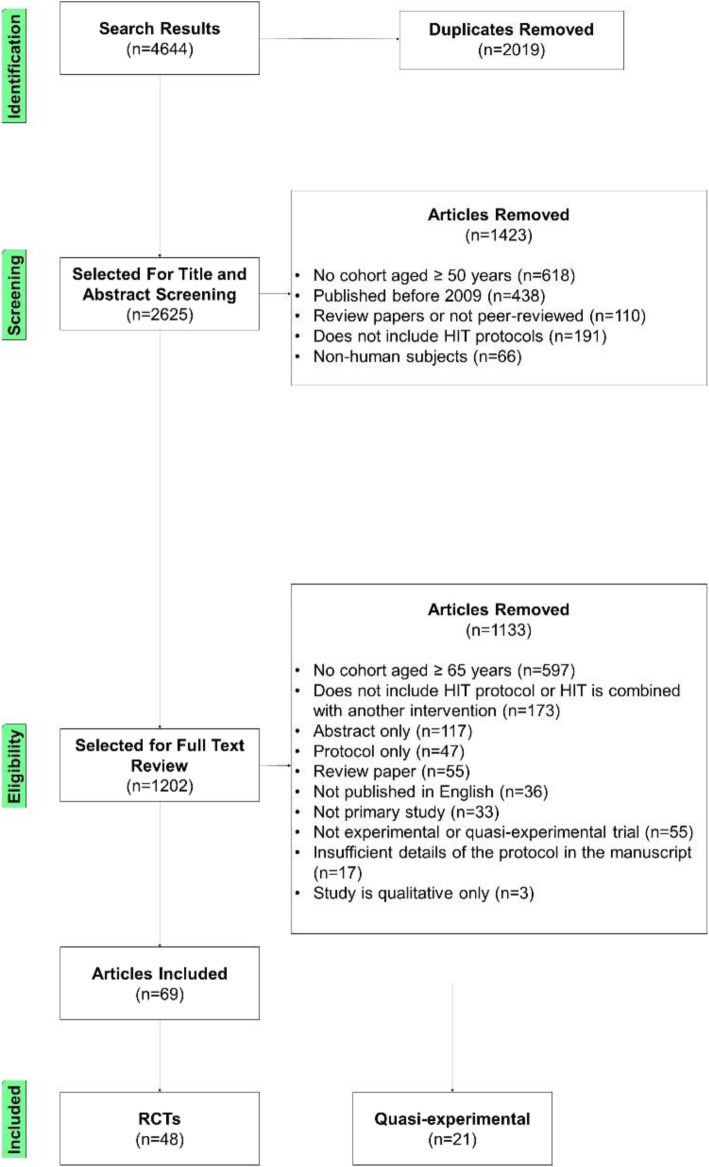
High-intensity interval training (HIIT) is an increasingly popular form of aerobic exercise which includes bouts of high-intensity exercise interspersed with periods of rest. The health benefits, risks, and optimal design of HIIT are still unclear. Further, most research on HIIT has been done in young and middle-aged adults, and as such, the tolerability and effects in senior populations are less well-known. The purpose of this scoping review was to characterize HIIT research that has been done in older adults including protocols, feasibility, and safety and to identify gaps in the current knowledge. Five databases were searched with variations of the terms, "high-intensity interval training" and "older adults" for experimental or quasi-experimental studies published in or after 2009. Studies were included if they had a treatment group with a mean age of 65 years or older who did HIIT, exclusively. Of 4644 papers identified, 69 met the inclusion criteria. The average duration of training was 7.9 (7.0) weeks (mean [SD]) and protocols ranged widely. The average sample size was 47.0 (65.2) subjects (mean [SD]). Healthy populations were the most studied group (n = 30), followed by subjects with cardiovascular (n = 12) or cardiac disease (n = 9), metabolic dysfunction (n = 8), and others (n = 10). The most common primary outcomes included changes in cardiorespiratory fitness (such as VO) as well as feasibility and safety of the protocols as measured by the number of participant dropouts, adverse events, and compliance rate. HIIT protocols were diverse but were generally well-tolerated and may confer many health advantages to older adults. Larger studies and more research in clinical populations most representative of older adults are needed to further evaluate the clinical effects of HIIT in these groups.
高强度间歇训练(HIIT)是一种越来越受欢迎的有氧运动形式,包括高强度运动时段与休息时段穿插进行。HIIT的健康益处、风险及最佳设计仍不明确。此外,大多数关于HIIT的研究是在年轻和中年成年人中进行的,因此,其在老年人群中的耐受性和效果鲜为人知。本范围综述的目的是描述在老年人中开展的HIIT研究,包括方案、可行性和安全性,并找出当前知识中的空白。检索了五个数据库,使用“高强度间歇训练”和“老年人”的不同表述,查找2009年及以后发表的实验性或准实验性研究。如果研究有一个平均年龄为65岁及以上且专门进行HIIT的治疗组,则纳入研究。在识别出的4644篇论文中,69篇符合纳入标准。训练的平均持续时间为7.9(7.0)周(均值[标准差]),方案差异很大。平均样本量为47.0(65.2)名受试者(均值[标准差])。健康人群是研究最多的组(n = 30),其次是患有心血管疾病(n = 12)或心脏病(n = 9)、代谢功能障碍(n = 8)以及其他疾病(n = 10)的受试者。最常见的主要结局包括心肺适能的变化(如VO)以及通过参与者退出人数、不良事件和依从率衡量的方案可行性和安全性。HIIT方案多种多样,但总体耐受性良好,可能给老年人带来许多健康益处。需要开展更大规模的研究以及在最能代表老年人的临床人群中进行更多研究,以进一步评估HIIT在这些人群中的临床效果。