
人工智能助力炎症性肠病研究。
Artificial Intelligence Enhances Studies on Inflammatory Bowel Disease.
作者信息
Chen Guihua, Shen Jun
机构信息
Division of Gastroenterology and Hepatology, Key Laboratory of Gastroenterology and Hepatology, Ministry of Health, Inflammatory Bowel Disease Research Center, Shanghai Institute of Digestive Disease, Renji Hospital, School of Medicine, Shanghai Jiao Tong University, Shanghai, China.
出版信息
Front Bioeng Biotechnol. 2021 Jul 8;9:635764. doi: 10.3389/fbioe.2021.635764. eCollection 2021.
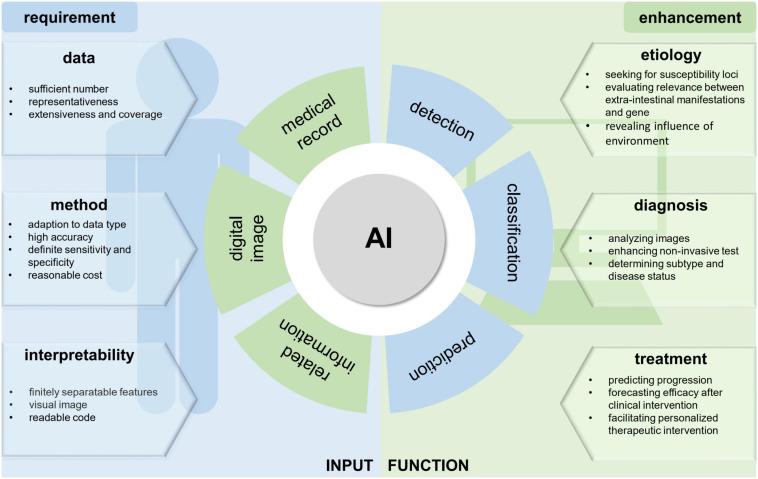
Inflammatory bowel disease (IBD), which includes ulcerative colitis (UC) and Crohn's disease (CD), is an idiopathic condition related to a dysregulated immune response to commensal intestinal microflora in a genetically susceptible host. As a global disease, the morbidity of IBD reached a rate of 84.3 per 100,000 persons and reflected a continued gradual upward trajectory. The medical cost of IBD is also notably extremely high. For example, in Europe, it has €3,500 in CD and €2,000 in UC per patient per year, respectively. In addition, taking into account the work productivity loss and the reduced quality of life, the indirect costs are incalculable. In modern times, the diagnosis of IBD is still a subjective judgment based on laboratory tests and medical images. Its early diagnosis and intervention is therefore a challenging goal and also the key to control its progression. Artificial intelligence (AI)-assisted diagnosis and prognosis prediction has proven effective in many fields including gastroenterology. In this study, support vector machines were utilized to distinguish the significant features in IBD. As a result, the reliability of IBD diagnosis due to its impressive performance in classifying and addressing region problems was improved. Convolutional neural networks are advanced image processing algorithms that are currently in existence. Digestive endoscopic images can therefore be better understood by automatically detecting and classifying lesions. This study aims to summarize AI application in the area of IBD, objectively evaluate the performance of these methods, and ultimately understand the algorithm-dataset combination in the studies.
炎症性肠病(IBD)包括溃疡性结肠炎(UC)和克罗恩病(CD),是一种在遗传易感宿主中与对共生肠道微生物群免疫反应失调相关的特发性疾病。作为一种全球性疾病,IBD的发病率达到了每10万人84.3例的水平,且呈持续缓慢上升趋势。IBD的医疗费用也非常高昂。例如,在欧洲,每位CD患者每年的费用为3500欧元,UC患者每年为2000欧元。此外,考虑到工作生产力损失和生活质量下降,间接成本难以估量。在现代,IBD的诊断仍然是基于实验室检查和医学影像的主观判断。因此,其早期诊断和干预是一个具有挑战性的目标,也是控制其进展的关键。人工智能(AI)辅助诊断和预后预测在包括胃肠病学在内的许多领域已被证明是有效的。在本研究中,支持向量机被用于区分IBD的显著特征。结果,由于其在分类和解决区域问题方面的出色表现,IBD诊断的可靠性得到了提高。卷积神经网络是目前现有的先进图像处理算法。因此,通过自动检测和分类病变,可以更好地理解消化内镜图像。本研究旨在总结AI在IBD领域的应用,客观评估这些方法的性能,并最终了解研究中的算法 - 数据集组合。



 Zotero 插件