Ghafouri-Fard Soudeh, Niazi Vahid, Hussen Bashdar Mahmud, Omrani Mir Davood, Taheri Mohammad, Basiri Abbas
Department of Medical Genetics, School of Medicine, Shahid Beheshti University of Medical Sciences, Tehran, Iran.
Department of Tissue Engineering and Applied Cell Sciences, School of Advanced Technologies in Medicine, Shahid Beheshti University of Medical Sciences, Tehran, Iran.
Front Cell Dev Biol. 2021 Jul 7;9:653296. doi: 10.3389/fcell.2021.653296. eCollection 2021.
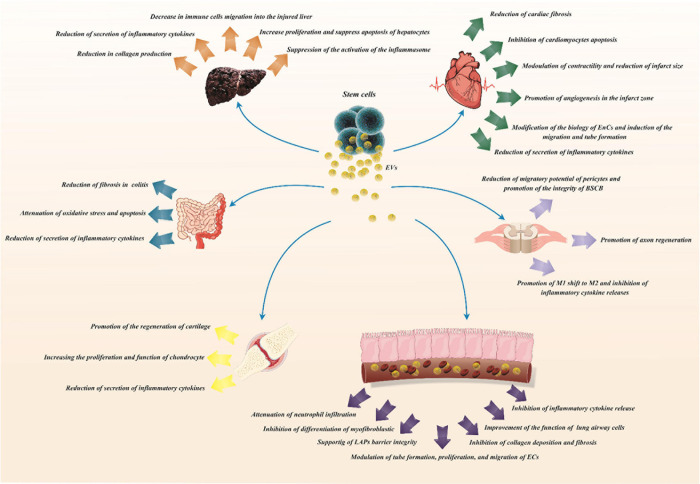
Extracellular vesicles (EVs) are produced by diverse eukaryotic and prokaryotic cells. They have prominent roles in the modulation of cell-cell communication, inflammation versus immunomodulation, carcinogenic processes, cell proliferation and differentiation, and tissue regeneration. These acellular vesicles are more promising than cellular methods because of the lower risk of tumor formation, autoimmune responses and toxic effects compared with cell therapy. Moreover, the small size and lower complexity of these vesicles compared with cells have made their production and storage easier than cellular methods. Exosomes originated from mesenchymal stem cells has also been introduced as therapeutic option for a number of human diseases. The current review aims at summarization of the role of EVs in the regenerative medicine with a focus on their therapeutic impacts in liver fibrosis, lung disorders, osteoarthritis, colitis, myocardial injury, spinal cord injury and retinal injury.
细胞外囊泡(EVs)由多种真核细胞和原核细胞产生。它们在调节细胞间通讯、炎症与免疫调节、致癌过程、细胞增殖与分化以及组织再生中发挥着重要作用。与细胞疗法相比,这些无细胞囊泡形成肿瘤、引发自身免疫反应和产生毒性作用的风险更低,因此比细胞方法更具前景。此外,与细胞相比,这些囊泡体积小且复杂性低,使其生产和储存比细胞方法更容易。源自间充质干细胞的外泌体也已被用作多种人类疾病的治疗选择。本综述旨在总结细胞外囊泡在再生医学中的作用,重点关注其在肝纤维化、肺部疾病、骨关节炎、结肠炎、心肌损伤、脊髓损伤和视网膜损伤中的治疗作用。