Department of Imaging Physics - Unit 1472, The University of Texas MD Anderson Cancer Center, Houston, Texas, USA.
The University of Texas at Austin, Austin, Texas, USA.
Med Phys. 2021 Oct;48(10):5702-5711. doi: 10.1002/mp.15133. Epub 2021 Aug 19.
The global noise (GN) algorithm has been previously introduced as a method for automatic noise measurement in clinical CT images. The accuracy of the GN algorithm has been assessed in abdomen CT examinations, but not in any other body part until now. This work assesses the GN algorithm accuracy in automatic noise measurement in head CT examinations.
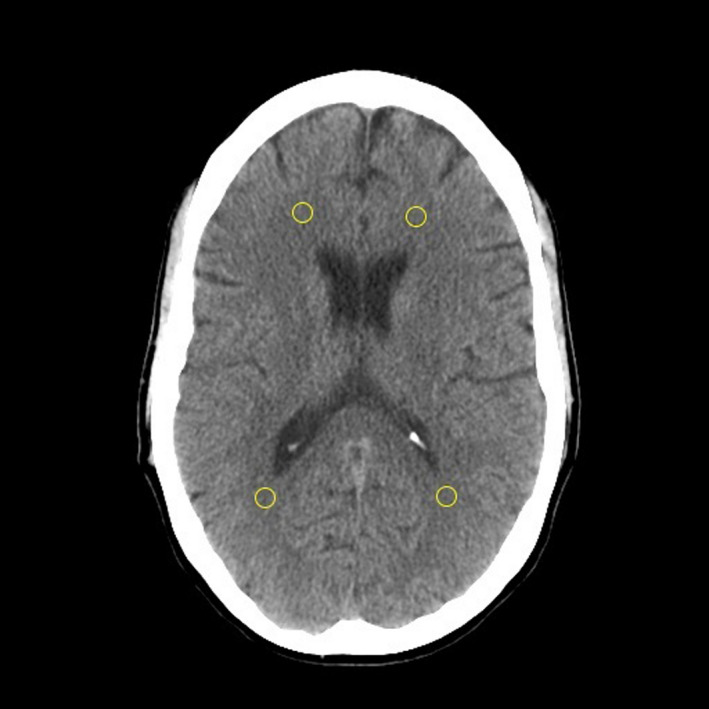
A publicly available image dataset of 99 head CT examinations was used to evaluate the accuracy of the GN algorithm in comparison to reference noise values. Reference noise values were acquired using a manual noise measurement procedure. The procedure used a consistent instruction protocol and multiple observers to mitigate the influence of intra- and interobserver variation, resulting in precise reference values. Optimal GN algorithm parameter values were determined. The GN algorithm accuracy and the corresponding statistical confidence interval were determined. The GN measurements were compared across the six different scan protocols used in this dataset. The correlation of GN to patient head size was also assessed using a linear regression model, and the CT scanner's X-ray beam quality was inferred from the model fit parameters.
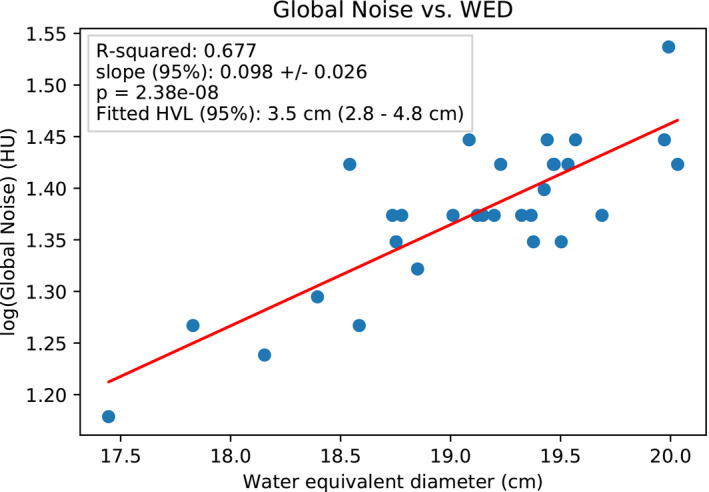
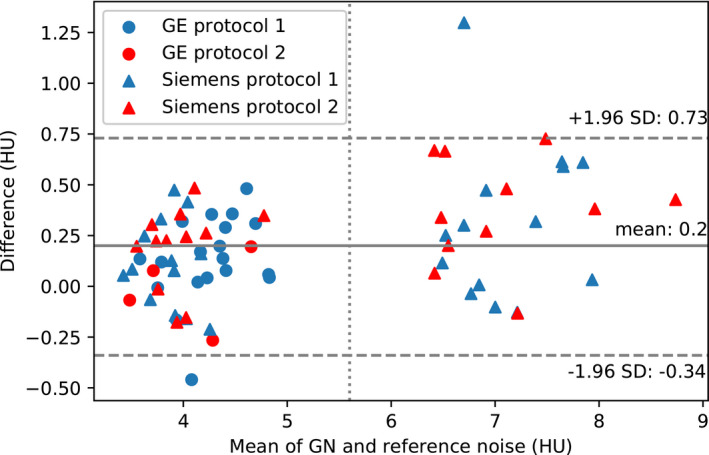
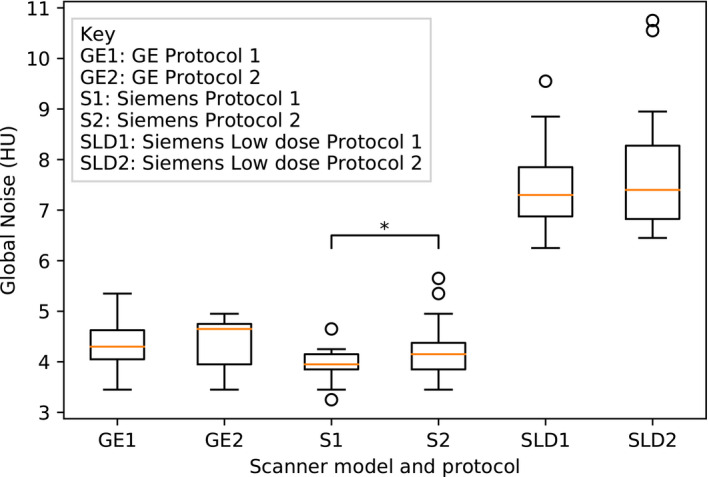
Across all head CT examinations in the dataset, the range of reference noise was 2.9-10.2 HU. A precision of ±0.33 HU was achieved in the reference noise measurements. After optimization, the GN algorithm had a RMS error 0.34 HU corresponding to a percent RMS error of 6.6%. The GN algorithm had a bias of +3.9%. Statistically significant differences in GN were detected in 11 out of the 15 different pairs of scan protocols. The GN measurements were correlated with head size with a statistically significant regression slope parameter (p < 10 ). The CT scanner X-ray beam quality estimated from the slope parameter was 3.5 cm water HVL (2.8-4.8 cm 95% CI).
The GN algorithm was validated for application in head CT examinations. The GN algorithm was accurate in comparison to reference manual measurement, with errors comparable to interobserver variation in manual measurement. The GN algorithm can detect noise differences in examinations performed on different scanner models or using different scan protocols. The trend in GN across patients of different head sizes closely follows that predicted by a physical model of X-ray attenuation.
全球噪声(GN)算法已被先前引入作为临床 CT 图像中自动噪声测量的一种方法。GN 算法的准确性已在腹部 CT 检查中进行了评估,但直到现在还没有在任何其他身体部位进行评估。本研究旨在评估 GN 算法在头部 CT 检查中自动噪声测量的准确性。
使用一个公开的 99 例头部 CT 检查图像数据集来评估 GN 算法与参考噪声值相比的准确性。参考噪声值是通过手动噪声测量程序获得的。该程序使用一致的指令协议和多个观察者来减轻内-观察者和观察者间变异性的影响,从而产生精确的参考值。确定了 GN 算法的最佳参数值。确定了 GN 算法的准确性及其相应的统计置信区间。比较了 GN 算法在该数据集使用的六种不同扫描协议中的测量值。还使用线性回归模型评估了 GN 与患者头部大小的相关性,并从模型拟合参数推断了 CT 扫描仪的 X 射线束质量。
在数据集的所有头部 CT 检查中,参考噪声范围为 2.9-10.2 HU。参考噪声测量的精度达到了±0.33 HU。经过优化,GN 算法的均方根误差为 0.34 HU,对应的均方根误差百分比为 6.6%。GN 算法的偏倚为+3.9%。在 15 对不同的扫描协议中,有 11 对的 GN 差异具有统计学意义。GN 测量值与头部大小呈显著相关,回归斜率参数具有统计学意义(p<0.001)。从斜率参数估计的 CT 扫描仪 X 射线束质量为 3.5 cm 水 HVL(2.8-4.8 cm 95%CI)。
GN 算法已在头部 CT 检查中得到验证。GN 算法与手动参考测量相比是准确的,误差与手动测量的观察者间变异性相当。GN 算法可以检测不同扫描仪型号或使用不同扫描协议进行的检查中的噪声差异。不同头部大小的患者的 GN 趋势与 X 射线衰减的物理模型预测的趋势非常吻合。