• 文献检索
  • 文档翻译
  • 深度研究
  • 学术资讯
  • Suppr Zotero 插件Zotero 插件
  • 邀请有礼
  • 套餐&价格
  • 历史记录
应用&插件
Suppr Zotero 插件Zotero 插件浏览器插件Mac 客户端Windows 客户端微信小程序
定价
高级版会员购买积分包购买API积分包
服务
文献检索文档翻译深度研究API 文档MCP 服务
关于我们
关于 Suppr公司介绍联系我们用户协议隐私条款
关注我们

Suppr 超能文献

核心技术专利:CN118964589B侵权必究
粤ICP备2023148730 号-1Suppr @ 2026

文献检索

告别复杂PubMed语法,用中文像聊天一样搜索,搜遍4000万医学文献。AI智能推荐,让科研检索更轻松。

立即免费搜索

文件翻译

保留排版,准确专业,支持PDF/Word/PPT等文件格式,支持 12+语言互译。

免费翻译文档

深度研究

AI帮你快速写综述,25分钟生成高质量综述,智能提取关键信息,辅助科研写作。

立即免费体验

在本科环境科学课程中建立科学传播技能的基线。

Establishing a baseline of science communication skills in an undergraduate environmental science course.

作者信息

Shivni Rashmi, Cline Christina, Newport Morgan, Yuan Shupei, Bergan-Roller Heather E

机构信息

Department of Biological Sciences, College of Liberal Arts and Sciences, Northern Illinois University, 447 Montgomery Hall, DeKalb, IL 60115 USA.

Weinberg College of Arts and Sciences, Northwestern University, Evanston, IL USA.

出版信息

Int J STEM Educ. 2021;8(1):47. doi: 10.1186/s40594-021-00304-0. Epub 2021 Jul 23.

DOI:10.1186/s40594-021-00304-0
PMID:34316435
原文链接:https://pmc.ncbi.nlm.nih.gov/articles/PMC8299166/
Abstract

BACKGROUND

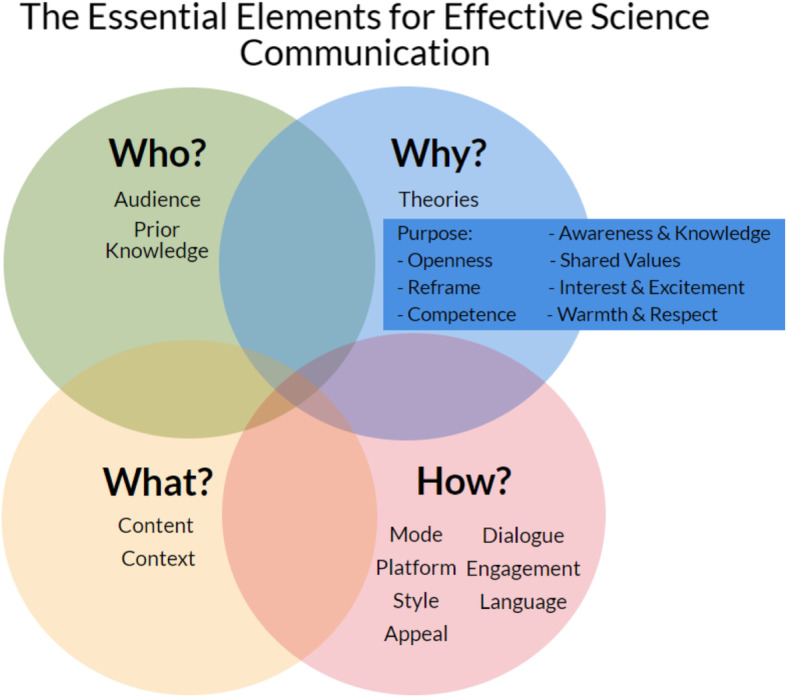
Seminal reports, based on recommendations by educators, scientists, and in collaboration with students, have called for undergraduate curricula to engage students in some of the same practices as scientists-one of which is communicating science with a general, non-scientific audience (SciComm). Unfortunately, very little research has focused on helping students develop these skills. An important early step in creating effective and efficient curricula is understanding what baseline skills students have prior to instruction. Here, we used the Essential Elements for Effective Science Communication (EEES) framework to survey the SciComm skills of students in an environmental science course in which they had little SciComm training.

RESULTS

Our analyses revealed that, despite not being given the framework, students included several of the 13 elements, especially those which were explicitly asked for in the assignment instructions. Students commonly targeted broad audiences composed of interested adults, aimed to increase the knowledge and awareness of their audience, and planned and executed remote projects using print on social media. Additionally, students demonstrated flexibility in their skills by slightly differing their choices depending on the context of the assignment, such as creating more engaging content than they had planned for.

CONCLUSIONS

The students exhibited several key baseline skills, even though they had minimal training on the best practices of SciComm; however, more support is required to help students become better communicators, and more work in different contexts may be beneficial to acquire additional perspectives on SciComm skills among a variety of science students. The few elements that were not well highlighted in the students' projects may not have been as intuitive to novice communicators. Thus, we provide recommendations for how educators can help their undergraduate science students develop valuable, prescribed SciComm skills. Some of these recommendations include helping students determine the right audience for their communication project, providing opportunities for students to try multiple media types, determining the type of language that is appropriate for the audience, and encouraging students to aim for a mix of communication objectives. With this guidance, educators can better prepare their students to become a more open and communicative generation of scientists and citizens.

SUPPLEMENTARY INFORMATION

The online version contains supplementary material available at 10.1186/s40594-021-00304-0.

摘要

背景

基于教育工作者、科学家的建议并与学生合作得出的开创性报告呼吁本科课程让学生参与一些与科学家相同的实践活动——其中之一是与普通的非科学受众进行科学交流(科学传播)。不幸的是,很少有研究专注于帮助学生培养这些技能。创建有效且高效课程的重要早期步骤是了解学生在接受教学之前具备哪些基础技能。在此,我们使用有效科学传播基本要素(EEES)框架对一门环境科学课程中的学生的科学传播技能进行了调查,在该课程中他们几乎没有接受过科学传播方面的培训。

结果

我们的分析表明,尽管未被告知该框架,但学生纳入了13个要素中的几个,尤其是作业说明中明确要求的那些要素。学生通常将目标受众定位为感兴趣的成年人组成的广泛群体,旨在增加受众的知识和意识,并利用社交媒体上的印刷品策划和执行远程项目。此外,学生根据作业的背景略微改变他们的选择,展示了他们技能的灵活性,比如创作比原计划更具吸引力的内容。

结论

尽管学生在科学传播的最佳实践方面接受的培训很少,但他们展现出了几项关键的基础技能;然而,需要更多支持来帮助学生成为更好的传播者,并且在不同背景下开展更多工作可能有助于从各类理科学生中获取关于科学传播技能的更多观点。在学生项目中未得到充分体现的少数要素对于新手传播者来说可能不那么直观。因此,我们就教育工作者如何帮助他们的本科理科学生培养有价值的、规定的科学传播技能提供了建议。其中一些建议包括帮助学生确定其传播项目的合适受众,为学生提供尝试多种媒体类型的机会,确定适合受众的语言类型,以及鼓励学生追求多种传播目标的组合。有了这些指导,教育工作者可以更好地让他们的学生做好准备,成为更开放、更善于交流的一代科学家和公民。

补充信息

在线版本包含可在10.1186/s40594 - 021 - 00304 - 0获取的补充材料。
https://cdn.ncbi.nlm.nih.gov/pmc/blobs/1fc7/8299166/033bf78d18fe/40594_2021_304_Fig2_HTML.jpg
https://cdn.ncbi.nlm.nih.gov/pmc/blobs/1fc7/8299166/907383902501/40594_2021_304_Fig1_HTML.jpg
https://cdn.ncbi.nlm.nih.gov/pmc/blobs/1fc7/8299166/033bf78d18fe/40594_2021_304_Fig2_HTML.jpg
https://cdn.ncbi.nlm.nih.gov/pmc/blobs/1fc7/8299166/907383902501/40594_2021_304_Fig1_HTML.jpg
https://cdn.ncbi.nlm.nih.gov/pmc/blobs/1fc7/8299166/033bf78d18fe/40594_2021_304_Fig2_HTML.jpg

相似文献

1
Establishing a baseline of science communication skills in an undergraduate environmental science course.在本科环境科学课程中建立科学传播技能的基线。
Int J STEM Educ. 2021;8(1):47. doi: 10.1186/s40594-021-00304-0. Epub 2021 Jul 23.
2
Student and educator experiences of maternal-child simulation-based learning: a systematic review of qualitative evidence protocol.基于母婴模拟学习的学生和教育工作者体验:定性证据协议的系统评价
JBI Database System Rev Implement Rep. 2015 Jan;13(1):14-26. doi: 10.11124/jbisrir-2015-1694.
3
Students' approaches to developing scientific communication skills.学生发展科学交流技能的方法。
Adv Physiol Educ. 2024 Sep 1;48(3):639-647. doi: 10.1152/advan.00009.2024. Epub 2024 Jun 27.
4
Podcasting Neuroscience: A Science Communication Assignment.播客神经科学:一项科学传播任务。
J Undergrad Neurosci Educ. 2022 Jun 1;20(2):A120-A145. doi: 10.59390/FKXM3006. eCollection 2022 Winter.
5
Facilitating awareness of philosophy of science, ethics and communication through manual skills training in undergraduate education.通过本科教育中的实践技能培训,促进对科学哲学、伦理学和沟通的认识。
Physiother Theory Pract. 2017 Mar;33(3):206-217. doi: 10.1080/09593985.2016.1277289. Epub 2017 Jan 17.
6
Broadening the voice of science: Promoting scientific communication in the undergraduate classroom.拓宽科学之声:促进本科课堂中的科学交流。
Ecol Evol. 2017 Oct 24;7(23):10124-10130. doi: 10.1002/ece3.3501. eCollection 2017 Dec.
7
Teaching students to explain the pathophysiology of diseases to lay audiences with a scaffold that supports student choice.用支持学生选择的支架教学生向非专业听众解释疾病的病理生理学。
Adv Physiol Educ. 2021 Jun 1;45(2):281-289. doi: 10.1152/advan.00016.2020.
8
The Role of Scientific Communication Skills in Trainees' Intention to Pursue Biomedical Research Careers: A Social Cognitive Analysis.科学沟通技巧在实习生从事生物医学研究职业意向中的作用:一项社会认知分析
CBE Life Sci Educ. 2015 Winter;14(4):ar46. doi: 10.1187/cbe.14-09-0152.
9
A set of vertically integrated inquiry-based practical curricula that develop scientific thinking skills for large cohorts of undergraduate students.一套纵向整合的基于探究的实践课程,旨在为大批本科生培养科学思维能力。
Adv Physiol Educ. 2013 Dec;37(4):303-15. doi: 10.1152/advan.00082.2012.
10
Effective teaching of communication to health professional undergraduate and postgraduate students: A Systematic Review.向健康专业本科和研究生有效传授沟通技巧:一项系统综述。
JBI Libr Syst Rev. 2012;10(28 Suppl):1-12. doi: 10.11124/jbisrir-2012-327.

引用本文的文献

1
The impact of exposure to scientific research and inclusive mentoring style on medical undergraduates' perceptions of critical thinking, communication, and passion.接触科学研究和包容性指导方式对医学本科生批判性思维、沟通能力和热情认知的影响。
Med Educ Online. 2025 Dec;30(1):2535406. doi: 10.1080/10872981.2025.2535406. Epub 2025 Jul 28.
2
Undergraduate Biology Students' Climate Change Communication Experiences Indicate a Need for Discipline-Based Education Research on Science Communication Education about Culturally Controversial Science Topics.本科生物学专业学生的气候变化传播经历表明,需要开展基于学科的教育研究,以探讨关于文化争议性科学话题的科学传播教育。
CBE Life Sci Educ. 2025 Jun 1;24(2):ar24. doi: 10.1187/cbe.23-07-0134.
3

本文引用的文献

1
BioSkills Guide: Development and National Validation of a Tool for Interpreting the Core Competencies.生物技能指南:解释核心能力工具的开发和国家验证。
CBE Life Sci Educ. 2020 Dec;19(4):ar53. doi: 10.1187/cbe.19-11-0259.
2
Science audiences, misinformation, and fake news.科学受众、错误信息和假新闻。
Proc Natl Acad Sci U S A. 2019 Apr 16;116(16):7662-7669. doi: 10.1073/pnas.1805871115. Epub 2019 Jan 14.
3
Scientists' views about communication objectives.科学家对传播目标的看法。
Development of a Scale to Measure Planned Behavior in Inclusive Science Communication: Validity Evidence in Undergraduate STEM Students.
开发一种衡量包容性科学传播中计划行为的量表:本科 STEM 学生中的效验证据。
CBE Life Sci Educ. 2024 Dec;23(4):ar48. doi: 10.1187/cbe.24-01-0012.
4
Non-STEM majors COVID-19 vaccine impressions improve, and misconceptions resolve, after podcast assignment.非STEM专业学生在完成播客任务后,对新冠疫苗的印象有所改善,误解也得以消除。
J Microbiol Biol Educ. 2024 Aug 29;25(2):e0003423. doi: 10.1128/jmbe.00034-23. Epub 2024 Jun 14.
5
Science Communication and Biomedical Visualization: Two Sides of the Same Coin.科学传播与生物医学可视化:同一枚硬币的两面。
Adv Exp Med Biol. 2023;1421:3-13. doi: 10.1007/978-3-031-30379-1_1.
6
Analysis of Inclusivity of Published Science Communication Curricula for Scientists and STEM Students.分析已发表的针对科学家和 STEM 学生的科学传播课程的包容性。
CBE Life Sci Educ. 2023 Mar;22(1):ar8. doi: 10.1187/cbe.22-03-0040.
7
Undergraduate students' involvement in research: Values, benefits, barriers and recommendations.本科生参与研究:价值、益处、障碍与建议。
Ann Med Surg (Lond). 2022 Aug 17;81:104384. doi: 10.1016/j.amsu.2022.104384. eCollection 2022 Sep.
8
Disseminating Science and Education through Social Media: The Experience of a Students' Editorial Team at the University of Padova.通过社交媒体传播科学与教育:帕多瓦大学学生编辑团队的经验
J Microbiol Biol Educ. 2022 Apr 5;23(1). doi: 10.1128/jmbe.00345-21. eCollection 2022 Apr.
9
Toward scientific dissemination of undergraduate thesis in physical therapy programs - a cross-sectional study.迈向物理治疗专业本科生论文的科学传播——一项横断面研究。
BMC Med Educ. 2022 Jan 11;22(1):32. doi: 10.1186/s12909-021-03087-8.
Public Underst Sci. 2018 Aug;27(6):708-730. doi: 10.1177/0963662517728478. Epub 2017 Aug 25.
4
De-Problematizing 'GMOs': Suggestions for Communicating about Genetic Engineering.去问题化“转基因生物”:关于遗传工程沟通的建议。
Trends Biotechnol. 2017 Mar;35(3):185-186. doi: 10.1016/j.tibtech.2016.12.004. Epub 2017 Jan 7.
5
Unbalanced progress: The hard road from science popularisation to public engagement with science in China.不均衡的进展:中国从科学普及到公众参与科学的艰难之路。
Public Underst Sci. 2014 Jan;23(1):32-7. doi: 10.1177/0963662513476404.
6
Science Communication to the General Public: Why We Need to Teach Undergraduate and Graduate Students this Skill as Part of Their Formal Scientific Training.向公众进行科学传播:为何我们需要将此技能作为本科生和研究生正规科学训练的一部分来教授。
J Undergrad Neurosci Educ. 2013 Oct 15;12(1):E6-E10. eCollection 2013.
7
Communicating science in social settings.在社会环境中传播科学。
Proc Natl Acad Sci U S A. 2013 Aug 20;110 Suppl 3(Suppl 3):14040-7. doi: 10.1073/pnas.1213275110. Epub 2013 Aug 12.
8
How scientists view the public, the media and the political process.科学家如何看待公众、媒体和政治进程。
Public Underst Sci. 2013 Aug;22(6):644-59. doi: 10.1177/0963662511418743. Epub 2011 Aug 30.
9
A writing-intensive course improves biology undergraduates' perception and confidence of their abilities to read scientific literature and communicate science.写作密集型课程提高了生物学本科生对阅读科学文献和交流科学能力的感知和信心。
Adv Physiol Educ. 2013 Mar;37(1):70-9. doi: 10.1152/advan.00138.2012.
10
Learning to improve: using writing to increase critical thinking performance in general education biology.学会提升:通过写作提高通识教育生物学中的批判性思维能力
CBE Life Sci Educ. 2007 Summer;6(2):140-54. doi: 10.1187/cbe.06-11-0203.