Faculty of Physics and Center for NanoScience (CeNS), Ludwig-Maximilians-University, Geschwister-Scholl-Platz 1, 80539, Munich, Germany.
Research Group Molecular Imaging and Bionanotechnology, Max Planck Institute of Biochemistry, Am Klopferspitz 18, 82152, Martinsried, Germany.
Adv Mater. 2021 Sep;33(37):e2101986. doi: 10.1002/adma.202101986. Epub 2021 Aug 1.
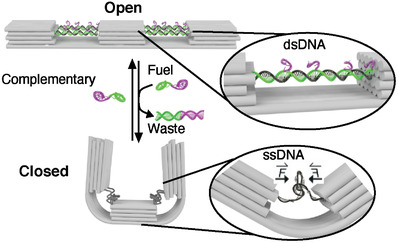
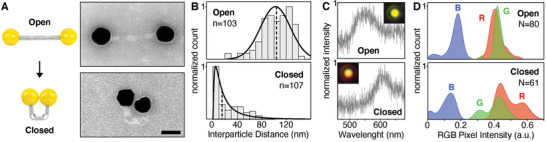
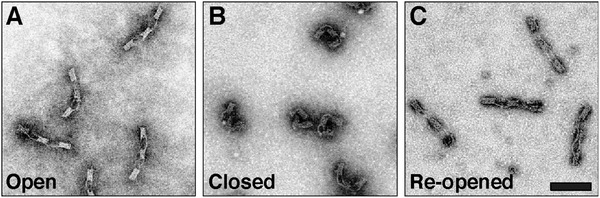
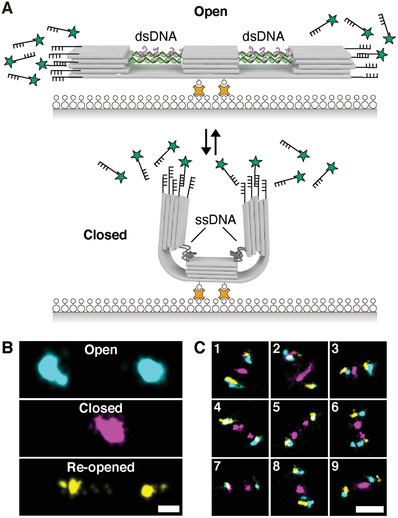
The design of dynamic, reconfigurable devices is crucial for the bottom-up construction of artificial biological systems. DNA can be used as an engineering material for the de-novo design of such dynamic devices. A self-assembled DNA origami switch is presented that uses the transition from double- to single-stranded DNA and vice versa to create and annihilate an entropic force that drives a reversible conformational change inside the switch. It is distinctively demonstrated that a DNA single-strand that is extended with 0.34 nm per nucleotide - the extension this very strand has in the double-stranded configuration - exerts a contractive force on its ends leading to large-scale motion. The operation of this type of switch is demonstrated via transmission electron microscopy, DNA-PAINT super-resolution microscopy and darkfield microscopy. The work illustrates the intricate and sometimes counter-intuitive forces that act in nanoscale physical systems that operate in fluids.
动态、可重构器件的设计对于人工生物系统的自下而上构建至关重要。DNA 可以用作此类动态器件的全新设计的工程材料。本文提出了一种自组装 DNA 折纸开关,它利用从双链到单链和反之亦然的转变来创建和消除熵力,从而驱动开关内的可逆构象变化。本文鲜明地证明,一条延伸每个核苷酸 0.34nm 的 DNA 单链——这条单链在双链构象中的延伸——会对其末端施加收缩力,从而导致大规模运动。通过透射电子显微镜、DNA-PAINT 超分辨率显微镜和暗场显微镜证明了这种开关的操作。这项工作说明了在在流体中运行的纳米级物理系统中作用的复杂且有时违反直觉的力。