Ahannach Sarah, Spacova Irina, Decorte Ronny, Jehaes Els, Lebeer Sarah
Department of Bioscience Engineering, Research Group Environmental Ecology and Applied Microbiology, University of Antwerp, Antwerp, Belgium.
Laboratory of Forensic Genetics, Department of Forensic Medicine, University Hospitals Leuven, Leuven, Belgium.
Front Microbiol. 2021 Jul 28;12:694447. doi: 10.3389/fmicb.2021.694447. eCollection 2021.
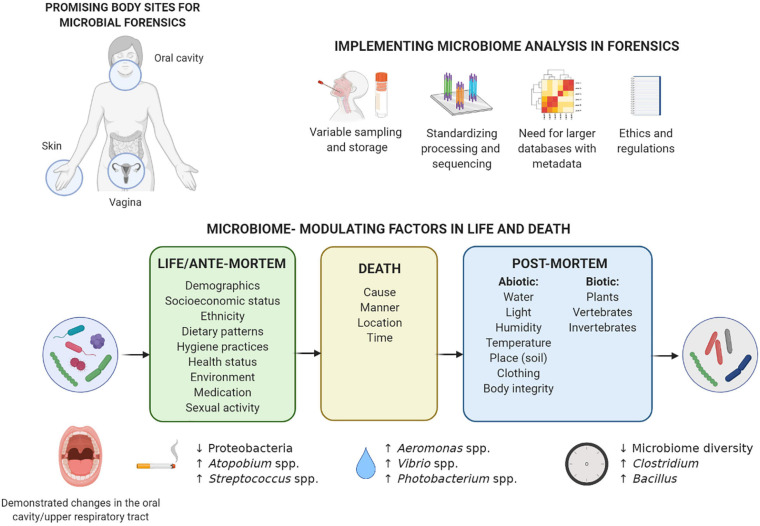
Microbial forensics represents a promising tool to strengthen traditional forensic investigative methods and fill related knowledge gaps. Large-scale microbiome studies indicate that microbial fingerprinting can assist forensics in areas such as trace evidence, source tracking, geolocation, and circumstances of death. Nevertheless, the majority of forensic microbiome studies focus on soil and internal organ samples, whereas the microbiome of skin, mouth, and especially vaginal samples that are routinely collected in sexual assault and femicide cases remain underexplored. This review discusses the current and emerging insights into vaginal, skin, and salivary microbiome-modulating factors during life (e.g., lifestyle and health status) and after death (e.g., environmental influences and post-mortem interval) based on next-generation sequencing. We specifically highlight the key aspects of female reproductive tract, skin, and mouth microbiome samples relevant in forensics. To fill the current knowledge gaps, future research should focus on the degree to which the post-mortem succession rate and profiles of vaginal, skin, and saliva microbiota are sensitive to abiotic and biotic factors, presence or absence of oxygen and other gases, and the nutrient richness of the environment. Application of this microbiome-related knowledge could provide valuable complementary data to strengthen forensic cases, for example, to shed light on the circumstances surrounding death with (post-mortem) microbial fingerprinting. Overall, this review synthesizes the present knowledge and aims to provide a framework to adequately comprehend the hurdles and potential application of vaginal, skin, and salivary post-mortem microbiomes in forensic investigations.
微生物法医学是一种很有前景的工具,可强化传统法医调查方法并填补相关知识空白。大规模微生物组研究表明,微生物指纹识别可在微量物证、源头追踪、地理定位和死亡情形等领域协助法医学工作。然而,大多数法医微生物组研究聚焦于土壤和内部器官样本,而在性侵犯和杀害女性案件中经常采集的皮肤、口腔尤其是阴道样本的微生物组仍未得到充分探索。本综述基于下一代测序技术,讨论了生前(如生活方式和健康状况)和死后(如环境影响和死后间隔)阴道、皮肤和唾液微生物组调节因素的当前及新见解。我们特别强调了法医学中与女性生殖道、皮肤和口腔微生物组样本相关的关键方面。为填补当前知识空白,未来研究应聚焦于死后阴道、皮肤和唾液微生物群的演替速率和特征对非生物和生物因素、氧气及其他气体的有无以及环境营养丰富程度的敏感程度。应用这些与微生物组相关的知识可为强化法医案件提供有价值的补充数据,例如,通过(死后)微生物指纹识别来揭示死亡周围的情形。总体而言,本综述综合了现有知识,旨在提供一个框架,以充分理解阴道、皮肤和唾液死后微生物组在法医调查中的障碍和潜在应用。