The Edward S Rogers Sr Department of Electrical and Computer Engineering, University of Toronto, Toronto, ON, Canada.
START Clinic for Mood and Anxiety Disorders, Toronto, ON, Canada.
J Med Internet Res. 2021 Aug 13;23(8):e28918. doi: 10.2196/28918.
The lack of access to mental health care could be addressed, in part, through the development of automated screening technologies for detecting the most common mental health disorders without the direct involvement of clinicians. Objective smartphone-collected data may contain sufficient information about individuals' behaviors to infer their mental states and therefore screen for anxiety disorders and depression.
The objective of this study is to compare how a single set of recognized and novel features, extracted from smartphone-collected data, can be used for predicting generalized anxiety disorder (GAD), social anxiety disorder (SAD), and depression.
An Android app was designed, together with a centralized server system, to collect periodic measurements of objective smartphone data. The types of data included samples of ambient audio, GPS location, screen state, and light sensor data. Subjects were recruited into a 2-week observational study in which the app was run on their personal smartphones. The subjects also completed self-report severity measures of SAD, GAD, and depression. The participants were 112 Canadian adults from a nonclinical population. High-level features were extracted from the data of 84 participants, and predictive models of SAD, GAD, and depression were built and evaluated.
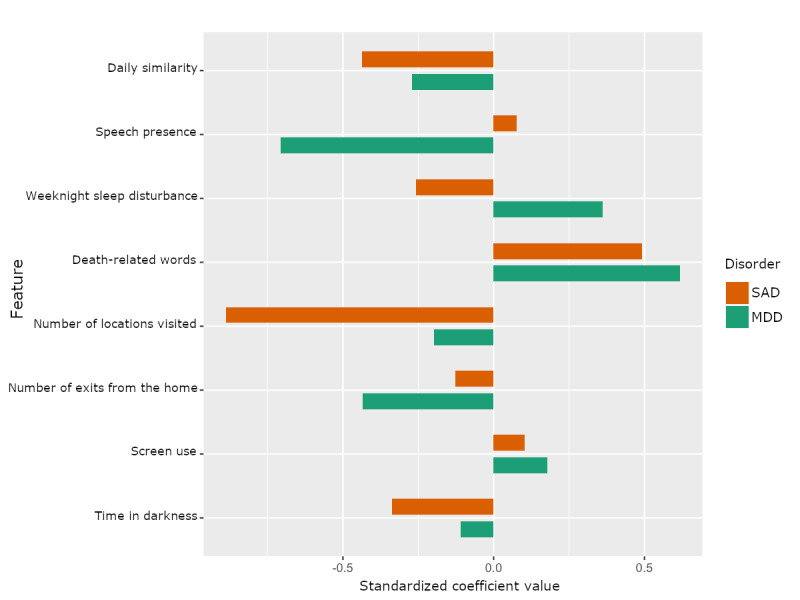
Models of SAD and depression achieved a significantly greater screening accuracy than uninformative models (area under the receiver operating characteristic means of 0.64, SD 0.13 and 0.72, SD 0.12, respectively), whereas models of GAD failed to be predictive. Investigation of the model coefficients revealed key features that were predictive of SAD and depression.
We demonstrate the ability of a common set of features to act as predictors in the models of both SAD and depression. This suggests that the types of behaviors that can be inferred from smartphone-collected data are broad indicators of mental health, which can be used to study, assess, and track psychopathology simultaneously across multiple disorders and diagnostic boundaries.
可以通过开发自动化筛查技术来部分解决心理健康护理的可及性问题,这些技术可以在不涉及临床医生的情况下检测最常见的心理健康障碍。智能手机收集的数据可能包含有关个人行为的足够信息,以推断其心理状态,从而筛查出焦虑症和抑郁症。
本研究的目的是比较从智能手机收集的数据中提取的一组公认和新颖的特征如何用于预测广泛性焦虑症(GAD)、社交焦虑症(SAD)和抑郁症。
设计了一个 Android 应用程序,以及一个集中的服务器系统,以定期收集客观智能手机数据。数据类型包括环境音频样本、GPS 位置、屏幕状态和光传感器数据。受试者被招募参加一项为期两周的观察性研究,在此期间,他们的个人智能手机上运行该应用程序。受试者还完成了 SAD、GAD 和抑郁症的自我报告严重程度测量。参与者是来自非临床人群的 112 名加拿大成年人。从 84 名参与者的数据中提取高级特征,并构建和评估 SAD、GAD 和抑郁症的预测模型。
SAD 和抑郁症模型的筛查准确性明显高于无信息模型(接收者操作特征曲线下的平均面积分别为 0.64,SD 0.13 和 0.72,SD 0.12),而 GAD 模型未能进行预测。对模型系数的研究发现了预测 SAD 和抑郁症的关键特征。
我们证明了一组通用特征可以作为 SAD 和抑郁症模型的预测因子。这表明,从智能手机收集的数据中推断出的行为类型是心理健康的广泛指标,可以用于同时研究、评估和跟踪多种障碍和诊断边界的精神病理学。