Francis Ben, Urich Tim, Mikolasch Annett, Teeling Hanno, Amann Rudolf
Max Planck Institute for Marine Microbiology, Bremen, Germany.
Institute for Microbiology, University of Greifswald, Greifswald, Germany.
Environ Microbiome. 2021 Aug 17;16(1):15. doi: 10.1186/s40793-021-00385-y.
The planktonic bacterial community associated with spring phytoplankton blooms in the North Sea is responsible for a large amount of carbon turnover in an environment characterised by high primary productivity. Individual clades belonging to the Gammaproteobacteria have shown similar population dynamics to Bacteroidetes species, and are thus assumed to fill competing ecological niches. Previous studies have generated large numbers of metagenome assembled genomes and metaproteomes from these environments, which can be readily mined to identify populations performing potentially important ecosystem functions. In this study we attempt to catalogue these spring bloom-associated Gammaproteobacteria, which have thus far attracted less attention than sympatric Alphaproteobacteria and Bacteroidetes.
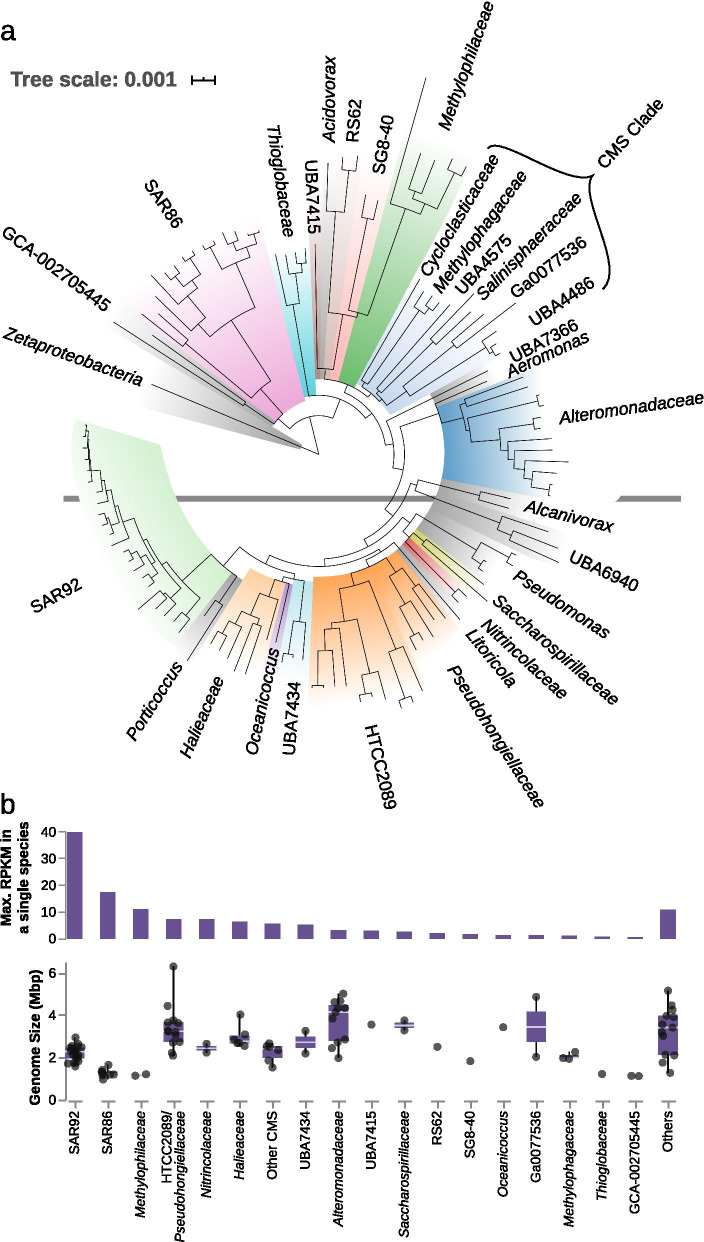
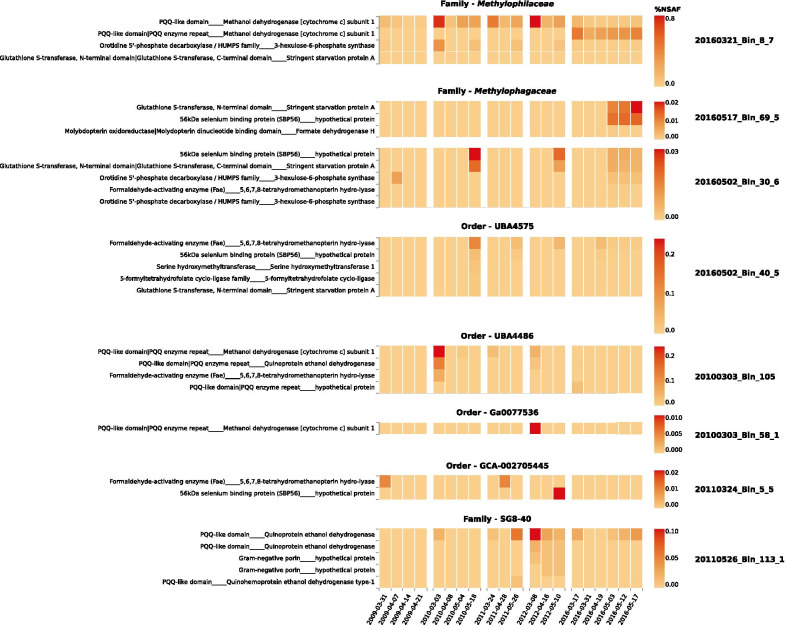
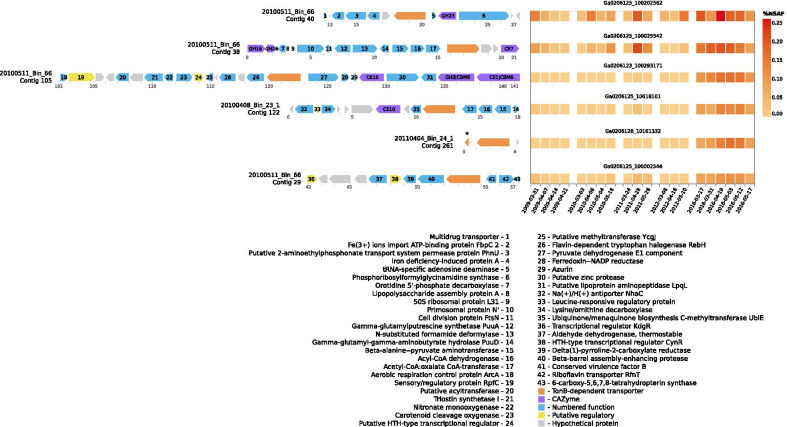
We annotated 120 non-redundant species-representative gammaproteobacterial metagenome assembled genomes from spring bloom sampling campaigns covering the four years 2010-2012 and 2016 using a combination of Prokka and PfamScan, with further confirmation via BLAST against NCBI-NR. We also matched these gene annotations to 20 previously published metaproteomes covering those sampling periods plus the spring of 2009.
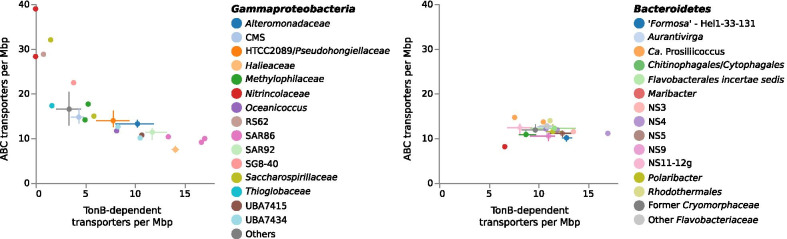
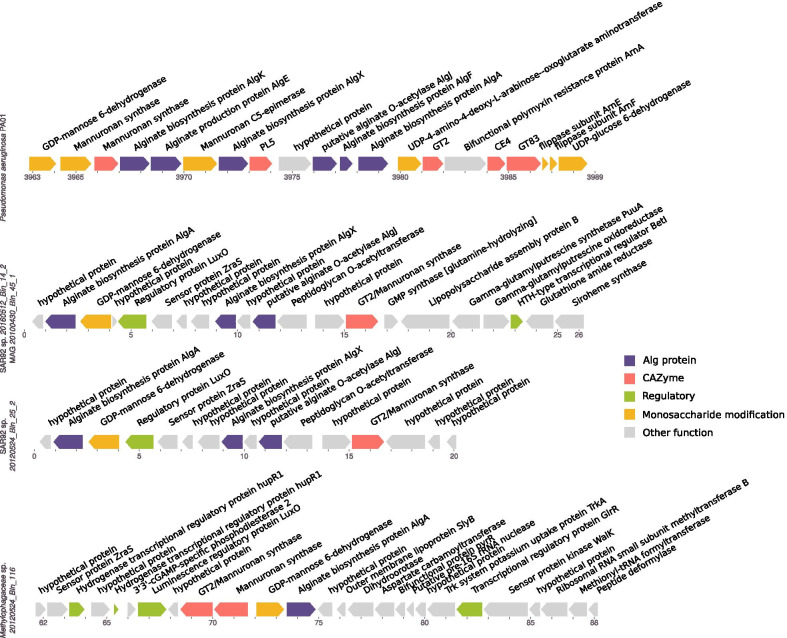
Metagenome assembled genomes with clear capacity for polysaccharide degradation via dedicated clusters of carbohydrate active enzymes were among the most abundant during blooms. Many genomes lacked gene clusters with clearly identifiable predicted polysaccharide substrates, although abundantly expressed loci for the uptake of large molecules were identified in metaproteomes. While the larger biopolymers, which are the most abundant sources of reduced carbon following algal blooms, are likely the main energy source, some gammaproteobacterial clades were clearly specialised for smaller organic compounds. Their substrates range from amino acids, monosaccharides, and DMSP, to the less expected, such as terpenoids, and aromatics and biphenyls, as well as many 'unknowns'. In particular we uncover a much greater breadth of apparent methylotrophic capability than heretofore identified, present in several order level clades without cultivated representatives.
Large numbers of metagenome assembled genomes are today publicly available, containing a wealth of readily accessible information. Here we identified a variety of predicted metabolisms of interest, which include diverse potential heterotrophic niches of spring bloom-associated Gammaproteobacteria. Features such as those identified here could well be fertile ground for future experimental studies.
北海春季浮游植物大量繁殖期间相关的浮游细菌群落,在这个以高初级生产力为特征的环境中,对大量碳周转起着重要作用。属于γ-变形菌纲的各个进化枝已显示出与拟杆菌门物种相似的种群动态,因此被认为占据了相互竞争的生态位。以往的研究从这些环境中产生了大量的宏基因组组装基因组和宏蛋白质组,从中可以很容易地挖掘出执行潜在重要生态系统功能的种群。在本研究中,我们试图对这些与春季大量繁殖相关的γ-变形菌进行编目,到目前为止,它们受到的关注比同域的α-变形菌和拟杆菌门要少。
我们使用Prokka和PfamScan相结合的方法,对2组样本(2010 - 2012年和2016年)中120个非冗余的、代表γ-变形菌的宏基因组组装基因组进行注释,并通过与NCBI-NR数据库进行BLAST比对进一步确认。我们还将这些基因注释与20个先前发表的宏蛋白质组进行匹配,这些宏蛋白质组涵盖了上述采样期以及2009年春季。
通过专门的碳水化合物活性酶簇具有明显多糖降解能力的宏基因组组装基因组,在大量繁殖期间最为丰富。许多基因组缺乏具有明确可预测多糖底物的基因簇,尽管在宏蛋白质组中鉴定出了大量表达的大分子摄取位点。虽然较大的生物聚合物是藻类大量繁殖后最丰富的还原碳来源,可能是主要能量来源,但一些γ-变形菌进化枝显然专门用于较小的有机化合物。它们的底物范围从氨基酸、单糖和二甲基巯基丙酸内盐,到不太常见的,如萜类化合物、芳烃和联苯,以及许多“未知物”。特别是,我们发现了比以往所确定的更为广泛的明显甲基营养能力,存在于几个没有培养代表的目级进化枝中。
如今有大量公开可用的宏基因组组装基因组,包含丰富的易于获取的信息。在这里我们确定了各种有趣的预测代谢途径,其中包括与春季大量繁殖相关的γ-变形菌的各种潜在异养生态位。此处所确定的特征很可能是未来实验研究的沃土。