Zewude Bewunetu, Belachew Abreham
Department of Sociology, Wolaita Sodo University, Wolaita Sodo, Ethiopia.
Department of Sociology, Haramaya University, Haramaya, Ethiopia.
Infect Drug Resist. 2021 Aug 11;14:3071-3082. doi: 10.2147/IDR.S326055. eCollection 2021.
COVID-19 pandemic has remained one of the leading causes of death which claimed the lives of many well-trained and experienced healthcare professionals. Vaccination is the most effective way of controlling infectious diseases, while success is challenged by individuals and groups who choose to delay or refuse vaccines. The objective of the present study was to assess the intention of healthcare workers in Eastern Ethiopia to receive the second round of COVID-19 vaccine.
Institution-based cross-sectional survey research design was used to collect quantitative data from a representative sample of healthcare workers in Dire Dawa, Haramaya, and Harar towns of Eastern Ethiopia. The correctly filled questionnaires were selected and entered into SPSS software for further analysis, where frequency tables, percentages, mean, and multinomial logistic regression analysis were used in the process.
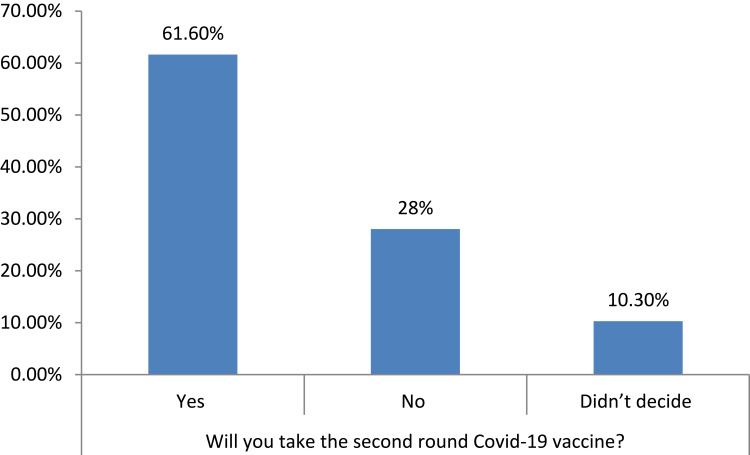
The findings revealed that most (61.6%) of the research participants are willing to receive the second round of COVID-19 vaccine, and 10.3% reported that they have not decided yet. Moreover, the main reason for respondents' lack of intention to receive the second round of COVID-19 vaccine is the belief that the first round of COVID-19 vaccine is sufficient to prevent infection (27.8%) followed by concern over the safety or side effects of the vaccine (26.6%). Above all, the healthcare workers' intention of taking the second round of COVID-19 vaccine is significantly associated to having children (OR=0.362, <0.05; 95% CI: 3.279-5465.189), previous interaction with someone infected by COVID-19 (OR=1.480, <0.05; 95% CI: 3.949-0.055), the perception that COVID-19 causes a severe illness (OR=0.018, <0.05, 95% CI: 13.489-196.391), and experience of receiving the first round of COVID-19 vaccine (OR=50431.104, <0.01; 95% CI: 408.789-626.00).
The present study has shown that healthcare workers in Eastern Ethiopia have a good intention of receiving the second round of COVID-19 vaccine. Nevertheless, the findings have also made it clear that there are still issues to be addressed as far as both willingness to receive the second round of the vaccine and experience of taking the first round of the vaccine are concerned. It is, therefore, important that sufficient training should be given to the healthcare workers in the area in order to raise their level of awareness and enhance their willingness to receive the second round of the vaccine.
新冠疫情一直是主要死因之一,许多训练有素、经验丰富的医护人员因此丧生。接种疫苗是控制传染病最有效的方法,但却受到选择延迟或拒绝接种疫苗的个人和群体的挑战。本研究的目的是评估埃塞俄比亚东部医护人员接种第二轮新冠疫苗的意愿。
采用基于机构的横断面调查研究设计,从埃塞俄比亚东部德雷达瓦、哈拉马亚和哈勒尔镇的医护人员代表性样本中收集定量数据。选取填写正确的问卷并录入SPSS软件进行进一步分析,过程中使用频率表、百分比、均值和多项逻辑回归分析。
研究结果显示,大多数(61.6%)研究参与者愿意接种第二轮新冠疫苗,10.3%的人表示尚未做出决定。此外,受访者不愿接种第二轮新冠疫苗的主要原因是认为第一轮新冠疫苗足以预防感染(27.8%),其次是担心疫苗的安全性或副作用(26.6%)。最重要的是,医护人员接种第二轮新冠疫苗的意愿与生育子女情况(比值比=0.362,<0.05;95%置信区间:3.279 - 5465.189)、之前与新冠感染者的接触情况(比值比=1.480,<0.05;95%置信区间:3.949 - 0.055)、认为新冠会导致重病的看法(比值比=0.018,<0.05,95%置信区间:13.489 - 196.391)以及接种第一轮新冠疫苗的经历(比值比=50431.104,<0.01;95%置信区间:408.789 - 626.00)显著相关。
本研究表明,埃塞俄比亚东部的医护人员有接种第二轮新冠疫苗的良好意愿。然而,研究结果也明确表明,在接种第二轮疫苗的意愿和接种第一轮疫苗的经历方面,仍有问题需要解决。因此,重要的是要对该地区的医护人员进行充分培训,以提高他们的认识水平,增强他们接种第二轮疫苗的意愿。