Clementz Brett A, Parker David A, Trotti Rebekah L, McDowell Jennifer E, Keedy Sarah K, Keshavan Matcheri S, Pearlson Godfrey D, Gershon Elliot S, Ivleva Elena I, Huang Ling-Yu, Hill S Kristian, Sweeney John A, Thomas Olivia, Hudgens-Haney Matthew, Gibbons Robert D, Tamminga Carol A
Departments of Psychology and Neuroscience, BioImaging Research Center, University of Georgia, Athens, GA, USA.
Department of Psychiatry and Behavioral Neuroscience, University of Chicago, Chicago, IL, USA.
Schizophr Bull. 2022 Jan 21;48(1):56-68. doi: 10.1093/schbul/sbab090.
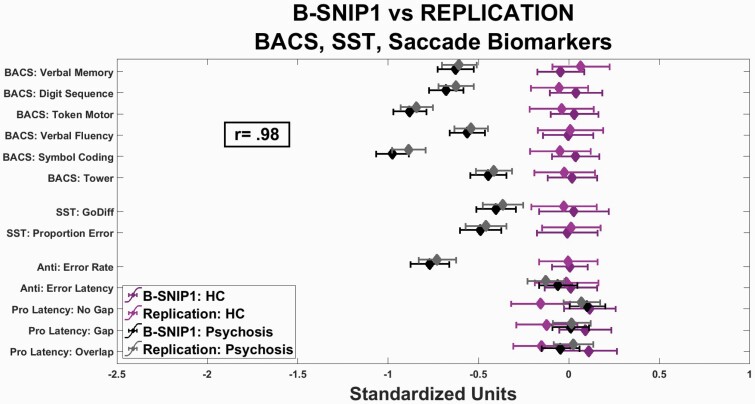
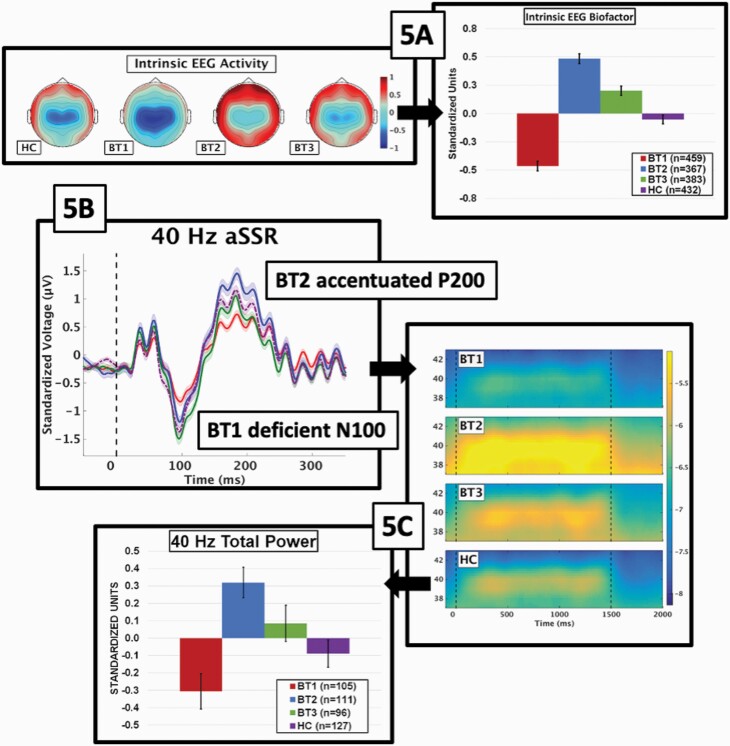
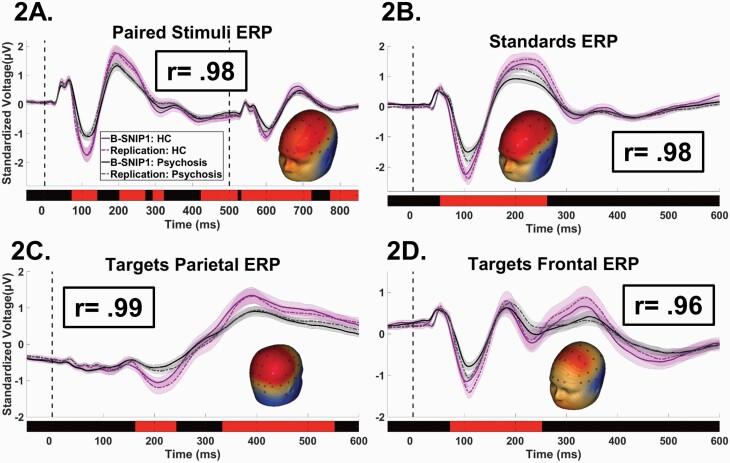
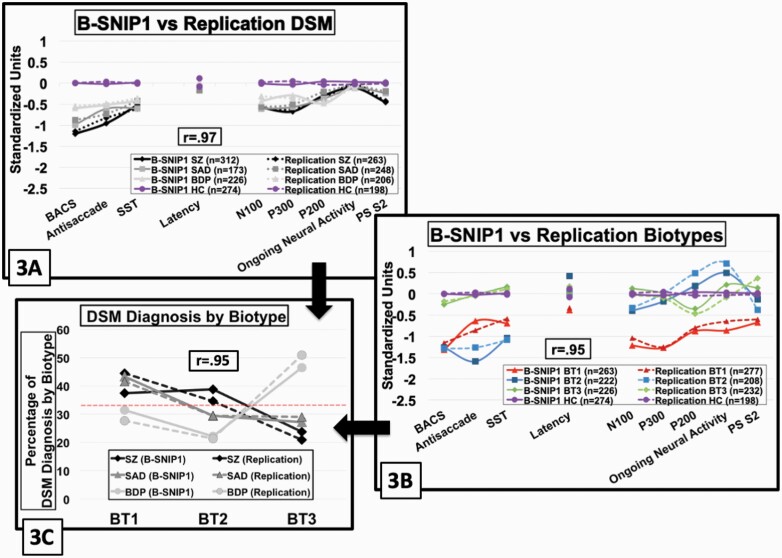
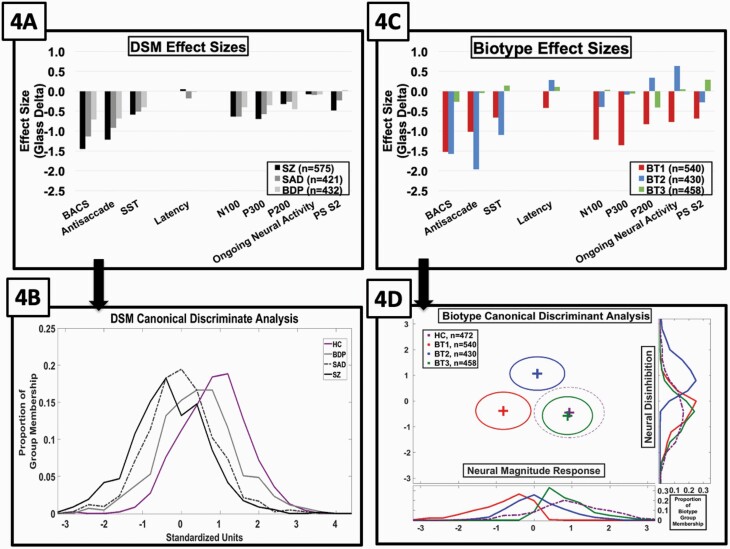
Current clinical phenomenological diagnosis in psychiatry neither captures biologically homologous disease entities nor allows for individualized treatment prescriptions based on neurobiology. In this report, we studied two large samples of cases with schizophrenia, schizoaffective, and bipolar I disorder with psychosis, presentations with clinical features of hallucinations, delusions, thought disorder, affective, or negative symptoms. A biomarker approach to subtyping psychosis cases (called psychosis Biotypes) captured neurobiological homology that was missed by conventional clinical diagnoses. Two samples (called "B-SNIP1" with 711 psychosis and 274 healthy persons, and the "replication sample" with 717 psychosis and 198 healthy persons) showed that 44 individual biomarkers, drawn from general cognition (BACS), motor inhibitory (stop signal), saccadic system (pro- and anti-saccades), and auditory EEG/ERP (paired-stimuli and oddball) tasks of psychosis-relevant brain functions were replicable (r's from .96-.99) and temporally stable (r's from .76-.95). Using numerical taxonomy (k-means clustering) with nine groups of integrated biomarker characteristics (called bio-factors) yielded three Biotypes that were virtually identical between the two samples and showed highly similar case assignments to subgroups based on cross-validations (88.5%-89%). Biotypes-1 and -2 shared poor cognition. Biotype-1 was further characterized by low neural response magnitudes, while Biotype-2 was further characterized by overactive neural responses and poor sensory motor inhibition. Biotype-3 was nearly normal on all bio-factors. Construct validation of Biotype EEG/ERP neurophysiology using measures of intrinsic neural activity and auditory steady state stimulation highlighted the robustness of these outcomes. Psychosis Biotypes may yield meaningful neurobiological targets for treatments and etiological investigations.
目前精神病学中的临床现象学诊断既无法捕捉到生物学上同源的疾病实体,也无法基于神经生物学进行个体化的治疗处方。在本报告中,我们研究了两组大样本病例,包括精神分裂症、分裂情感性障碍和伴有精神病性症状的双相I型障碍,这些病例表现出幻觉、妄想、思维紊乱、情感或阴性症状等临床特征。一种对精神病病例进行亚型分类的生物标志物方法(称为精神病生物型)捕捉到了传统临床诊断所遗漏的神经生物学同源性。两个样本(分别称为“B-SNIP1”,包含711例精神病患者和274名健康人,以及“复制样本”,包含717例精神病患者和198名健康人)显示,从与精神病相关的大脑功能的一般认知(BACS)、运动抑制(停止信号)、扫视系统(顺向和逆向扫视)以及听觉脑电图/事件相关电位(配对刺激和oddball)任务中提取的44种个体生物标志物具有可重复性(相关系数r为0.96 - 0.99)且在时间上稳定(相关系数r为0.76 - 0.95)。使用具有九组综合生物标志物特征(称为生物因子)的数值分类法(k均值聚类)产生了三种生物型,这两种样本中的生物型几乎相同,并且基于交叉验证显示出对亚组的病例分配高度相似(88.5% - 89%)。生物型1和生物型2的认知功能较差。生物型1的进一步特征是神经反应幅度较低,而生物型2的进一步特征是神经反应过度活跃且感觉运动抑制较差。生物型3在所有生物因子上几乎正常。使用内在神经活动测量和听觉稳态刺激对生物型脑电图/事件相关电位神经生理学进行的结构验证突出了这些结果的稳健性。精神病生物型可能为治疗和病因学研究提供有意义的神经生物学靶点。