Nurazzi N M, Asyraf M R M, Rayung M, Norrrahim M N F, Shazleen S S, Rani M S A, Shafi A R, Aisyah H A, Radzi M H M, Sabaruddin F A, Ilyas R A, Zainudin E S, Abdan K
Institute of Tropical Forestry and Forest Products (INTROP), Universiti Putra Malaysia (UPM), Seri Kembangan 43400, Selangor, Malaysia.
Centre for Defence Foundation Studies, Universiti Pertahanan Nasional Malaysia (UPNM), Kem Perdana Sungai Besi, Kuala Lumpur 57000, Malaysia.
Polymers (Basel). 2021 Aug 13;13(16):2710. doi: 10.3390/polym13162710.
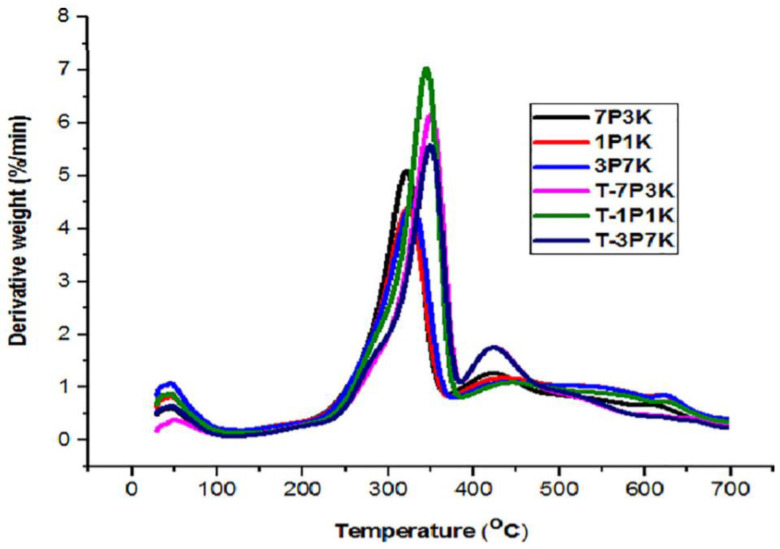
Natural fiber such as bamboo fiber, oil palm empty fruit bunch (OPEFB) fiber, kenaf fiber, and sugar palm fiber-reinforced polymer composites are being increasingly developed for lightweight structures with high specific strength in the automotive, marine, aerospace, and construction industries with significant economic benefits, sustainability, and environmental benefits. The plant-based natural fibers are hydrophilic, which is incompatible with hydrophobic polymer matrices. This leads to a reduction of their interfacial bonding and to the poor thermal stability performance of the resulting fiber-reinforced polymer composite. Based on the literature, the effect of chemical treatment of natural fiber-reinforced polymer composites had significantly influenced the thermogravimetric analysis (TGA) together with the thermal stability performance of the composite structure. In this review, the effect of chemical treatments used on cellulose natural fiber-reinforced thermoplastic and thermosetting polymer composites has been reviewed. From the present review, the TGA data are useful as guidance in determining the purity and composition of the composites' structures, drying, and the ignition temperatures of materials. Knowing the stability temperatures of compounds based on their weight, changes in the temperature dependence is another factor to consider regarding the effectiveness of chemical treatments for the purpose of synergizing the chemical bonding between the natural fiber with polymer matrix or with the synthetic fibers.
诸如竹纤维、油棕空果串(OPEFB)纤维、红麻纤维和糖棕纤维增强的聚合物复合材料等天然纤维,正越来越多地应用于汽车、船舶、航空航天和建筑行业中具有高比强度的轻质结构,具有显著的经济效益、可持续性和环境效益。植物基天然纤维具有亲水性,这与疏水性聚合物基体不相容。这导致它们的界面结合力降低,进而使所得纤维增强聚合物复合材料的热稳定性性能较差。基于文献,天然纤维增强聚合物复合材料的化学处理效果对热重分析(TGA)以及复合结构的热稳定性性能有显著影响。在本综述中,对用于纤维素天然纤维增强热塑性和热固性聚合物复合材料的化学处理效果进行了综述。从目前的综述来看,TGA数据对于确定复合材料结构的纯度和组成、干燥以及材料的着火温度具有指导作用。根据化合物的重量了解其稳定温度,温度依赖性的变化是考虑化学处理有效性的另一个因素,目的是增强天然纤维与聚合物基体或与合成纤维之间的化学键合。