Neto Jorge S S, de Queiroz Henrique F M, Aguiar Ricardo A A, Banea Mariana D
Federal Centre of Technological Education in Rio de Janeiro (CEFET/RJ), Rio de Janeiro 20271-110, Brazil.
Polymers (Basel). 2021 Dec 16;13(24):4425. doi: 10.3390/polym13244425.
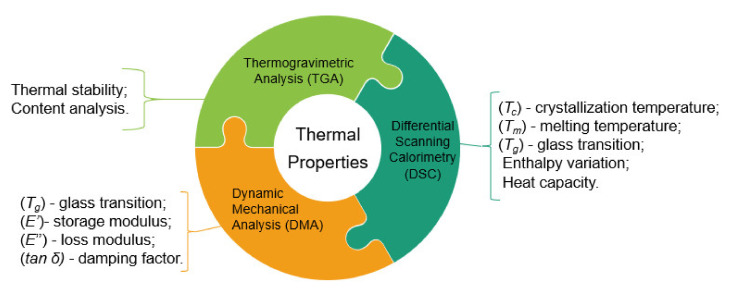
The thermal stability of natural fiber composites is a relevant aspect to be considered since the processing temperature plays a critical role in the manufacturing process of composites. At higher temperatures, the natural fiber components (cellulose, hemicellulose, and lignin) start to degrade and their major properties (mechanical and thermal) change. Different methods are used in the literature to determine the thermal properties of natural fiber composites as well as to help to understand and determine their suitability for a certain applications (e.g., Thermogravimetric analysis (TGA), differential scanning calorimetry (DSC), and differential mechanical thermal analysis (DMA)). Weight loss percentage, the degradation temperature, glass transition temperature (), and viscoelastic properties (storage modulus, loss modulus, and the damping factor) are the most common thermal properties determined by these methods. This paper provides an overview of the recent advances made regarding the thermal properties of natural and hybrid fiber composites in thermoset and thermoplastic polymeric matrices. First, the main factors that affect the thermal properties of natural and hybrid fiber composites (fiber and matrix type, the presence of fillers, fiber content and orientation, the treatment of the fibers, and manufacturing process) are briefly presented. Further, the methods used to determine the thermal properties of natural and hybrid composites are discussed. It is concluded that thermal analysis can provide useful information for the development of new materials and the optimization of the selection process of these materials for new applications. It is crucial to ensure that the natural fibers used in the composites can withstand the heat required during the fabrication process and retain their characteristics in service.
天然纤维复合材料的热稳定性是一个需要考虑的重要方面,因为加工温度在复合材料的制造过程中起着关键作用。在较高温度下,天然纤维成分(纤维素、半纤维素和木质素)开始降解,其主要性能(机械性能和热性能)也会发生变化。文献中使用了不同的方法来测定天然纤维复合材料的热性能,以及帮助理解和确定它们对特定应用的适用性(例如,热重分析(TGA)、差示扫描量热法(DSC)和动态热机械分析(DMA))。失重百分比、降解温度、玻璃化转变温度()以及粘弹性性能(储能模量、损耗模量和阻尼因子)是通过这些方法测定的最常见的热性能。本文概述了在热固性和热塑性聚合物基体中天然和混杂纤维复合材料热性能方面的最新进展。首先,简要介绍了影响天然和混杂纤维复合材料热性能的主要因素(纤维和基体类型、填料的存在、纤维含量和取向、纤维处理以及制造工艺)。此外,还讨论了用于测定天然和混杂复合材料热性能的方法。得出的结论是,热分析可以为新材料的开发以及这些材料在新应用中的选择过程优化提供有用信息。确保复合材料中使用的天然纤维能够承受制造过程中所需的热量并在使用中保持其特性至关重要。