Division of Preventive Medicine, Niigata University Graduate School of Medical and Dental Sciences, Niigata, 951-8510, Japan.
Ojiya City Government, Ojiya, Niigata, 947-0028, Japan.
BMC Geriatr. 2021 Aug 28;21(1):474. doi: 10.1186/s12877-021-02418-0.
Beneficial effects of napping on cognition have been suggested in cross-sectional studies. This study aimed to clarify longitudinal associations between cognitive decline and sleep characteristics, particularly daytime napping, over a 5-year period in older adults.
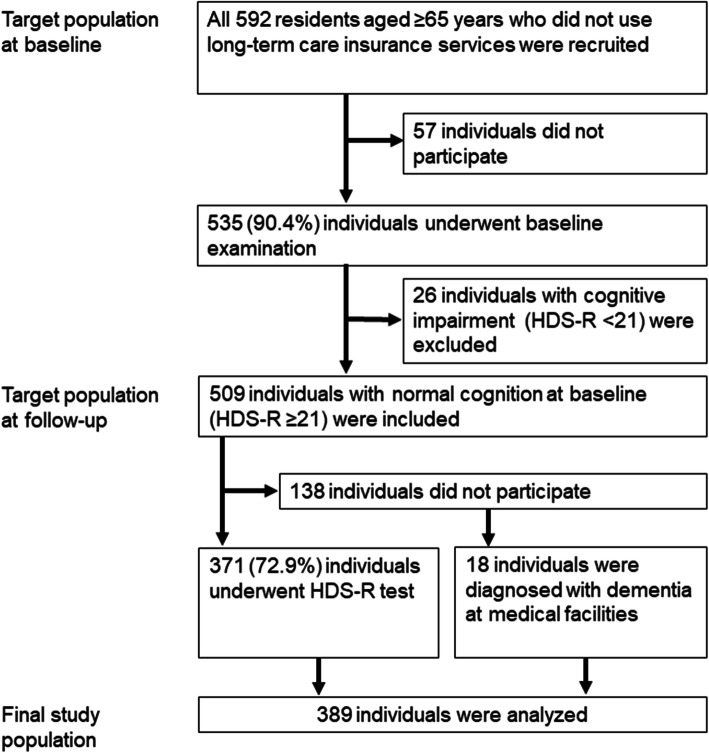
Study participants were 389 community-dwelling individuals aged ≥65 years living in Ojiya City, Niigata, Japan. Baseline and follow-up examinations were conducted in 2011-2013 and 2016-2018, respectively. Trained nurses visited and interviewed participants to collect the following information at baseline and follow-up: demographic characteristics, disease history, lifestyle habits including bedtime, sleeping hours, and daytime nap duration, and cognitive function. The assessment of cognitive function was performed using the revised Hasegawa's dementia scale (HDS-R), with cognitive decline defined as a change in the HDS-R of ≤ - 3 over 5 years. Odds ratios (ORs) for cognitive decline were calculated using multiple logistic regression analysis.
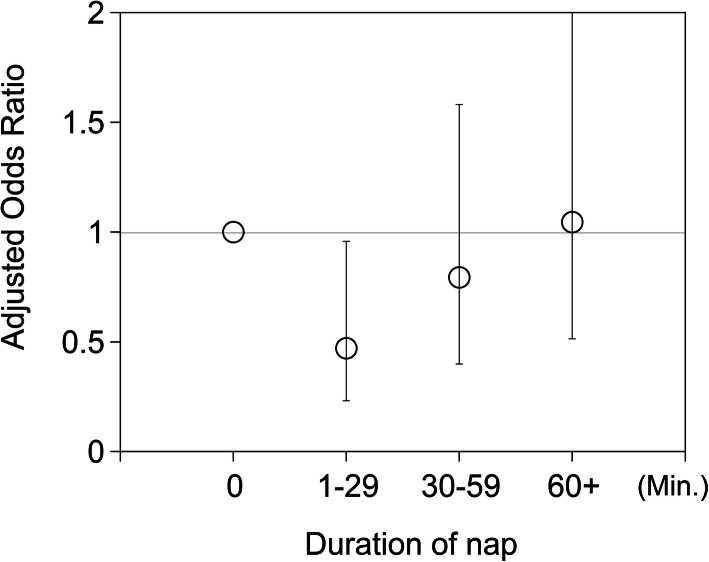
Mean age of participants was 74.6 years (SD 6.4), and the cumulative incidence of cognitive decline was 106/389 (27.3%). The adjusted OR for 1-29 min daytime napping was significantly lower compared to that for no napping (OR = 0.47, 95%CI: 0.23-0.96). Earlier bedtime was associated with cognitive decline (adjusted P for trend = 0.0480).
Short daytime napping (< 30 min) reduces the risk of cognitive decline over 5 years for community-dwelling older people. A future study will be necessary to confirm the effect of short napping on the reduction of risk for clinically diagnosed dementia.
横断面研究表明小睡对认知有益。本研究旨在明确认知衰退与睡眠特征(尤其是日间小睡)在 5 年内的纵向关联,研究对象为日本新潟县糸鱼川市的 389 名 65 岁以上的社区居民。基线和随访检查分别在 2011-2013 年和 2016-2018 年进行。经过培训的护士上门对参与者进行访谈,收集基线和随访时的以下信息:人口统计学特征、疾病史、生活方式习惯(包括上床时间、睡眠时间和日间小睡时长)和认知功能。认知功能评估使用修订后的长谷川痴呆量表(HDS-R),5 年内 HDS-R 变化≤-3 定义为认知衰退。使用多因素 logistic 回归分析计算认知衰退的比值比(OR)。
参与者的平均年龄为 74.6 岁(SD 6.4),认知衰退的累积发生率为 106/389(27.3%)。与不午睡相比,1-29 分钟日间小睡的调整后 OR 明显降低(OR=0.47,95%CI:0.23-0.96)。早睡与认知衰退相关(趋势检验调整 P 值=0.0480)。
对于社区居住的老年人,短时间(<30 分钟)的日间小睡可降低 5 年内认知衰退的风险。未来的研究将有必要确认短时间小睡对降低临床诊断痴呆风险的效果。