Faculty of Health Medicine and Life Sciences, Maastricht University, Universiteitssingel 40, 6229, Maastricht, Netherlands.
Department of Health Services Research, Care and Public Health Research Institute (CAPHRI), Maastricht University, Duboisdomein 30, 6229, Maastricht, Netherlands.
BMC Infect Dis. 2021 Aug 28;21(1):879. doi: 10.1186/s12879-021-06398-9.
Choice-based experiments have been increasingly used to elicit preferences for vaccines and vaccination programs. This study aims to systematically identify and examine choice-based experiments assessing (differences in) vaccine preferences of vaccinees, representatives and health advisors.
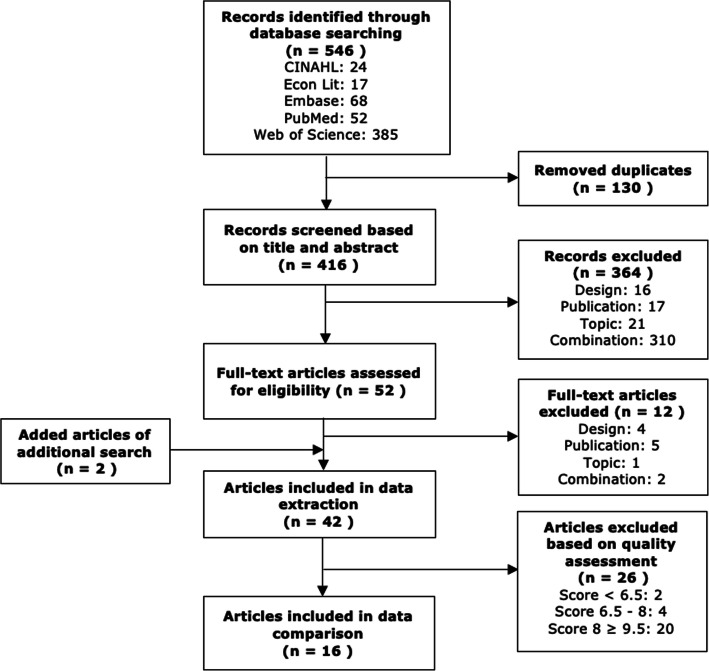
Five electronic databases were searched on choice-based conjoint analysis studies or discrete choice experiments capturing vaccine preferences of children, adolescents, parents, adults and healthcare professionals for attributes of vaccines or vaccine settings up to September 2020. Data was extracted using a standardized form covering all important aspects of choice experiments. A quality assessment was used to assess the validity of studies. Attributes were categorized into outcome, process, cost and other. The importance of attributes was assessed by the frequency of reporting and statistical significance. Results were compared between high-quality studies and lower-quality studies.
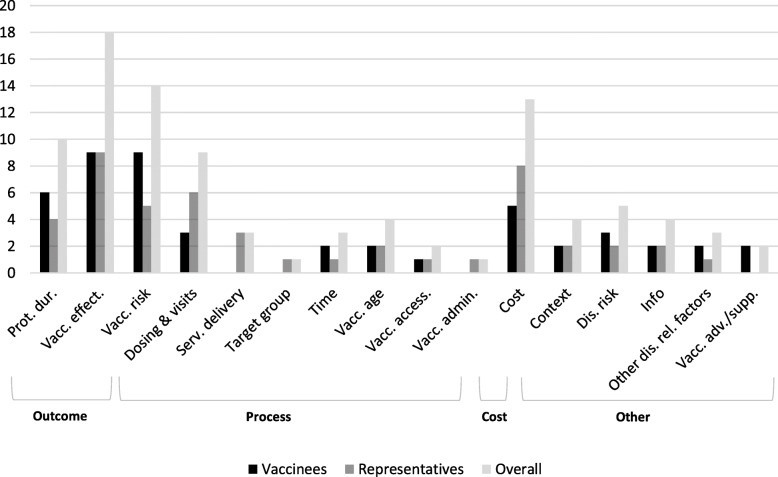
A total of 42 studies were included, with the majority conducted in high-income countries after 2010 (resp. n = 34 and n = 37). Preferences of representatives were studied in nearly half of the studies (47.6%), followed by vaccinees (35.7%) and health advisors (9.5%). Sixteen high-quality studies passed the quality assessment. Outcome- and cost- related attributes such as vaccine effectiveness, vaccine risk, cost and protection duration were most often statistically significant across both target groups, with vaccine effectiveness being the most important. Risks associated with vaccination, such as side effects, were more often statistically significant in studies targeting vaccinees, while cost-related attributes were more often statistically significant in studies of representatives. Process-related attributes such as vaccine accessibility and time were least important across both target groups.
To our knowledge, this is the first systematic review in which vaccine preferences of different target groups were assessed and compared. The same attributes were most important for vaccine decisions of vaccinees and representatives, with only minor differences in level of evidence for vaccine risk and cost. Future research on vaccine preferences of health advisors and/or among target groups in low-resource settings would give insight into the generalizability of current findings.
选择实验已越来越多地被用于引出疫苗接种者对疫苗和疫苗接种计划的偏好。本研究旨在系统地识别和检查评估疫苗接种者、代表和卫生顾问对疫苗偏好(差异)的选择实验。
截至 2020 年 9 月,在五个电子数据库中搜索了关于选择实验联合分析研究或离散选择实验的文献,这些研究旨在捕获儿童、青少年、父母、成人和医疗保健专业人员对疫苗或疫苗接种环境属性的疫苗偏好。使用标准化表格提取数据,涵盖选择实验的所有重要方面。使用质量评估来评估研究的有效性。将属性分为结果、过程、成本和其他。通过报告频率和统计显著性来评估属性的重要性。比较了高质量研究和低质量研究的结果。
共纳入 42 项研究,其中大多数研究于 2010 年后在高收入国家进行(分别为 n=34 和 n=37)。近一半的研究(47.6%)研究了代表的偏好,其次是疫苗接种者(35.7%)和卫生顾问(9.5%)。16 项高质量研究通过了质量评估。结果和成本相关的属性,如疫苗效力、疫苗风险、成本和保护持续时间,在两个目标群体中都具有统计学意义,疫苗效力是最重要的。与疫苗接种相关的风险,如副作用,在针对疫苗接种者的研究中更具统计学意义,而成本相关的属性在针对代表的研究中更具统计学意义。过程相关属性,如疫苗可及性和时间,在两个目标群体中都不重要。
据我们所知,这是第一项系统评价,评估和比较了不同目标群体的疫苗偏好。疫苗接种者和代表在疫苗决策方面最重要的属性相同,只有疫苗风险和成本的证据水平略有差异。未来对卫生顾问和/或资源匮乏环境中的目标群体的疫苗偏好进行研究,将深入了解当前研究结果的普遍性。