Banerjee Aparna, Sarkar Shrabana, Govil Tanvi, González-Faune Patricio, Cabrera-Barjas Gustavo, Bandopadhyay Rajib, Salem David R, Sani Rajesh K
Centro de investigación en Estudios Avanzados del Maule (CIEAM), Vicerrectoría de Investigación Y Posgrado, Universidad Católica del Maule, Talca, Chile.
Centro de Biotecnología de los Recursos Naturales (CENBio), Facultad de Ciencias Agrarias Y Forestales, Universidad Católica del Maule, Talca, Chile.
Front Microbiol. 2021 Aug 19;12:721365. doi: 10.3389/fmicb.2021.721365. eCollection 2021.
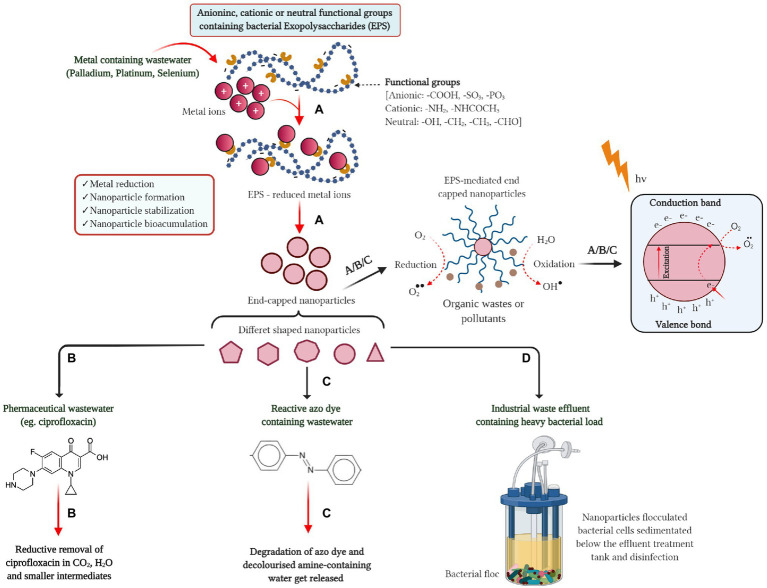
Various microorganisms thrive under extreme environments, like hot springs, hydrothermal vents, deep marine ecosystems, hyperacid lakes, acid mine drainage, high UV exposure, and more. To survive against the deleterious effect of these extreme circumstances, they form a network of biofilm where exopolysaccharides (EPSs) comprise a substantial part. The EPSs are often polyanionic due to different functional groups in their structural backbone, including uronic acids, sulfated units, and phosphate groups. Altogether, these chemical groups provide EPSs with a negative charge allowing them to (a) act as ligands toward dissolved cations as well as trace, and toxic metals; (b) be tolerant to the presence of salts, surfactants, and alpha-hydroxyl acids; and (c) interface the solubilization of hydrocarbons. Owing to their unique structural and functional characteristics, EPSs are anticipated to be utilized industrially to remediation of metals, crude oil, and hydrocarbons from contaminated wastewaters, mines, and oil spills. The biotechnological advantages of extremophilic EPSs are more diverse than traditional biopolymers. The present review aims at discussing the mechanisms and strategies for using EPSs from extremophiles in industries and environment bioremediation. Additionally, the potential of EPSs as fascinating biomaterials to mediate biogenic nanoparticles synthesis and treat multicomponent water contaminants is discussed.
各种微生物在极端环境中繁衍生息,如温泉、热液喷口、深海生态系统、超酸性湖泊、酸性矿山排水、高紫外线照射环境等等。为了抵御这些极端环境的有害影响,它们形成了一个生物膜网络,其中胞外多糖(EPSs)占了很大一部分。由于其结构主链中存在不同的官能团,包括糖醛酸、硫酸化单元和磷酸基团,EPSs通常呈聚阴离子性。总的来说,这些化学基团赋予EPSs负电荷,使其能够(a)作为溶解阳离子以及微量和有毒金属的配体;(b)耐受盐、表面活性剂和α-羟基酸的存在;(c)促进碳氢化合物的溶解。由于其独特的结构和功能特性,预计EPSs可用于工业上从受污染的废水、矿山和石油泄漏中修复金属、原油和碳氢化合物。嗜极端微生物EPSs的生物技术优势比传统生物聚合物更多样化。本综述旨在讨论在工业和环境生物修复中使用嗜极端微生物EPSs的机制和策略。此外,还讨论了EPSs作为迷人的生物材料介导生物纳米颗粒合成和处理多组分水污染物的潜力。