Institute for Health Systems Research, National Institutes of Health, Ministry of Health Malaysia, Shah Alam 40170, Selangor, Malaysia.
Institute for Health Management, National Institutes of Health, Ministry of Health Malaysia, Shah Alam 40170, Selangor, Malaysia.
Int J Environ Res Public Health. 2021 Aug 27;18(17):9047. doi: 10.3390/ijerph18179047.
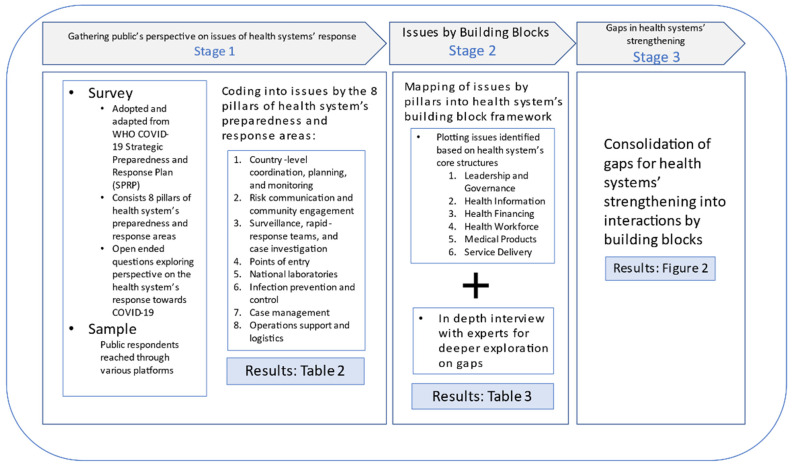
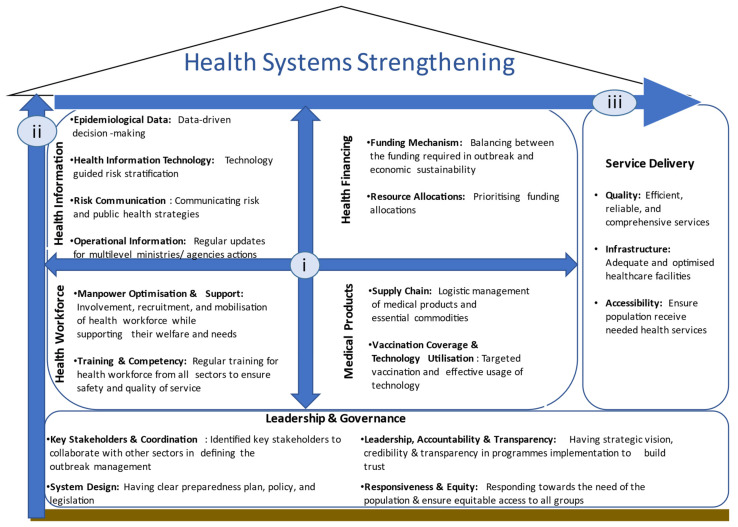
Strengthening the health systems through gaps identification is necessary to ensure sustainable improvements especially in facing a debilitating outbreak such as COVID-19. This study aims to explore public perspective on health systems' response towards COVID-19, and to identify gaps for health systems strengthening by leveraging on WHO health systems' building blocks. A qualitative study was conducted using open-ended questions survey among public followed by in-depth interviews with key informants. Opinions on Malaysia's health systems response towards COVID-19 were gathered. Data were exported to NVIVO version 12 and analysed using content analysis approach. The study identified various issues on health systems' response towards COVID-19, which were then mapped into health systems' building blocks. The study showed the gaps were embedded among complex interactions between the health systems building blocks. The leadership and governance building block had cross-cutting effects, and all building blocks influenced service deliveries. Understanding the complexities in fostering whole-systems strengthening through a holistic measure in facing an outbreak was paramount. Applying systems thinking in addressing gaps could help addressing the complexity at a macro level, including consideration of how an action implicates other building blocks and approaching the governance effort in a more adaptive manner to develop resilient systems.
通过识别差距来加强卫生系统对于确保可持续改进是必要的,特别是在应对 COVID-19 等破坏性疫情时。本研究旨在通过利用世界卫生组织卫生系统的组成部分,探索公众对卫生系统应对 COVID-19 的看法,并确定加强卫生系统的差距。采用开放式问题调查对公众进行了定性研究,随后对关键知情人进行了深入访谈。收集了对马来西亚卫生系统应对 COVID-19 的看法。数据被导出到 NVIVO 版本 12 并使用内容分析方法进行分析。研究发现了卫生系统应对 COVID-19 存在的各种问题,然后将其映射到卫生系统的组成部分。研究表明,这些差距存在于卫生系统组成部分之间复杂的相互作用中。领导力和治理组成部分具有跨领域的影响,所有组成部分都影响服务提供。了解在面对疫情时通过整体措施培养全系统强化的复杂性至关重要。运用系统思维来解决差距可以帮助在宏观层面解决复杂性,包括考虑一个行动如何影响其他组成部分,并以更具适应性的方式处理治理工作,以建立有弹性的系统。