Department of Human-Computer Interaction, Hanyang University, Ansan, Republic of Korea.
Department of Psychiatry, Samsung Medical Center, Sungkyunkwan University School of Medicine, Seoul, Republic of Korea.
Transl Psychiatry. 2021 Sep 18;11(1):484. doi: 10.1038/s41398-021-01604-3.
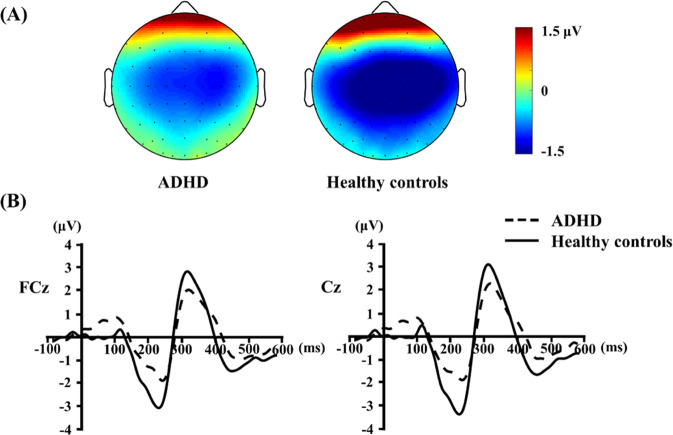
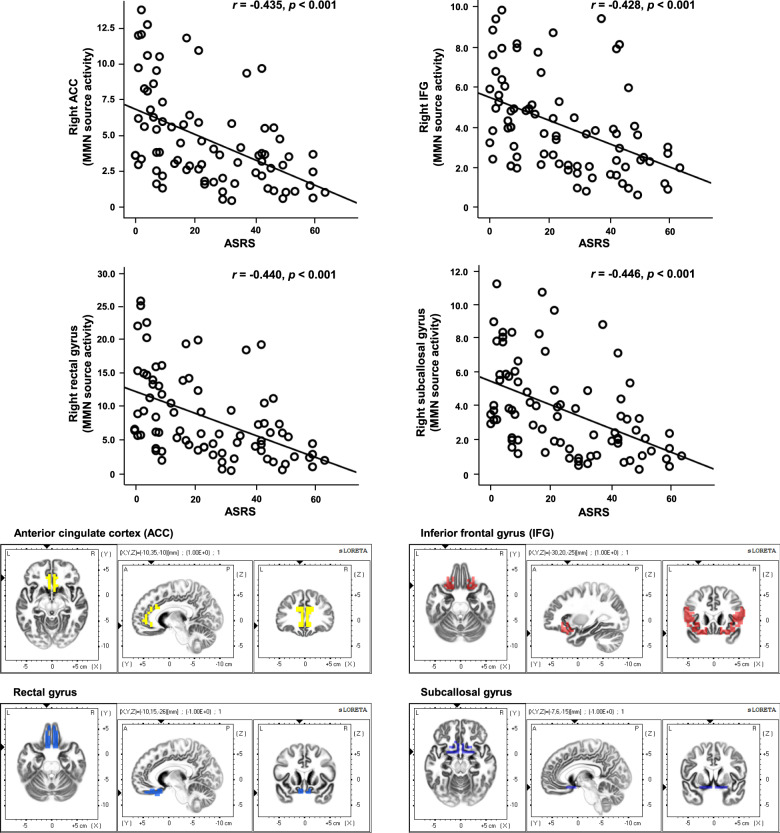
Relatively little is investigated regarding the neurophysiology of adult attention-deficit/hyperactivity disorder (ADHD). Mismatch negativity (MMN) is an event-related potential component representing pre-attentive auditory processing, which is closely associated with cognitive status. We investigated MMN features as biomarkers to classify drug-naive adult patients with ADHD and healthy controls (HCs). Sensor-level features (amplitude and latency) and source-level features (source activation) of MMN were investigated and compared between the electroencephalograms of 34 patients with ADHD and 45 HCs using a passive auditory oddball paradigm. Correlations between MMN features and ADHD symptoms were analyzed. Finally, we applied machine learning to differentiate the two groups using sensor- and source-level features of MMN. Adult patients with ADHD showed significantly lower MMN amplitudes at the frontocentral electrodes and reduced MMN source activation in the frontal, temporal, and limbic lobes, which were closely associated with MMN generators and ADHD pathophysiology. Source activities were significantly correlated with ADHD symptoms. The best classification performance for adult ADHD patients and HCs showed an 81.01% accuracy, 82.35% sensitivity, and 80.00% specificity based on MMN source activity features. Our results suggest that abnormal MMN reflects the adult ADHD patients' pathophysiological characteristics and might serve clinically as a neuromarker of adult ADHD.
关于成人注意缺陷多动障碍(ADHD)的神经生理学研究相对较少。失匹配负波(MMN)是一种与认知状态密切相关的事件相关电位成分,代表前注意听觉处理。我们研究了 MMN 特征作为生物标志物,以对未经药物治疗的成人 ADHD 患者和健康对照(HC)进行分类。使用被动听觉Oddball 范式,在 34 名 ADHD 患者和 45 名 HC 的脑电图中研究并比较了 MMN 的传感器水平特征(振幅和潜伏期)和源水平特征(源激活)。分析了 MMN 特征与 ADHD 症状之间的相关性。最后,我们应用机器学习方法,使用 MMN 的传感器和源水平特征来区分这两组。ADHD 患者的 MMN 振幅在前额中央电极处明显降低,额叶、颞叶和边缘叶的 MMN 源激活减少,这与 MMN 发生器和 ADHD 病理生理学密切相关。源活动与 ADHD 症状显著相关。基于 MMN 源活动特征,ADHD 患者和 HC 的最佳分类性能表现为 81.01%的准确率、82.35%的敏感性和 80.00%的特异性。我们的研究结果表明,异常的 MMN 反映了成人 ADHD 患者的病理生理学特征,并且可能在临床上作为成人 ADHD 的神经标志物。