Quaglia Giulia, Ambrogi Valeria, Pietrella Donatella, Nocchetti Morena, Latterini Loredana
Nano4Light Lab, Dipartimento di Chimica, Biologia e Biotecnologie, Università degli Studi di Perugia, Via Elce di Sotto, 06123 Perugia, Italy.
Dipartimento di Scienze Farmaceutiche, Università degli Studi di Perugia, Via del Liceo, 06123 Perugia, Italy.
Nanomaterials (Basel). 2021 Sep 9;11(9):2340. doi: 10.3390/nano11092340.
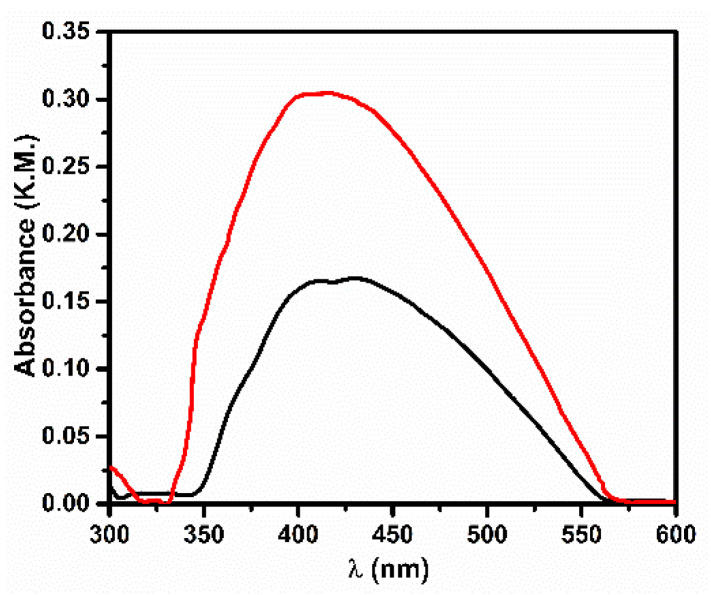
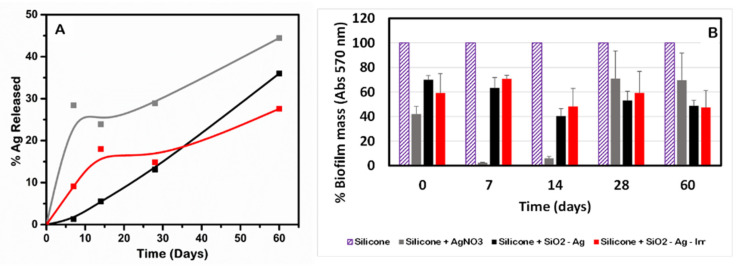
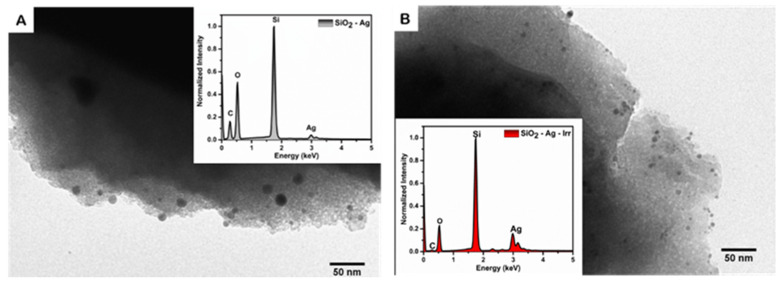
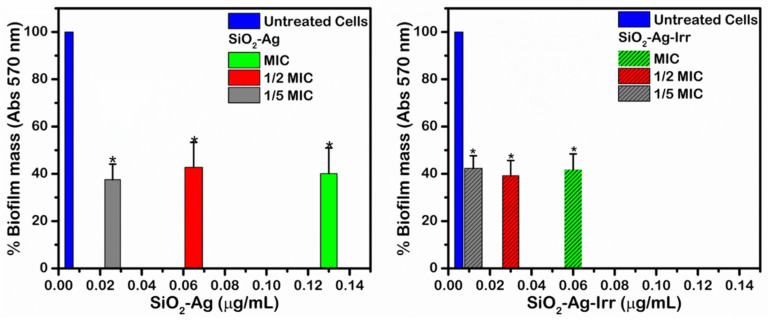
A solid-state Ultraviolet-photoreduction process of silver cations to produce Ag nanostructures on a mesoporous silica is presented as an innovative method for the preparation of efficient environmental anti-fouling agents. Mesoporous silica powder, contacted with AgNO, is irradiated at 366 nm, where silica surface defects absorb. The detailed characterization of the materials enables us to document the silica assisted photo-reduction. The appearance of a Visible (Vis) band centered at 470 nm in the extinction spectra, due to the surface plasmon resonance of Ag nanostructures, and the morphology changes observed in transmission electron microscopy (TEM) images, associated with the increase of Ag/O ratio in energy dispersive X-ray (EDX) analysis, indicate the photo-induced formation of Ag. The data demonstrate that the photo-induced reduction of silver cation occurs in the solid state and takes place through the activation of silica defects. The activation of the materials after UV-processing is then tested, evaluating their antimicrobial activity using an environmental filamentous fungus, . The treatment doubled inhibitory capacity in terms of minimal inhibitory concentration (MIC) and biofilm growth. The antimicrobial properties of silver-silica nanocomposites are investigated when dispersed in a commercial sealant; the nanocomposites show excellent dispersion in the silicon and improve its anti-fouling capacity.
本文介绍了一种固态紫外光还原银阳离子的过程,即在介孔二氧化硅上制备银纳米结构,作为一种制备高效环境防污剂的创新方法。将介孔二氧化硅粉末与硝酸银接触,在366nm处进行辐照,二氧化硅表面缺陷会吸收该波长的光。对材料的详细表征使我们能够记录二氧化硅辅助的光还原过程。由于银纳米结构的表面等离子体共振,在消光光谱中出现了以470nm为中心的可见(Vis)波段,并且在透射电子显微镜(TEM)图像中观察到形态变化,这与能量色散X射线(EDX)分析中银/氧比的增加相关,表明光诱导形成了银。数据表明,银阳离子的光诱导还原发生在固态中,并且是通过二氧化硅缺陷的激活而发生的。然后测试紫外处理后材料的活性,使用一种环境丝状真菌评估其抗菌活性。在最小抑菌浓度(MIC)和生物膜生长方面,处理使抑制能力提高了一倍。研究了银-二氧化硅纳米复合材料分散在商业密封剂中的抗菌性能;纳米复合材料在硅中表现出优异的分散性,并提高了其防污能力。