Department of Maternal and Child Health, School of Public Health, Sun Yat-sen University, Guangzhou 510080, China.
Department of Physical Education, Sun Yat-sen University, Guangzhou 510275, China.
Nutrients. 2021 Sep 16;13(9):3222. doi: 10.3390/nu13093222.
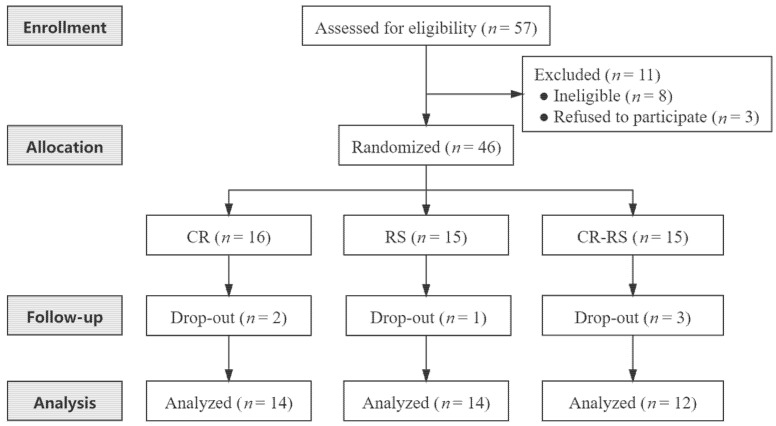
The aim of this study is to investigate the effects of calorie restriction (CR), rope-skipping (RS) exercise, and their joint effects on cardiometabolic health in young adults. An 8-week randomized trial was conducted on 46 undergraduates aged 19-21 y from South China. The participants were randomized into the following three groups: Calorie restriction (CR) group ( = 14), Rope-skipping (RS) group ( = 14), and CR plus RS (CR-RS) group ( = 12). At both allocation and the end of the intervention, data on anthropometry, serum metabolic, and inflammatory markers were collected. A total of 40 participants completed the intervention and were included in the analysis. After the 8-week intervention, the participants from the CR group and the CR-RS group reduced in body weight (-1.1 ± 1.7 kg, -1.3 ± 2.0 kg), body mass index (-0.4 ± 0.6 kg/m, -0.5 ± 0.7 kg/m), body fat percentage (-1.2 ± 1.6%, -1.7 ± 1.8%), and body fat mass (-1.1 kg (-2.2, -0.3), -1.1 kg (-2.5, -0.4)) compared to the baseline ( < 0.05 or = 0.051). For metabolic and inflammatory factors, the participants in the CR-RS group showed significant decreases in low density lipoprotein cholesterol (-0.40 mmol/L) and interleukin-8 (-0.73 mmol/L). While all the above markers showed no significant difference among the groups after intervention, in the subgroup of overweight/obese participants ( = 23), the CR-RS group had significantly lower blood pressure, fasting insulin, homeostatic model assessment of insulin resistance, tumor necrosis factor-α, and interleukin-8 levels than the CR or RS groups ( < 0.05). In conclusion, both CR and CR-RS could reduce weight and improve body composition in young adults. More importantly, in those with overweight or obesity, CR-RS intervention might be superior to either CR or RS in improving cardiometabolic health.
本研究旨在探讨热量限制(CR)、跳绳(RS)运动及其联合作用对年轻成年人心脏代谢健康的影响。一项为期 8 周的随机试验在中国南方的 46 名 19-21 岁的大学生中进行。参与者被随机分为以下三组:热量限制(CR)组(n=14)、跳绳(RS)组(n=14)和 CR 加 RS(CR-RS)组(n=12)。在分配和干预结束时,收集人体测量学、血清代谢和炎症标志物的数据。共有 40 名参与者完成了干预并纳入分析。经过 8 周的干预,CR 组和 CR-RS 组的参与者体重(-1.1 ± 1.7 kg,-1.3 ± 2.0 kg)、体重指数(-0.4 ± 0.6 kg/m,-0.5 ± 0.7 kg/m)、体脂百分比(-1.2 ± 1.6%,-1.7 ± 1.8%)和体脂量(-1.1 kg(-2.2,-0.3),-1.1 kg(-2.5,-0.4))与基线相比均有所下降(<0.05 或 =0.051)。对于代谢和炎症因素,CR-RS 组的参与者低密度脂蛋白胆固醇(-0.40 mmol/L)和白细胞介素-8(-0.73 mmol/L)显著降低。然而,干预后各组间所有上述标志物均无显著差异,在超重/肥胖参与者亚组(n=23)中,CR-RS 组的血压、空腹胰岛素、胰岛素抵抗评估的稳态模型、肿瘤坏死因子-α和白细胞介素-8水平明显低于 CR 组或 RS 组(<0.05)。总之,CR 和 CR-RS 均可减轻年轻成年人的体重并改善身体成分。更重要的是,在超重或肥胖者中,CR-RS 干预可能优于 CR 或 RS 改善心脏代谢健康。