Mac Giollabhui Naoise
Department of Psychology, Temple University, Weiss Hall, 1701 N. 13th St, Philadelphia, PA, 19122, USA.
Brain Behav Immun Health. 2021 May 27;15:100278. doi: 10.1016/j.bbih.2021.100278. eCollection 2021 Aug.
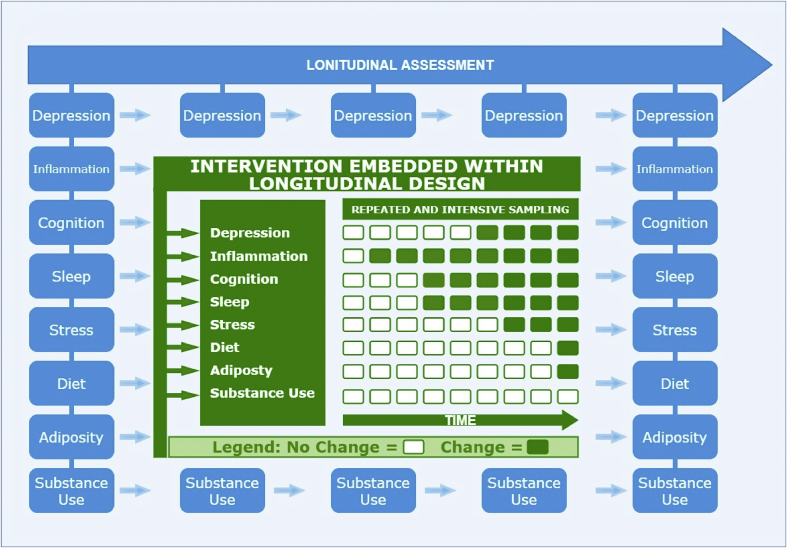
There is convergent evidence that the immune system is dysregulated in some depressed individuals. A psychoneuroimmunology-based understanding of depression is advancing rapidly; however, a question of fundamental importance is poorly understood: does inflammation play a causal role in the etiology of depression or are elevated inflammatory biomarkers a downstream effect of depressive behaviors? Although longitudinal studies suggest that the relationship between depression and inflammation is characterized by complex bidirectional associations, existing prospective, longitudinal research designs are poorly equipped to investigate the dynamic interplay of depression and inflammation that unfolds over a relatively short time period. In addition, the precise role played by multiple, shared, and overlapping risk factors (e.g., diet, adiposity, stress, sleep dysregulation) in the etiology of depression and a pro-inflammatory phenotype (or both) is poorly understood. In this manuscript, I highlight the benefits of research designs that (i) manipulate constructs of interest (depression/inflammation) using intervention or treatment designs and (ii) use intensive sampling approaches with an ultimate goal of better understanding the temporal sequence and causal relationships of depression, inflammation, cognitive dysfunction, and their shared risk factors. For instance, are improved depressive symptoms a downstream effect of changes in inflammatory activity caused by increases in exercise or, alternatively, are changes in inflammatory activity and depression sequelae of improvements in sleep quality caused by increases in exercise? Potential benefits of these research designs are discussed in terms of their contribution to a better understanding of the etiology of depression and a pro-inflammatory phenotype, their relevance to structural health inequalities, and better characterizing the heterogeneous clinical presentation of depression, particularly relating to the etiology of cognitive dysfunction in depression.
有越来越多的证据表明,一些抑郁症患者的免疫系统失调。基于心理神经免疫学对抑郁症的理解正在迅速发展;然而,一个至关重要的问题却鲜为人知:炎症在抑郁症的病因中是否起因果作用,或者炎症生物标志物升高是抑郁行为的下游效应?尽管纵向研究表明,抑郁症与炎症之间的关系具有复杂的双向关联,但现有的前瞻性纵向研究设计在研究抑郁症与炎症在相对较短时间内展开的动态相互作用方面能力不足。此外,多种、共同和重叠的风险因素(如饮食、肥胖、压力、睡眠失调)在抑郁症病因和促炎表型(或两者)中所起的精确作用也鲜为人知。在本手稿中,我强调了研究设计的好处,这些设计:(i)使用干预或治疗设计来操纵感兴趣的结构(抑郁症/炎症);(ii)使用密集抽样方法,最终目标是更好地理解抑郁症、炎症、认知功能障碍及其共同风险因素的时间顺序和因果关系。例如,抑郁症状的改善是运动增加导致炎症活动变化的下游效应,还是相反,炎症活动的变化和抑郁症后遗症是运动增加导致睡眠质量改善的结果?这些研究设计的潜在好处从它们对更好地理解抑郁症和促炎表型病因的贡献、它们与结构性健康不平等的相关性以及更好地描述抑郁症的异质性临床表现,特别是与抑郁症中认知功能障碍的病因相关的方面进行了讨论。