Department of Biomedical Informatics, University of Pittsburgh, Pittsburgh, Pennsylvania, USA.
Clinical and Translational Science Institute, University of Pittsburgh, Pittsburgh, Pennsylvania, USA.
J Am Med Inform Assoc. 2022 Mar 15;29(4):601-608. doi: 10.1093/jamia/ocab204.
As a long-standing Clinical and Translational Science Awards (CTSA) Program hub, the University of Pittsburgh and the University of Pittsburgh Medical Center (UPMC) developed and implemented a modern research data warehouse (RDW) to efficiently provision electronic patient data for clinical and translational research.
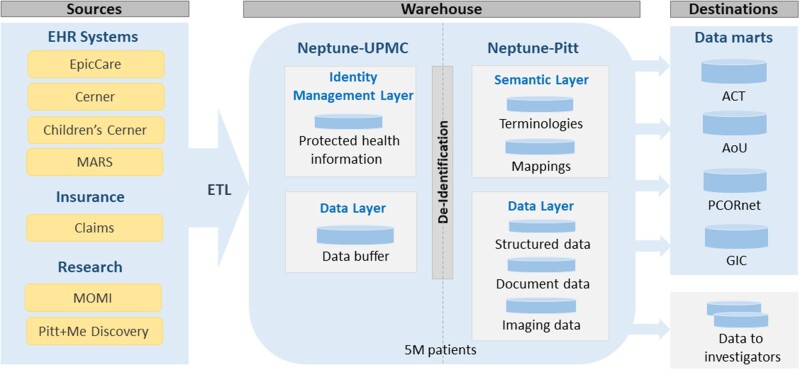
We designed and implemented an RDW named Neptune to serve the specific needs of our CTSA. Neptune uses an atomic design where data are stored at a high level of granularity as represented in source systems. Neptune contains robust patient identity management tailored for research; integrates patient data from multiple sources, including electronic health records (EHRs), health plans, and research studies; and includes knowledge for mapping to standard terminologies.
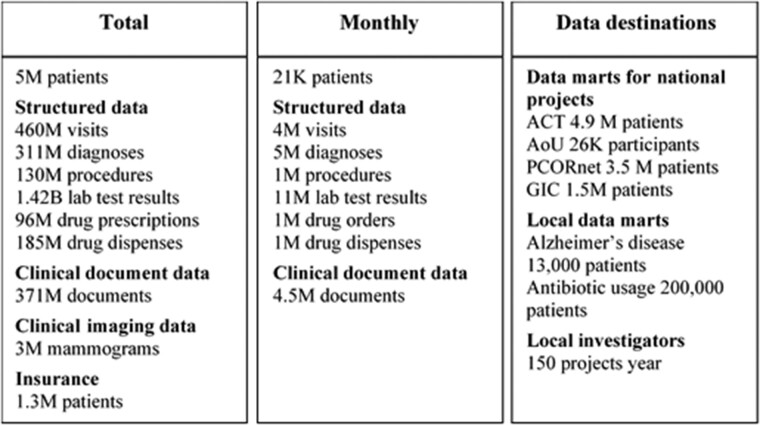
Neptune contains data for more than 5 million patients longitudinally organized as Health Insurance Portability and Accountability Act (HIPAA) Limited Data with dates and includes structured EHR data, clinical documents, health insurance claims, and research data. Neptune is used as a source for patient data for hundreds of institutional review board-approved research projects by local investigators and for national projects.
The design of Neptune was heavily influenced by the large size of UPMC, the varied data sources, and the rich partnership between the University and the healthcare system. It includes several unique aspects, including the physical warehouse straddling the University and UPMC networks and management under an HIPAA Business Associates Agreement.
We describe the design and implementation of an RDW at a large academic healthcare system that uses a distinctive atomic design where data are stored at a high level of granularity.
作为长期的临床与转化科学奖(CTSA)计划中心,匹兹堡大学和匹兹堡大学医学中心(UPMC)开发并实施了一个现代研究数据仓库(RDW),以便为临床和转化研究有效地提供电子患者数据。
我们设计并实施了一个名为 Neptune 的 RDW,以满足我们 CTSA 的特定需求。Neptune 采用原子设计,其中数据以源系统中表示的高度细粒度存储。Neptune 包含针对研究定制的强大患者身份管理;集成来自多个来源的患者数据,包括电子健康记录(EHR)、健康计划和研究;并包括用于映射到标准术语的知识。
Neptune 包含超过 500 万患者的数据,这些数据按健康保险流通与责任法案(HIPAA)有限数据的日期进行纵向组织,并包含结构化的 EHR 数据、临床文档、健康保险索赔和研究数据。Neptune 被用作数百个由当地研究人员进行的机构审查委员会批准的研究项目和国家项目的患者数据来源。
Neptune 的设计受到 UPMC 的规模、各种数据源以及大学与医疗保健系统之间丰富的合作关系的强烈影响。它包括几个独特的方面,包括跨越大学和 UPMC 网络的物理仓库以及在 HIPAA 业务伙伴协议下的管理。
我们描述了一个大型学术医疗保健系统中 RDW 的设计和实施,该系统使用独特的原子设计,其中数据以高度细粒度存储。