Çelik Ersin, Çora Ahmet Rıfkı, Karadem Kadir Burhan
Department of Cardiovascular Surgery, Isparta City Hospital, Isparta, Turkey.
Department of Cardiovascular Surgery, Medicine Faculty, Suleyman Demirel University, Isparta, Turkey.
J Saudi Heart Assoc. 2021 Sep 20;33(3):244-250. doi: 10.37616/2212-5043.1266. eCollection 2021.
In this study, we investigated the usability of atherogenic indices of patients who underwent coronary artery bypass surgery (CABG) due to coronary artery disease and patients without CAD as risk factors and markers for cardiovascular disease (CVD).
The data of 150 patients who underwent CABG, and 155 patients who underwent coronary angiography and was not diagnosed with CAD were analysed retrospectively. Demographic data and plasma lipid values were collected. The relationship between these ratios and CVD was investigated via univariate logistic regression analysis performed by creating atherogenic indices.
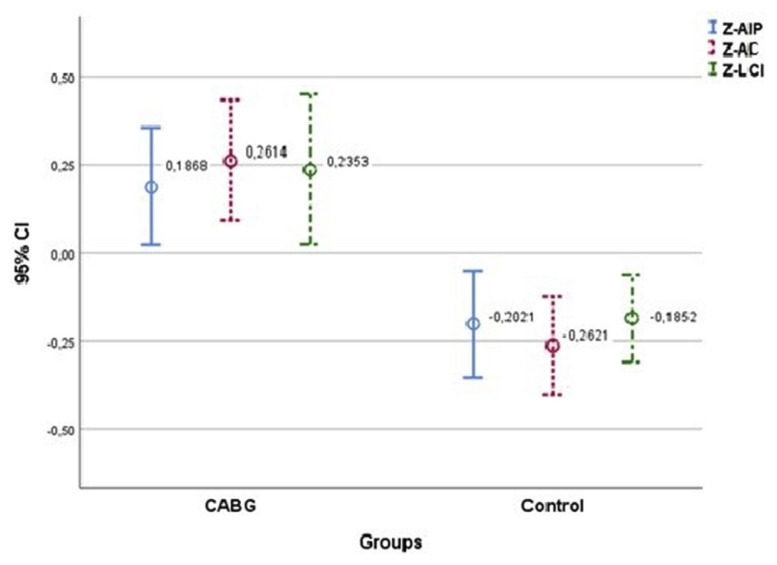
The data of 125 patients who underwent CABG between May 2018 and May 2020 (90 males, 35 females; mean age 64,94 ± 9,61), and 155 patients who had coronary angiography between the same dates and found to have no CAD (64 males, 91 females; mean age 60,12 ± 11,6) were analysed retrospectively. The atherogenic index of plasma (AIP), atherogenic coefficient (AC) and lipoprotein combined index (LCI) ratios were found to be significantly higher in the CABG group compared to the control group (p < 0.001). CABG applied patients were divided into three groups according to their SYNTAX Score-I values. There was no statistical difference in the AIP (p = 0.434), AC (p = 0.715) and LCI (p = 0.891) ratios between the groups. In the ROC analysis of the CABG group, it was found that the AC value was the highest in terms of sensitivity with a value of 74.4% (AUC = 0.669, p < 0.001), and the LCI was the highest in terms of specificity with a value of 65.8% (AUC = 0.634, p < 0.001). In the univariate logistic regression analysis created, it was seen that all three indices had a significant effect in the CABG group (AIP; OR 0.493 p = 0,002, AC; OR 0.298 p < 0,001, LCI; OR 0.358 p = 0,001).
The use of atherogenic indices in daily practice can be recommended in the process of monitoring the risk of CVD in CAD patients, along with determining those patients' lipid profiles.
在本研究中,我们调查了因冠状动脉疾病接受冠状动脉旁路移植术(CABG)的患者以及无CAD患者的致动脉粥样硬化指数作为心血管疾病(CVD)风险因素和标志物的可用性。
回顾性分析150例行CABG的患者以及155例行冠状动脉造影且未诊断出CAD的患者的数据。收集人口统计学数据和血脂值。通过创建致动脉粥样硬化指数进行单因素逻辑回归分析,研究这些比值与CVD之间的关系。
回顾性分析了2018年5月至2020年5月期间125例行CABG的患者(90例男性,35例女性;平均年龄64.94±9.61岁)以及同期行冠状动脉造影且未发现CAD的155例患者(64例男性,91例女性;平均年龄60.12±11.6岁)的数据。发现CABG组的血浆致动脉粥样硬化指数(AIP)、致动脉粥样硬化系数(AC)和脂蛋白综合指数(LCI)比值显著高于对照组(p<0.001)。根据SYNTAX评分-I值将行CABG的患者分为三组。各组间AIP(p=0.434)、AC(p=0.715)和LCI(p=0.891)比值无统计学差异。在CABG组的ROC分析中,发现AC值的敏感性最高,为74.4%(AUC=0.669,p<0.001),LCI的特异性最高,为65.8%(AUC=0.634,p<0.001)。在创建的单因素逻辑回归分析中,发现所有三个指数在CABG组中均有显著影响(AIP;OR 0.493,p=0.002,AC;OR 0.298,p<0.001,LCI;OR 0.358,p=0.001)。
在日常实践中,除了确定CAD患者的血脂谱外,推荐使用致动脉粥样硬化指数来监测CAD患者的CVD风险。