Kang Bing, Yuan Xianshun, Wang Hexiang, Qin Songnan, Song Xuelin, Yu Xinxin, Zhang Shuai, Sun Cong, Zhou Qing, Wei Ying, Shi Feng, Yang Shifeng, Wang Ximing
Cheeloo College of Medicine, School of Medicine, Shandong University, Jinan, China.
Department of Radiology, Shandong Provincial Hospital Affiliated to Shandong University, Jinan, China.
Front Oncol. 2021 Sep 17;11:750875. doi: 10.3389/fonc.2021.750875. eCollection 2021.
To develop and evaluate a deep learning model (DLM) for predicting the risk stratification of gastrointestinal stromal tumors (GISTs).
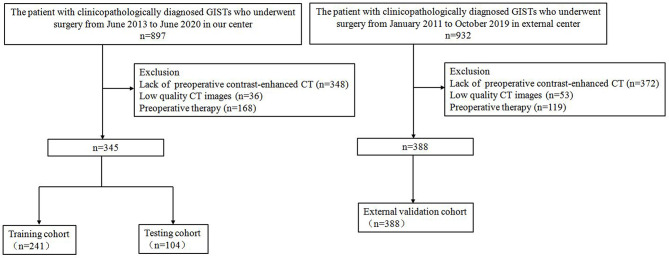
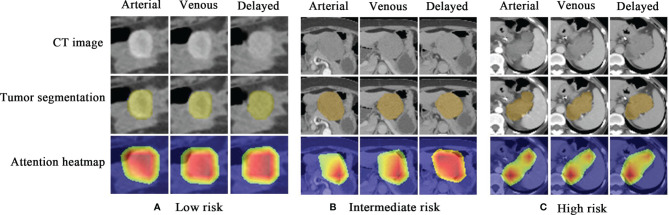
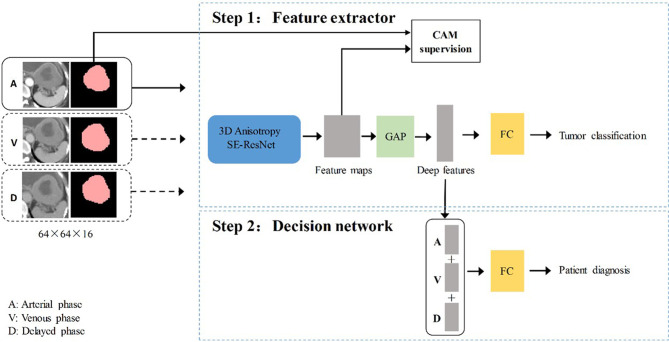
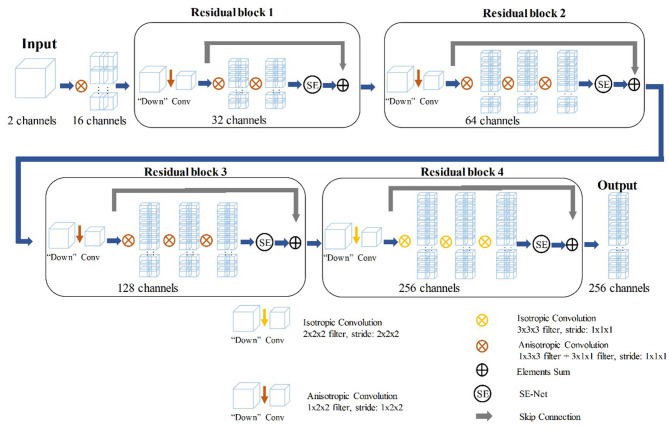
Preoperative contrast-enhanced CT images of 733 patients with GISTs were retrospectively obtained from two centers between January 2011 and June 2020. The datasets were split into training (n = 241), testing (n = 104), and external validation cohorts (n = 388). A DLM for predicting the risk stratification of GISTs was developed using a convolutional neural network and evaluated in the testing and external validation cohorts. The performance of the DLM was compared with that of radiomics model by using the area under the receiver operating characteristic curves (AUROCs) and the Obuchowski index. The attention area of the DLM was visualized as a heatmap by gradient-weighted class activation mapping.
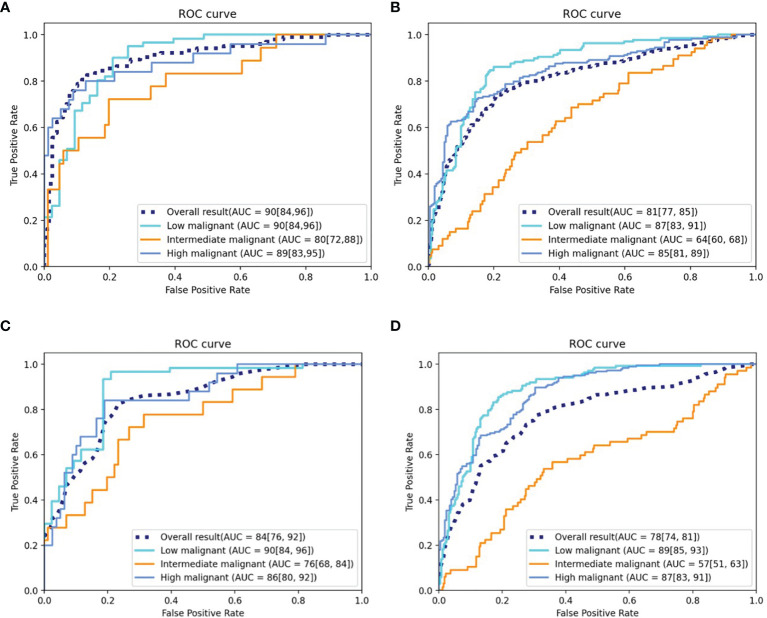
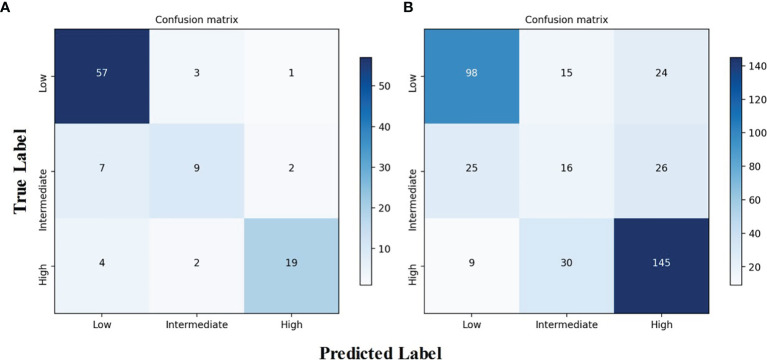
In the testing cohort, the DLM had AUROCs of 0.90 (95% confidence interval [CI]: 0.84, 0.96), 0.80 (95% CI: 0.72, 0.88), and 0.89 (95% CI: 0.83, 0.95) for low-malignant, intermediate-malignant, and high-malignant GISTs, respectively. In the external validation cohort, the AUROCs of the DLM were 0.87 (95% CI: 0.83, 0.91), 0.64 (95% CI: 0.60, 0.68), and 0.85 (95% CI: 0.81, 0.89) for low-malignant, intermediate-malignant, and high-malignant GISTs, respectively. The DLM (Obuchowski index: training, 0.84; external validation, 0.79) outperformed the radiomics model (Obuchowski index: training, 0.77; external validation, 0.77) for predicting risk stratification of GISTs. The relevant subregions were successfully highlighted with attention heatmap on the CT images for further clinical review.
The DLM showed good performance for predicting the risk stratification of GISTs using CT images and achieved better performance than that of radiomics model.
开发并评估一种用于预测胃肠道间质瘤(GIST)风险分层的深度学习模型(DLM)。
回顾性收集了2011年1月至2020年6月期间两个中心733例GIST患者的术前增强CT图像。数据集被分为训练集(n = 241)、测试集(n = 104)和外部验证队列(n = 388)。使用卷积神经网络开发了一种用于预测GIST风险分层的DLM,并在测试集和外部验证队列中进行评估。通过使用受试者操作特征曲线下面积(AUROCs)和奥布霍夫斯基指数,将DLM的性能与放射组学模型的性能进行比较。通过梯度加权类激活映射将DLM的关注区域可视化为热图。
在测试队列中,DLM对低恶性、中恶性和高恶性GIST的AUROCs分别为0.90(95%置信区间[CI]:0.84,0.96)、0.80(95%CI:0.72,0.88)和0.89(95%CI:0.83,0.95)。在外部验证队列中,DLM对低恶性、中恶性和高恶性GIST的AUROCs分别为0.87(95%CI:0.83,0.91)、0.64(95%CI:0.60,0.68)和0.85(95%CI:0.81,0.89)。在预测GIST风险分层方面,DLM(奥布霍夫斯基指数:训练集,0.84;外部验证,0.79)优于放射组学模型(奥布霍夫斯基指数:训练集,0.77;外部验证,0.77)。通过关注热图在CT图像上成功突出了相关子区域,以供进一步临床审查。
DLM在使用CT图像预测GIST风险分层方面表现良好,并且比放射组学模型具有更好的性能。