Yin Binfeng, Wan Xinhua, Qian Changcheng, Sohan A S M Muhtasim Fuad, Wang Songbai, Zhou Teng
School of Mechanical Engineering, Yangzhou University, Yangzhou, China.
School of Chemistry and Chemical Engineering, Shanxi University, Taiyuan, China.
Front Chem. 2021 Oct 4;9:741058. doi: 10.3389/fchem.2021.741058. eCollection 2021.
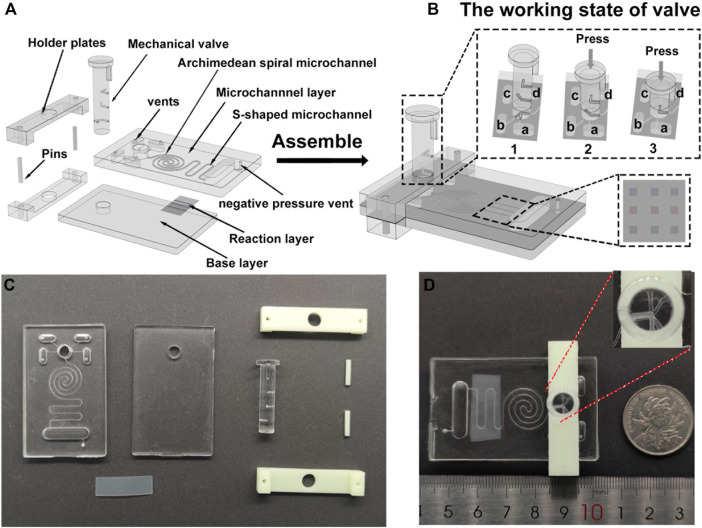
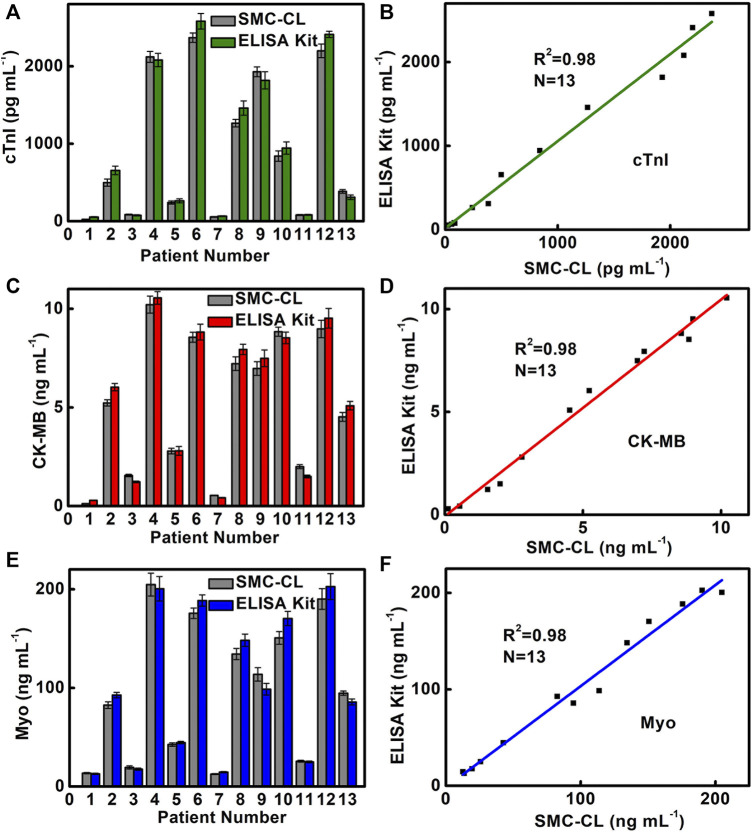
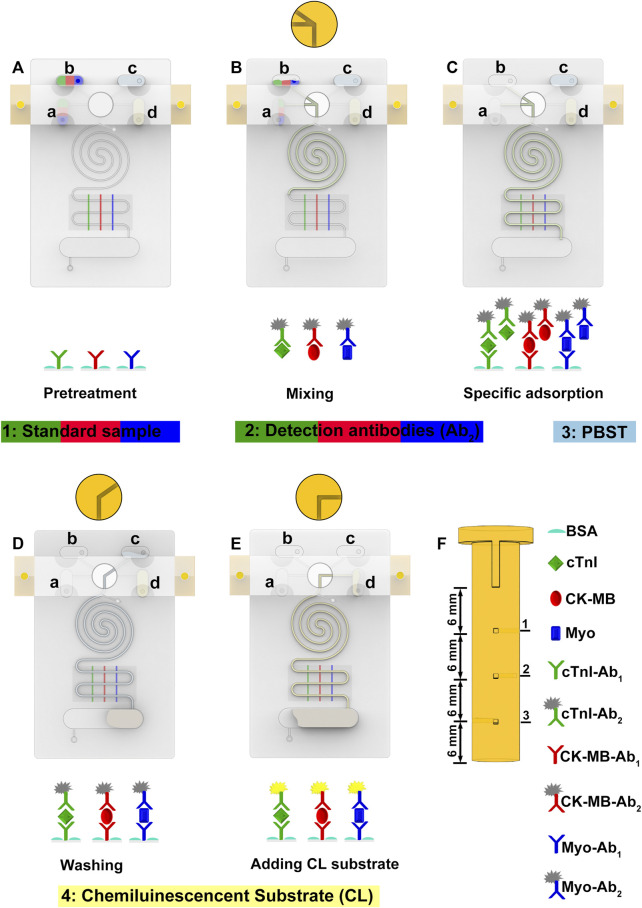
Existing methods for detecting cardiac markers are difficult to be applied in point-of-care testing (POCT) due to complex operation, long time consumption, and low sensitivity. Here, we report a snail-shaped microfluidic chip (SMC) for the multiplex detection of cTnI, CK-MB, and Myo with high sensitivity and a short detection time. The SMC consists of a sandwich structure: a channel layer with a mixer and reaction zone, a reaction layer coated with capture antibodies, and a base layer. The opening or closing of the microchannels is realized by controlling the downward movement of the press-type mechanical valve. The chemiluminescence method was used as a signal readout, and the experimental conditions were optimized. SMC could detect cTnI, CK-MB, and Myo at concentrations as low as 1.02, 1.37, and 4.15. The SMC will be a promising platform for a simultaneous determination of multianalytes and shows a potential application in POCT.
由于操作复杂、耗时较长且灵敏度较低,现有的心脏标志物检测方法难以应用于即时检测(POCT)。在此,我们报道了一种用于高灵敏度和短检测时间多重检测肌钙蛋白I(cTnI)、肌酸激酶同工酶(CK-MB)和肌红蛋白(Myo)的蜗牛形微流控芯片(SMC)。SMC由夹心结构组成:带有混合器和反应区的通道层、涂有捕获抗体的反应层以及基层。通过控制按压式机械阀的向下移动来实现微通道的打开或关闭。采用化学发光法作为信号读出,并对实验条件进行了优化。SMC能够检测低至1.02、1.37和4.15浓度的cTnI、CK-MB和Myo。SMC将成为同时测定多种分析物的有前景的平台,并在POCT中显示出潜在的应用价值。