Department of Radiology, Affiliated Hospital of Chengdu University, 82 2nd N Section of Second Ring Rd, Chengdu, 610081, Sichuan Province, China.
College of Information Science and Technology, Chengdu University, 1 Shiling shang Street, Chengdu, 610106, Sichuan Province, China.
Int J Comput Assist Radiol Surg. 2021 Dec;16(12):2235-2249. doi: 10.1007/s11548-021-02507-w. Epub 2021 Oct 22.
To establish machine learning(ML) models for the diagnosis of clinically significant prostate cancer (csPC) using multiparameter magnetic resonance imaging (mpMRI), texture analysis (TA), dynamic contrast-enhanced magnetic resonance imaging (DCE-MRI) quantitative analysis and clinical parameters and to evaluate the stability of these models in internal and temporal validation.
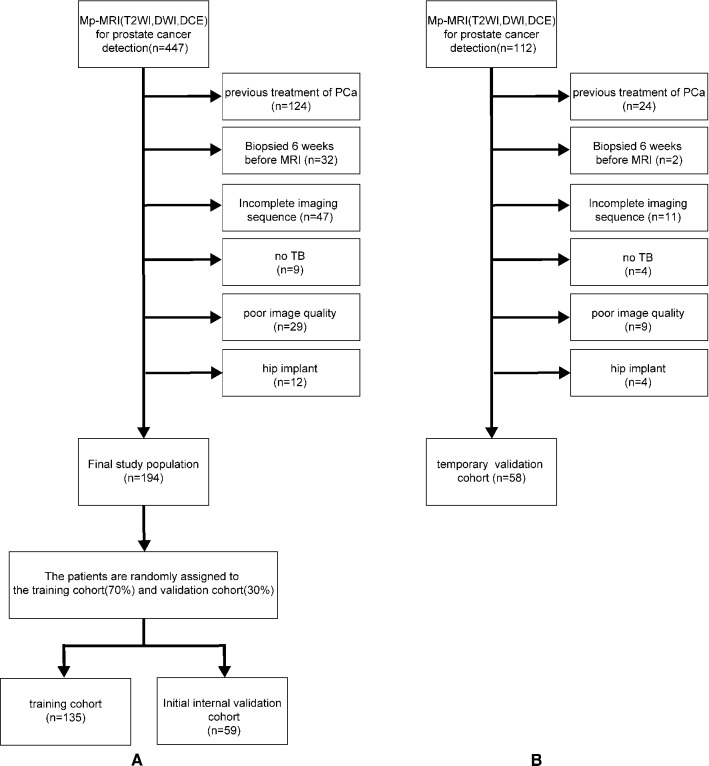
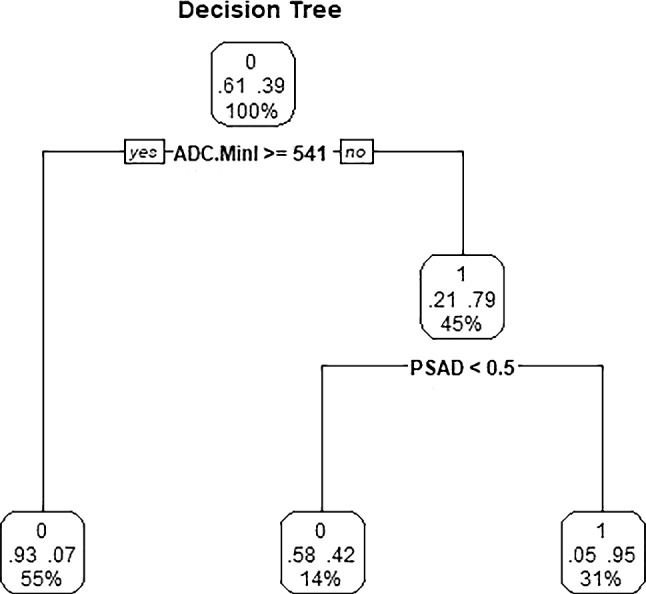
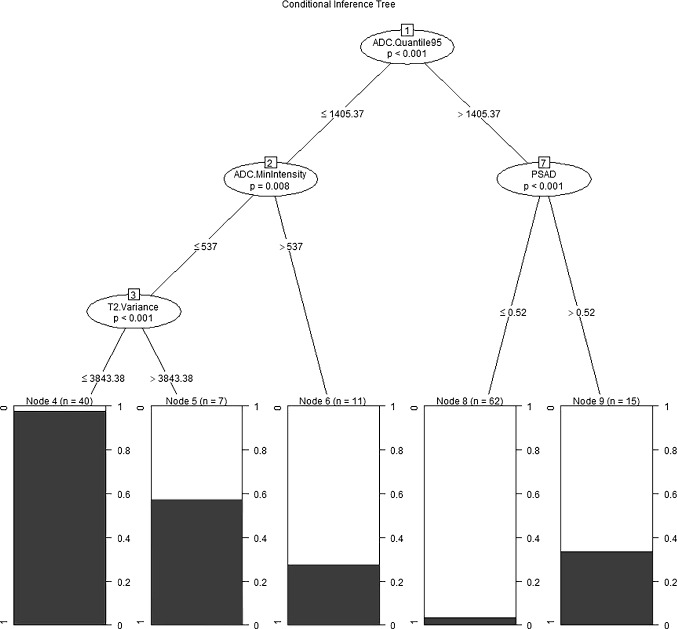
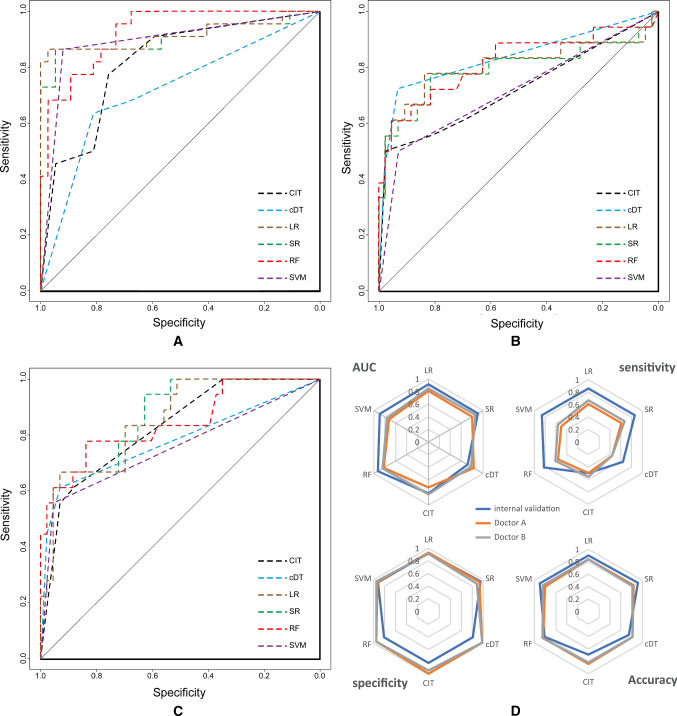
The dataset of 194 men was split into training (n = 135) and internal validation (n = 59) cohorts, and a temporal dataset (n = 58) was used for evaluation. The lesions with Gleason score ≥ 7 were defined as csPC. Logistic regression (LR), stepwise regression (SR), classical decision tree (cDT), conditional inference tree (CIT), random forest (RF) and support vector machine (SVM) models were established by combining mpMRI-TA, DCE-MRI and clinical parameters and validated by internal and temporal validation using the receiver operating characteristic (ROC) curve and Delong's method.
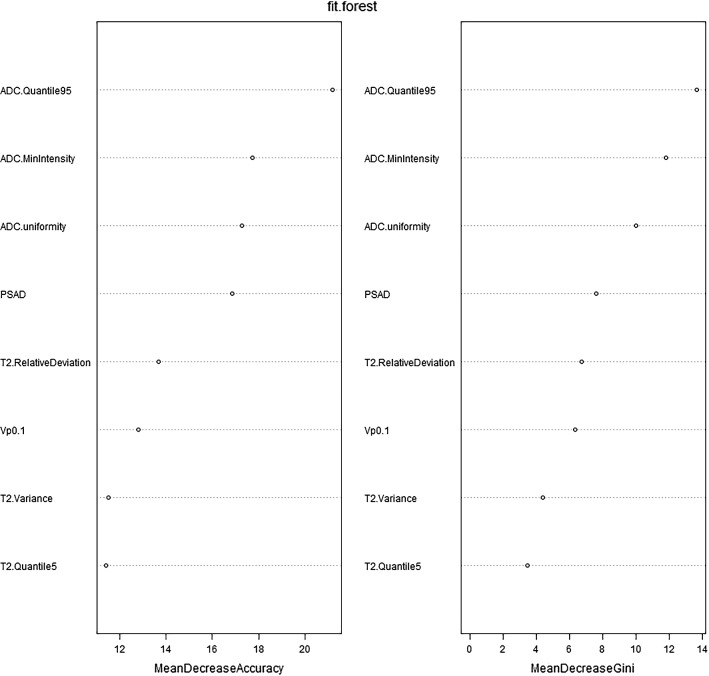
Eight variables were determined as important predictors for csPC, with the first three related to texture features derived from the apparent diffusion coefficient (ADC) mapping. RF, LR and SR models yielded larger and more stable area under the ROC curve values (AUCs) than other models. In the temporal validation, the sensitivity was lower than that of the internal validation (p < 0.05). There were no significant differences in specificity, accuracy, positive predictive value (PPV), negative predictive value (NPV) and AUC (p > 0.05).
Each machine learning model in this study has good classification ability for csPC. Compared with internal validation, the sensitivity of each machine learning model in temporal validation was reduced, but the specificity, accuracy, PPV, NPV and AUCs remained stable at a good level. The RF, LR and SR models have better classification performance in the imaging-based diagnosis of csPC, and ADC texture-related parameters are of the highest importance.
利用多参数磁共振成像(mpMRI)、纹理分析(TA)、动态对比增强磁共振成像(DCE-MRI)定量分析和临床参数建立机器学习(ML)模型,以诊断临床上有意义的前列腺癌(csPC),并评估这些模型在内部和时间验证中的稳定性。
将 194 名男性患者的数据分为训练(n=135)和内部验证(n=59)队列,同时使用时间验证(n=58)数据集进行评估。将 Gleason 评分≥7 的病灶定义为 csPC。通过结合 mpMRI-TA、DCE-MRI 和临床参数,建立逻辑回归(LR)、逐步回归(SR)、经典决策树(cDT)、条件推断树(CIT)、随机森林(RF)和支持向量机(SVM)模型,并通过内部和时间验证,使用接受者操作特征(ROC)曲线和 Delong 方法进行验证。
确定了 8 个变量作为 csPC 的重要预测因子,前三个变量与表观扩散系数(ADC)图衍生的纹理特征有关。RF、LR 和 SR 模型的 ROC 曲线下面积(AUC)值大于其他模型,且更稳定。在时间验证中,敏感性低于内部验证(p<0.05)。特异性、准确性、阳性预测值(PPV)、阴性预测值(NPV)和 AUC 无显著差异(p>0.05)。
本研究中的每个机器学习模型对 csPC 均具有良好的分类能力。与内部验证相比,每个机器学习模型在时间验证中的敏感性降低,但特异性、准确性、PPV、NPV 和 AUC 仍保持在较好水平。RF、LR 和 SR 模型在基于影像学的 csPC 诊断中具有较好的分类性能,ADC 纹理相关参数具有最高的重要性。