Department of Sustainable Crop Production, Università Cattolica del Sacro Cuore, Via Emilia Parmense 84, 29122 Piacenza, Italy.
Department of Animal Science, Food and Nutrition, Università Cattolica del Sacro Cuore, Via Emilia Parmense 84, 29122 Piacenza, Italy.
Toxins (Basel). 2021 Sep 24;13(10):680. doi: 10.3390/toxins13100680.
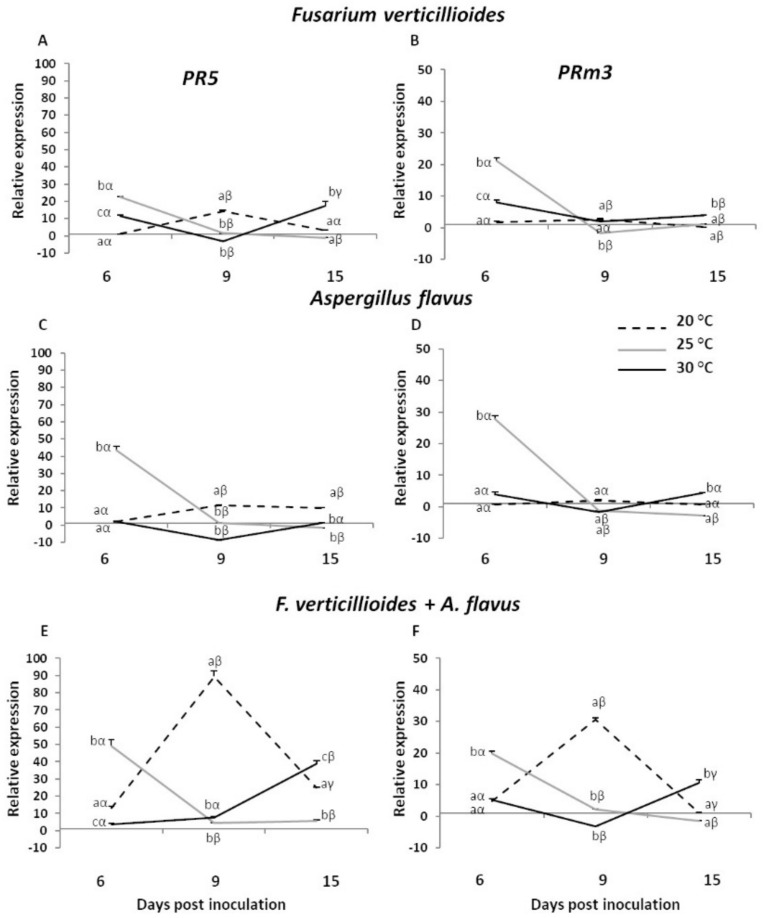
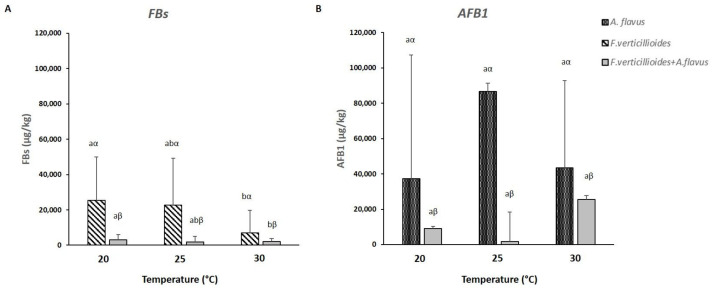
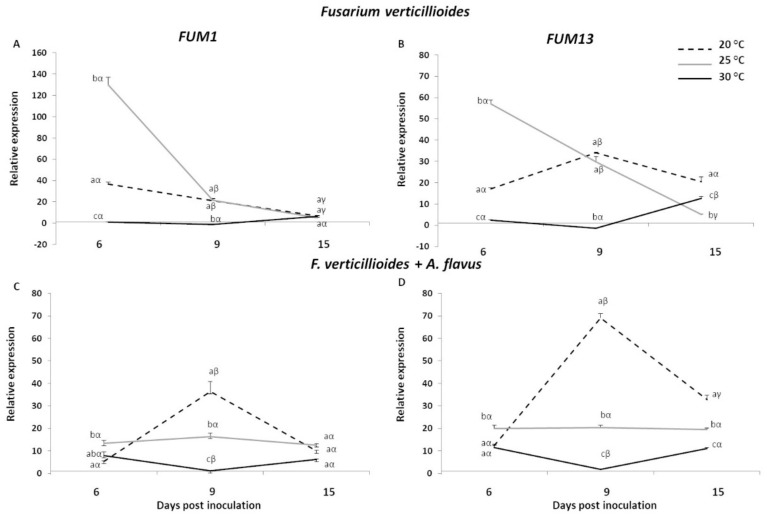
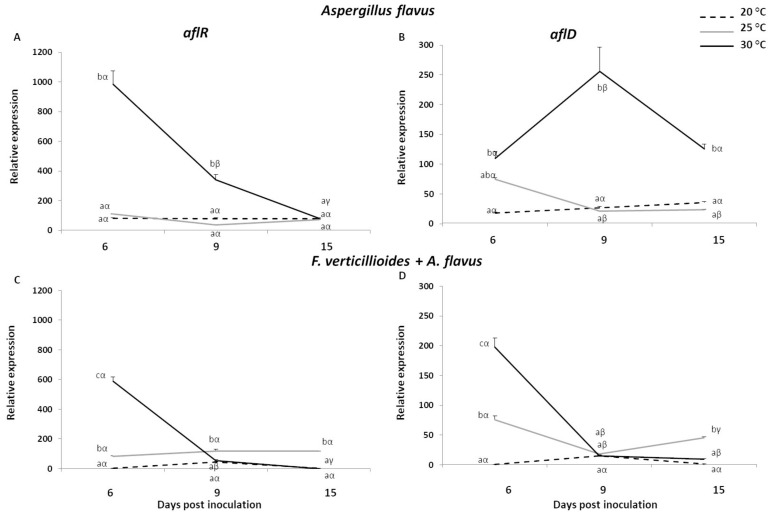
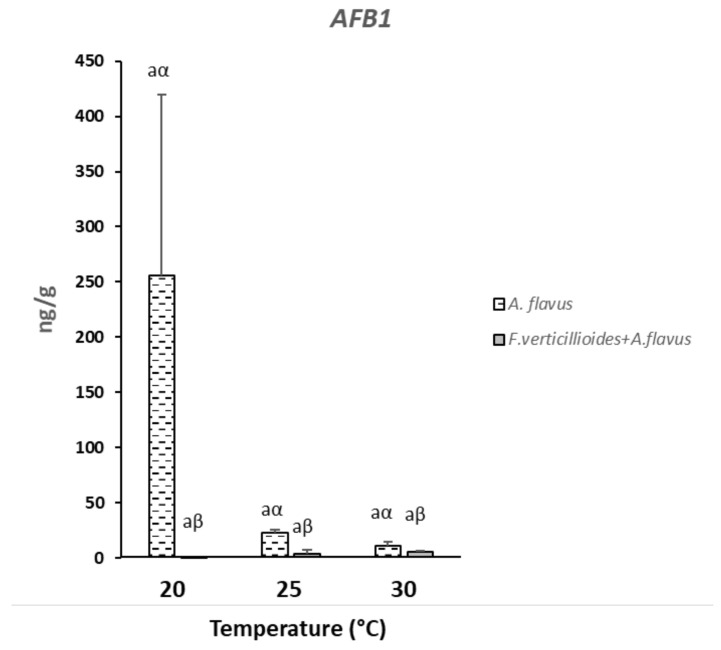
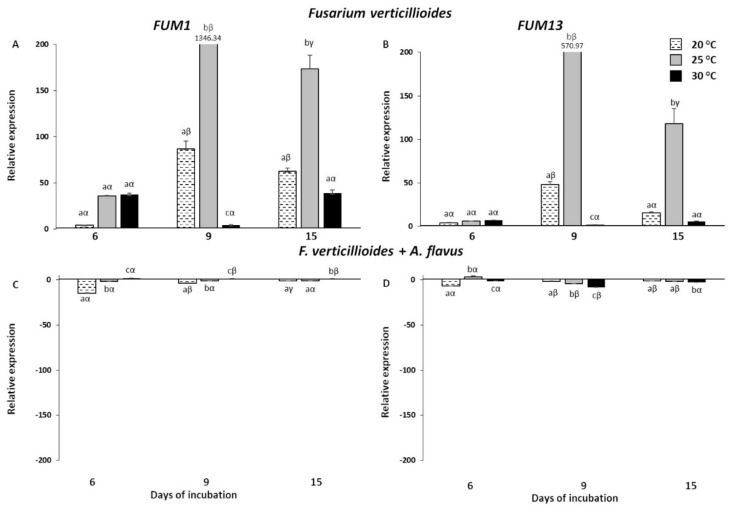
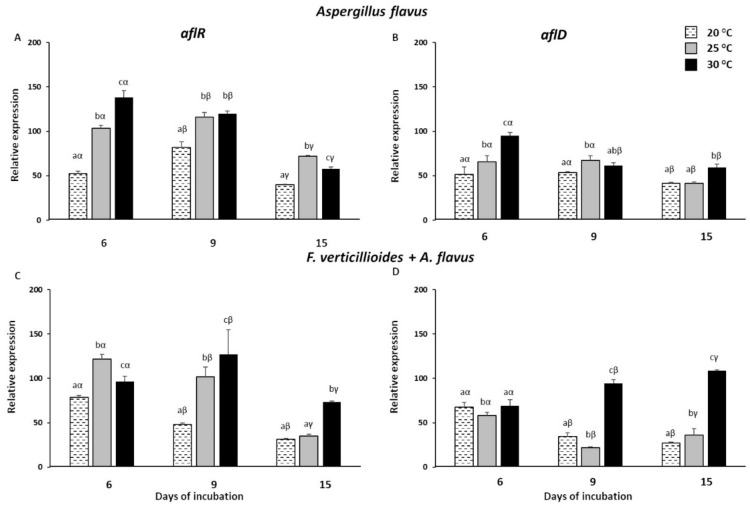
Climate change will increase the co-occurrence of and , along with their mycotoxins, in European maize. In this study, the expression profiles of two () genes and four mycotoxin biosynthetic genes, and , fumonisin pathway, and and , aflatoxin pathway, as well as mycotoxin production, were examined in kernels and in artificial medium after a single inoculation with or or with the two fungi in combination. Different temperature regimes (20, 25 and 30 °C) over a time-course of 21 days were also considered. In maize kernels, genes showed the strongest induction at 25 °C in the earlier days post inoculation (dpi)with both fungi inoculated singularly. A similar behaviour was maintained with fungi co-occurrence, but with enhanced defence response at 9 dpi under 20 °C. Regarding genes, in the kernels inoculated with the maximal transcript levels occurred at 6 dpi at 25 °C. At this temperature regime, expression values decreased with the co-occurrence of , where the highest gene induction was detected at 20 °C. Similar results were observed in fungi grown in vitro, whilst presence determined lower levels of expression along the entire time-course. As concerns genes, considering both alone and in combination, the most elevated transcript accumulation occurred at 30 °C during all time-course both in infected kernels and in fungi grown in vitro. Regarding mycotoxin production, no significant differences were found among temperatures for kernel contamination, whereas in vitro the highest production was registered at 25 °C for aflatoxin B1 and at 20 °C for fumonisins in the case of single inoculation. In fungal co-occurrence, both mycotoxins resulted reduced at all the temperatures considered compared to the amount produced with single inoculation.
气候变化将增加 和 及其真菌毒素在欧洲玉米中的共同发生。在这项研究中,研究了单一接种 或 或两种真菌同时接种后,在玉米籽粒和人工培养基中两个 ()基因和四个真菌毒素生物合成基因 、 、伏马菌素途径和 、 、黄曲霉毒素途径以及真菌毒素产生的表达谱。还考虑了不同的温度条件(20、25 和 30°C)和 21 天的时间过程。在玉米籽粒中,单独接种两种真菌时,在接种后早期(9 天)25°C 时 基因表现出最强的诱导。在真菌共存的情况下也保持了类似的行为,但在 20°C 下 9 天时防御反应增强。关于 基因,在单独接种 的籽粒中,在 25°C 时最大转录水平出现在 6 天。在该温度条件下,随着 的共存,表达值降低,在 20°C 时检测到最高的基因诱导。在体外培养的真菌中也观察到了类似的结果,而 的存在决定了整个时间过程中较低的表达水平。考虑到 基因,单独和共同考虑 ,在整个时间过程中,在感染的籽粒和体外生长的真菌中,在 30°C 时转录积累最高。关于真菌毒素的产生,在所有温度下,籽粒污染都没有差异,而在体外,单独接种时,黄曲霉毒素 B1 的最高产量为 25°C,伏马菌素为 20°C。在真菌共存的情况下,与单一接种相比,所有考虑的温度下两种真菌毒素的产量都减少了。